
All five endangered Hawaiian crows thriving nearly two years after Maui release
Trending
All five ʻalalā released on Maui in December 2024 remain alive and healthy nearly two years later, and that's not the only encouraging sign the Hawaiian crows are adapting to life in the wild.
The state Department of Land and Natural Resources reported Tuesday that the birds are flying freely, foraging for natural foods, establishing territories and building nests. They have also survived several powerful storms that have affected Maui.
"Having all five birds in the wild and healthy, nearly two years after release, is a significant accomplishment," said Hanna Mounce, program manager for the Maui Forest Bird Recovery Project.
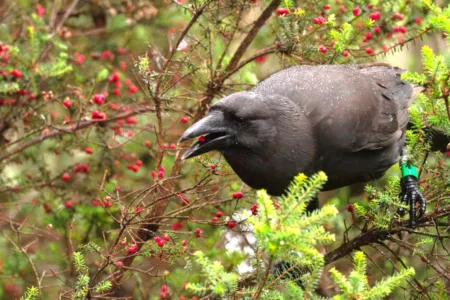
An ʻalalā forages for pukiawe berries in the forests of Haleakala. The endangered Hawaiian crows released on Maui have been observed feeding on native fruits, insects and other natural foods while continuing to use supplemental feeding stations. Photo courtesy Maui Forest Bird Recovery Project
One dominant pair has built nests in two consecutive nesting seasons, with the female regularly sitting on the nest and the male guarding her. Although the pair has not yet produced chicks, the repeated nesting attempts and natural breeding behaviors are encouraging signs as researchers evaluate the birds’ potential to reproduce in the wild.
"There is still a lot we need to learn, particularly about what it will take for them to successfully reproduce, but the progress we've seen on Maui is giving us valuable information to guide the next steps in ʻalalā recovery," Mounce said.
The five birds were raised in captive breeding centers, where they were accustomed to automated feeders, before being released into the forests of Haleakala. Since their release, the field monitoring team has provided supplemental food through similar feeders placed at strategic locations in the forest.
While the birds continue to use the feeding stations, they have also been observed regularly foraging for native fruits, insects, spiders and small vertebrates.
The birds have also adapted to challenging weather conditions, including Kona low storms in March, Tropical Storm Lala and other weather events that brought downed trees, flooding and damage to parts of Maui.
Researchers have monitored the birds’ behavior and health through remote field cameras and in-person observations.
The multiagency team overseeing the recovery effort had initially planned to release two additional birds to join the Maui flock but has since changed course. The original five birds have developed stronger territorial behaviors as they have matured, prompting the team to reconsider introducing additional birds into the same area.
Instead, recovery partners are evaluating other opportunities for future releases, including additional sites on Maui. Planning is also underway to resume ʻalalā reintroductions on Hawaii Island.
"ʻAlalā recovery efforts have entered a strong and hopeful phase," Mounce said. "This collaborative, interagency and multi-decade effort is a demonstration of some of the best work in bird conservation."