
Immigrant communities’ concerns come into focus ahead of Maui mayoral election

Trending
Famous mariachi bands flew to Maui this weekend to perform at Roots Reborn's Dia De Los Muertos, or Mexican Day of the Dead celebration Friday night. Partygoers of all ages filled Wailuku's J. Cameron Center, painting skull faces or catrinas, lighting candles and lining up for Latin American dishes like arepas, tacos, tamales and pambazos. Some stalls sold fusion foods like ube conchas and ube horchata, blending Filipino and Latin American cultures.
The nonprofit organization Roots Reborn serves Maui's immigrant communities and hosts an annual Dia De Los Muertos event honoring the lives of those who have passed. Roots Reborn was one of many groups that formed after the 2023 Lahaina fire to support the town's immigrant communities.
About one in three Lahaina residents before the fire were born in another country, according to the U.S. Census. Filipino, Mexican and Pasifika people make up Lahaina's biggest immigrant populations.
After the Lahaina fire, Roots advocated for different recovery needs like translation services, culturally competent resource providers and policies that better consider different immigration statuses and intergenerational living situations.
Ahead of this year's mayoral election, neither mayoral candidate responded to multiple requests from The Maui News about how they would protect immigrant communities.
The Maui News emailed each campaign to ask how the candidates would make county services safe and accessible for immigrant communities, whether they would support a data sharing policy with federal immigration enforcement and how they hope to continue supporting Maui's immigrant communities if elected mayor.
Sieny Corpuz is the founding director of Kaibigan ng Lahaina. The organization supports Filipino fire survivors with Filipino resource navigators, grocery assistance, mental healthcare programs and more. Corpuz said elected officials need to protect the community that they're voted to represent, including immigrants and non-immigrants alike.
For Corpuz, this looks like families staying together, for everyone to be able to make an honest living and to be able to thrive in Lahaina.
"We’re in a town where we’re in mid-recovery from a disaster that wiped it out," Corpuz said. "This is the only time and probably the only chance we will ever get to make things right and to make things for the community."
Filling the gaps
After the 2023 Lahaina fire, local and federal governments missed the mark in serving immigrant communities. Many announcements, resources and intake forms for different programs lacked language translations and culturally competent service providers. Many immigrant fire survivors didn't know about certain programs or found it hard to trust them.
Based on Oahu and Maui, the disaster recovery organization Tagnawa released its report on the needs of Filipino Lahaina fire survivors in December 2024 after surveying over 750 people. Over 69% of their survey respondents decided to answer in a Filipino language.
"Ilokano and Tagalog-speaking immigrants faced language barriers and unfamiliarity with local and state government systems, exacerbating their need for translation services and advocacy," the report said.
The report provided 18 recommendations for county leaders, including increased Filipino community representation, multilingual communication strategies, events to foster cultural connection, as well as rental assistance, grocery assistance, transportation and job training.
As Lahaina rebuilds, groups like Roots Reborn and Kaibigan are concerned that more than a third of the town's population isn't being included. Maui County's 2024 Lahaina Community Engagement report says while neighborhood fire recovery workshops provided materials in different languages with interpreters in Spanish, Tagalog, Ilocano and Tongan, the interpreters were never utilized.
"Upon reflection, the team could have done more direct outreach to these communities through organizations that work with those impacted. We also could have hosted workshops only with these communities to make sure their voice was heard," the report said.
Safety threats
Across the United States, the federal government has amped up immigration enforcement, often arresting and detaining people with various U.S. citizenship statuses without due process.
This June and July, immigration officers detained individuals in Lahaina and Kihei, including at Lahaina state housing for wildfire survivors.
Roots Reborn skipped its annual Dia De Los Muertos gathering in 2025 in response to the sharp rise in federal immigration agents raiding communities nationwide.
Among Maui's immigrant communities, many people cannot vote because they don't have full citizenship or are too scared to vote because of heightened immigration enforcement risks, Roots Reborn director Annie Alvelais said.
"We want to see someone who is gonna speak up for and answer to the people who can’t vote for them," Alvelais added. "It's not about who votes for me and serving them, but rather serving everyone that it's in the county."
In May, the state legislature passed six bills to protect Hawaii's immigrant communities by removing immigrant status from data collections, requiring multilingual notices and preventing local law enforcement from helping federal immigration agents.
At the county level, Maui County Council voted unanimously to let Bill 92, which would have authorized the mayor to renew the county’s agreement with the FBI-Joint Terrorism Task Force, die in committee. While some local organizers criticized Maui County Council budget chair and mayoral candidate Yuki Lei Sugimura for declining to discuss the bill in her committee meetings, Sugimura later urged the council to vote against local collaborations with the FBI.
"It's hurtful to think that these people who don't even know me and my culture, my history, my family would even accuse me of acting like what we're seeing in the nation, because I know firsthand what it could do," Sugimura told Honolulu Civil Beat in a Feb. 10 article.
Sugimura said the U.S. government imprisoned her grandfather and her husband's family in Japanese incarceration camps during World War II.
Officials with the Maui Police Department have said the department does not collaborate with ICE. But as Bill 92 only addresses FBI collaborations, the county still doesn't have any official written policy about ICE.
Maui County contributed $400,000 to immigrant and migrant services in 2025, $400,000 in 2026 and $660,000 for the 2027 budget. The money goes to Roots Reborn, Voices of Micronesians on Maui and legal immigration services at the Pacific Gateway Center.
The county also gave $235,000 to Know Your Rights training programs in 2026 to help protect communities against federal immigration enforcement agents.
A 'mixed plate' history
More than 28,000 people on Maui -- or about 17% of the island's population -- were born in another country, according to the 2024 U.S. Census.
Filipinos make up Maui's largest immigrant group. Other big immigrant groups include people from across Latin America and the Pacific Islands.
Migrants and immigrants have long been part of Hawaii's history. Hawaiian sugar plantation owners began recruiting Filipino workers to work on plantations in the early 1900s.
Many Filipino workers established families and brought other family members over from the Philippines. Many recent Filipino immigrants also come to Maui working as teachers on a visa program.
The story of Mexican migration to Hawaii has roots in the Hawaiian Kingdom. King Kamehameha III invited Mexican vaqueros, or cowboys, from California to teach Hawaiians how to rope and herd cattle.
Pasifika migrants and immigrants come to the U.S. through a government contract called the Compact of Free Association that allows people from the Marshall Islands and Federated States of Micronesia to work and study in the U.S. without a visa.
"Maui's many cultural traditions are an important part of our shared identity," Mayor Richard Bissen said at Friday's Dia De Los Muertos event. "Gatherings like this create opportunities to learn from one another while ensuring our diverse communities feel welcomed and valued."
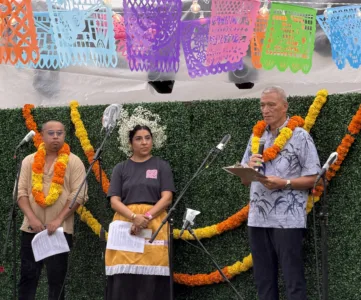
Maui County Mayor Richard Bissen speaks during Roots Reborn's Dia de los Muertos celebration Friday, Oct. 23, at the J. Cameron Center in Wailuku. Photo by Yiming Fu
Serving everyone
Ruben Juarez works with data from the Lahaina fires and creates programs that better support Maui's immigrant communities. Juarez works with MauiWES or Maui's Wildfire Exposure Study, which follows Maui wildfire survivors over time, tracks their health and provides referrals and care.
MauiWES also has specifically targeted outreach to the island's immigrant and Latino communities. Juarez and his team found about 40% of Latinos on Maui didn't have health insurance while conducting intake for the wildfire exposure study.
To meet this need, the MauiWES created a program with Kaiser Permanente called the Hawaiʻi Health Access Program, or HHAP, which provides free health insurance to Latino community members for three years. Through the health access program, Juarez and his team cut the number of Latinos without health insurance on Maui in half.
Now, the MauiWES team is working on a project called HOʻĀLA, which received county funds to get off the ground.
The project establishes a clinic at the Cameron Center which will screen and test immigrants with or without health insurance. The long-term project will service families that received health insurance through HHAP but already met their three-year coverage limit.
Juarez said the HOʻĀLA model is also intended to expand into a mobile healthcare facility that can reach all rural populations, and he said the organization will open up care to all people, not just Latino immigrants.
Alvelais at Roots Reborn would also like to see improved language access on Maui County websites, especially the Maui Emergency Management Agency.
This year, Maui residents have weathered two Kona low storms in March and multiple hurricane threats throughout the summer. But MEMA only sends disaster-alerts in English, and the website doesn't have any option to change languages.
Juarez said Maui immigrants who need services should feel comfortable turning to the county.
"People don't trust the federal government right now," Juarez said. "This is the time to step up and really show the commitment to the immigrant population."
Yiming Fu is reporting for The Maui News as part of the Maui Nui Media and Creativity Collaborative Investigative Elections Reporting Fellowship, which supports expanded reporting on Maui County elections.