
Trending
 Gary Kubota/The Maui News
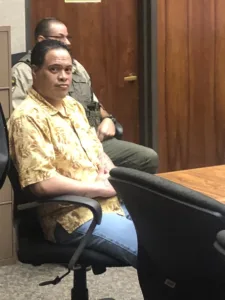
Clembert Kaneholani declined to testify during his first-degree murder trial in the shooting death of Maui Police Officer Suzanne O. A Maui Circuit Court jury began deliberating the case Tuesday.
The case against Clembert Alii Kaneholani, 39, went to the jury Tuesday afternoon in Maui Circuit Court, with jurors tasked with deciding whether he is guilty of first-degree murder in the killing of Maui Police Officer Suzanne O on Aug. 15, 2025.
As of presstime Wednesday afternoon, the jury was still in deliberations.
Kaneholani, who exercised his constitutional right not to testify during his trial, is charged with first-degree murder and could face life without parole if convicted.
Officer O was shot and killed while responding to a call at the old Paia Sugar Mill off Baldwin Avenue a little after 8 p.m. Aug. 15. The mill's caretaker had encountered a man who was trespassing on the property and fired multiple shots at the caretaker.
Officer O and other police officers were searching for the suspect in a dark field when Officer O was shot in the left side of her chest. Despite lifesaving measures by other officers, she died at the scene.
Police returned fire and wounded the suspect, later identified as Kaneholani. A pistol and rifle were recovered from the area where Kaneholani had been crouched near a concrete pillar.
The trial began last week, and Officer O's family, friends and fellow officers have sat in the front row facing the prosecutor's desk throughout the proceedings.
Officer O grew up in a village in American Samoa and attended Farrington High School on Oahu. She had been with the Maui Police Department for five years and received a certificate of merit for working to protect people and property during the Aug. 8, 2023, Lahaina wildfire.
She was also a member of the Maui Police Honor Guard.
In addition to first-degree murder, Kaneholani faces multiple lesser charges, including one count of being a felon in possession of a firearm.
Kaneholani pleaded no contest to second-degree theft in Kauai Circuit Court in 2015 for stealing a rifle from a boat owned by a man who befriended him and took him fishing, the prosecution said at sentencing. In that case, Kaneholani was sentenced to four years of probation and a month in jail.
Kaneholani also had been served with a temporary restraining order two days before Officer O was killed. The order required him to leave his home and barred him from contact with his children. Prosecutors have alleged his anger over the restraining order provided a motive for the shooting.
[
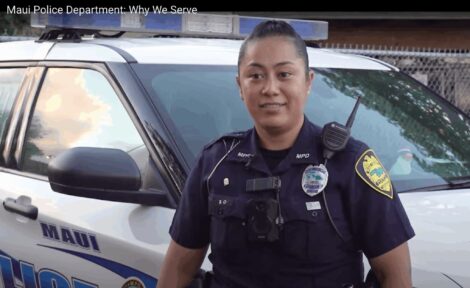 Photo courtesy Maui Police Department
Motive questioned
Defense attorney Zachary Raidmae has not disputed that his client shot Officer O, but he has argued Kaneholani did not know he was shooting a police officer. In his closing statement, Raidmae said the shooting was reckless manslaughter, not first-degree murder.
He also disputed the attempted murder charge Kaneholani is facing for allegedly firing shots in the direction of the caretaker.
Raidmae, a deputy public defender, said Kaneholani went to the mill to go hunting and brought his hunting license in addition to his firearms and skinning knives.
Raidmae has focused on how police did not use a drone to search for Kaneholani and did not call out identifying themselves while searching for him. Raidmae said that after encountering the caretaker, Kaneholani hid behind the concrete pillar.
He said Kaneholani saw a distant light from the south and multiple lights approaching him from the darkness.
"They had no blue lights on them," he said. "They had their pistols and AR-15s drawn."
Raidmae said the night was dark and Kaneholani stumbled, causing his weapon to fire, and that Kaneholani didn't know he had shot a police officer.
Raidmae replayed video from police body cameras shortly after the shooting in which Kaneholani said he was sorry. Raidmae also pointed to another police interaction involving Kaneholani in which officers identified themselves before serving the restraining order on him. The defense attorney said this showed Kaneholani submitted to police without resistance at his home in Makawao on Aug. 13.
'The person responsible'
In his closing argument, prosecutor Andrew Martin said Officer O's murder began with a series of choices made by Kaneholani.
Martin said the killing was Kaneholani's way of getting revenge on police officers who two days earlier enforced the temporary restraining order involving Kaneholani's family and the separation from his son.
Martin called the defense's attempt to fault police "a red herring" and described the shooting of Officer O as a deliberate act.
"It's not the six other officers who were out there and didn't announce that they were police officers. It's not some amorphous drone policy or failure to bring one out or have a pilot on site," Martin said. "The person responsible for the murder of Suzanne O is right there. He sits less than 20 feet from you now."
According to Martin, Kaneholani's friend testified that after receiving the restraining order, Kaneholani said more than once that he wanted to die in suicide by cop manner.
During the trial, Martin played one of the jailhouse recordings of Kaneholani speaking to family members.
"Like I told (another person), I wasn't -- I wasn't even supposed to live through this," Kaneholani said. "These cops was supposed to kill me. That's why I did what I did. I had to take one of their lives. They're supposed to take me, but a bunch of (expletive), they didn't have the heart to kill me."
Martin also replayed another jailhouse conversation in which Kaneholani said he "wanted to take lives" after police took his son away and described the shooting of Officer O as a deer hunt.
"I thought I got me a buck, but I got me a doe," Kaneholani said. "I'm happy for what I did. As long as you in blue, I ain't your friend. I ain't a friend to you. You're an enemy."
The prosecution presented evidence showing a pistol and rifle, along with a 27-round magazine, were found where Kaneholani was alleged to have fired at Officer O.
An evidence expert identified the slug that killed Officer O as having been fired from the pistol.
Martin said that in the six minutes and 35 seconds before the fatal shooting, there were no fewer than 10 chirps from police officers' body cameras and radio communications among officers.
"You will hear no fewer than 30 different back-and-forth conversations," Martin said.
Martin asked jurors to use their common sense.
"Did the defendant know who she was, what she did, and that she was in the performance of her duties?" Martin asked. "Reason and common sense tells you how could he not."
Martin noted that, according to the testimony of Maui Police Officer Mousa Kawas, after Officer O was shot, he heard a repeated racking sound of someone trying to reload.