
‘Aha ‘awa ceremony reflects on shared responsibility for Lahaina Royal Complex
Trending
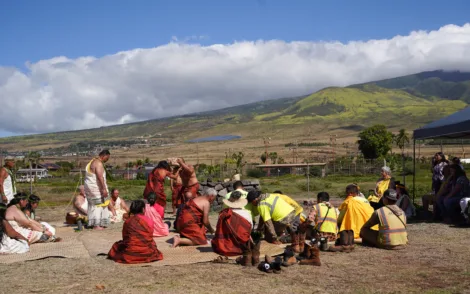
Before anyone set foot on the land that once held a community park and ballfields in Lahaina, Kumu Kapono'ai Molitau offered an oli kāhea, asking for permission to enter the sacred site.
Behind him, cultural practitioners, local leaders, construction workers, kūpuna and community members lined up two by two before quietly making their way onto the grounds of the former Malu 'Ulu o Lele Park for an 'aha 'awa ceremony.
An 'aha 'awa ceremony is a traditional Hawaiian practice for sacred rites, offerings, healing practices and blessings, centered around 'awa, a ceremonial drink prepared from the ancestral plant.
Friday's ceremony marked the beginning of land preparations for the restoration of Moku'ula, Mokuhinia and the historic Lahaina Royal Complex, or Lua'ehu.
For generations, the property served as a community park with ballfields and athletic courts. Its history, however, reaches back much further, to a time when Lahaina was the capital of the Hawaiian Kingdom and when Moku'ula served as the primary residence of Kamehameha III from 1837 to 1845.
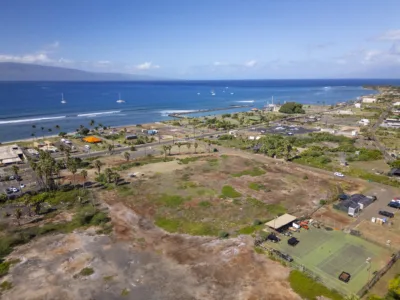
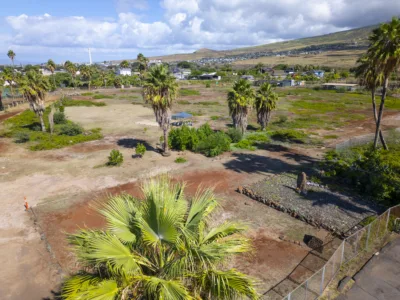
An aerial view shows the former Malu 'Ulu o Lele Park in Lahaina, where basketball and tennis courts will be removed as part of preliminary work to restore the historic Lahaina Royal Complex, including Moku'ula and Loko o Mokuhinia. Photo courtesy Maui County
The ceremony was held ahead of preliminary work by Alpha Inc., a Maui-based contractor that will remove the basketball and tennis courts damaged during the 2023 Maui wildfires. The county described it as an early step in a multiyear effort to restore the landscape.
In his opening remarks, Molitau welcomed people to the gathering and emphasized their shared kuleana, or responsibility, to care for the 'āina that holds deep ancestral and spiritual significance for the people of Lahaina, Maui Nui and Hawai'i.
"Restoration requires accountability, and that begins long before any physical work takes place," said Molitau, who led the ceremonial offering. "The ʻaha ʻawa calls us to confront the hewa of the past, recognize what has been lost and disrupted, and come together with a shared understanding of our kuleana. We cannot restore this place without first being accountable for how we care for it."
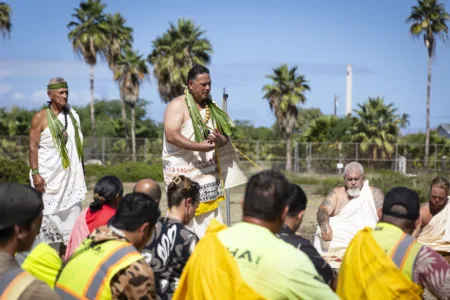
Kumu Kapono'ai Molitau, director of the Maui County Department of ʻŌiwi, speaks about the shared responsibility to care for the land during an 'aha 'awa ceremony at the former Malu 'Ulu o Lele Park in Lahaina. Photo courtesy Maui County
The Lahaina Royal Complex encompasses Moku'ula, Loko o Mokuhinia, Pākalā and Loko o Nālehu. Moku'ula was a one-acre island surrounded by the roughly 17-acre Loko o Mokuhinia pond. Historically, the royal complex was celebrated as a place of abundance, sustained by freshwater fishponds. It is also a resting place for ali'i and iwi kūpuna.
Friday's ceremony was hosted by the Maui County Department of 'Ōiwi Resources and attended by local leaders, including Maui County Mayor Richard Bissen, Maui County Council member Tamara Paltin and state Rep.-elect Pā'ele Kiakona, as well as workers from Alpha Inc., kūpuna and community members.
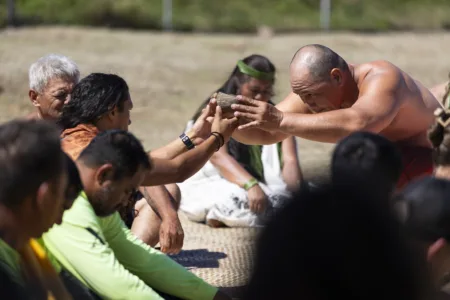
State Rep.-elect Pā'ele Kiakona is presented with a bowl of 'awa during a Friday ceremony marking the beginning of land preparations for the restoration of the historic Lahaina Royal Complex. Photo courtesy Maui County
After the 'awa had been prepared in a large wooden bowl, individual servings were poured into smaller bowls and shared with those who wished to speak.
When their time came, they spoke of the many hands that have carried the project to this point and the large amount of work that still lies ahead. Some recalled growing up playing at the park, never knowing the land beneath them was once the political center of the Hawaiian Kingdom.
One after another, the speakers expressed their joy and hope for the future, though one of the kūpuna said she didn't believe she would live long enough to see the restoration completed.
At the end of the ceremony, offerings were presented and laid upon the ahu, or stone altar.
The restoration effort is being led by the Department of 'Ōiwi Resources, which seeks to return the 'āina to its natural state, restoring the flow of wai, or water, where possible and renewing the relationships between land, water and people.
The goal is to restore the royal complex in a manner that's grounded in the ancestral knowledge and the relationships that sustained it long before the landscape was altered.
According to the county, preliminary work beginning in late November will continue for about two months as the larger master planning process for the Lahaina Royal Complex moves forward.
The process is incorporating perspectives from youth, kūpuna, parents and kumu hula, as well as local businesses and nonprofit organizations such as Hui o Wa'a Kaulua, Lahaina Restoration Foundation and Nā 'Aikāne o Maui.
The county will host an open house from 4 to 7:30 p.m. Dec. 1 at Lahaina Intermediate School to share restoration plans and provide information about the history and cultural significance of the royal complex.
Attendees will be able to explore educational displays about natural and cultural resources and learn about the work of community partners.
For more information about the Lahaina Royal Complex Master Plan, email LRC@g70.design.
Kumu Kapono'ai Molitau, director of the Maui County Department of ʻŌiwi, speaks about the shared responsibility to care for the land during an 'aha 'awa ceremony at the former Malu 'Ulu o Lele Park in Lahaina. Photo courtesy Maui County