
Documentary highlights Protect Kahoʻolawe ʻOhana
Trending
Arriving at a beach on Kahoʻolawe, Mark Carpenter, director of the new documentary "Protecting Kahoʻolawe: 50 Years of Aloha ʻĀina," said he could feel the weight of it.
"You feel the mana. You feel all the sacrifice. You can't help but feel that the land is calling you," he recalled.
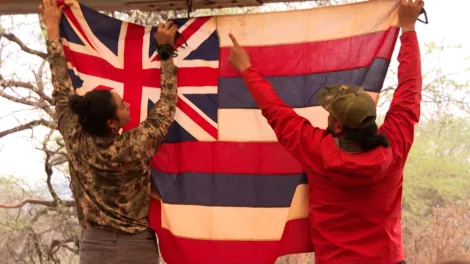
The film was produced and directed by Hawaii News Now reporter Carpenter with photojournalist Corbin Gregory. They initially had planned to produce a brief news segment but instead created a film immersed in the history of the Protect Kahoʻolawe ʻOhana and the island's cultural importance.
"I had no idea what it was going to turn into," Carpenter said about making the documentary. "I didn't know what the end result would be."
The film will screen Nov. 14 at the Maui Arts & Cultural Center as part of the 2026 Hawai'i International Film Festival presented by Halekulani.
"We were able to essentially immerse ourselves in the entire experience of Kahoʻolawe," Carpenter said. "It was magnificent."
For decades, the U.S. military used Kahoʻolawe as a bombing range, scarring the island sacred to Native Hawaiians.
Protesting U.S. military control and destruction of Hawaiian lands, nine Hawaiian activists landed on Kahoʻolawe in 1976, galvanizing a movement that ultimately led to the end of the bombing in 1990.
"I have family that is actively involved with the Protect Kahoʻolawe ʻOhana," Carpenter said. "As the 50th anniversary of the landing of the Kahoʻolawe Nine was approaching, my family approached me, basically to see if there's interest from Hawaii News Now to cover the anniversary and what the 'Ohana would be doing."
Excited by the opportunity to spend three days on the island, he said, "I was hesitant because of the pressure and the kuleana that comes with that. Just because there is so much history wrapped up into it and to gain the trust of the 'Ohana to share their stories about the work that they have done over the years is something that I take seriously."
Born and raised in Hawaii, Carpenter is a Kamehameha Schools graduate passionate about telling stories that reflect and serve the community. "Being a Native Hawaiian storyteller, there comes a weight," he said. "I use my career as a way to highlight the stories of the Native Hawaiian community and represent something much larger than yourself. This story is a part of that."
Sailing from Maui to Kahoʻolawe around 4 a.m. one morning in January, he recalled how they jumped into the water about a quarter mile offshore with dry bags, and started a human train to bring the bags onto shore.
"It was perfect because it forced you to unplug and immerse yourself in the entire island," he said. "You talk with the 'Ohana members, and they all talk about this spiritual energy that pulls you in. Kahoʻolawe calls to you."
The film includes interviews with University of Hawaiʻi at Mānoa professor Davianna McGregor, Kaipulaumakaniolono Keala, UH Hawaiian language instructor Kaliko Baker, Craig Neff and Hawaiian activist Walter Ritte, one of the original Kahoʻolawe Nine.
"Talking with veteran 'Ohana leaders, you hear the responsibility that comes with Kahoʻolawe," he said. "What it symbolizes in the larger Native Hawaiian community and the causes and the fight that remains to this day on so many different Native Hawaiian issues, whether that's TMT, Pohakuloa with military land leases, or water rights on Maui. Kahoʻolawe is a major component of that, and the progress that you see on Kahoʻolawe is emblematic of progress that you're seeing in the Native Hawaiian community."
Carpenter said he was constantly mindful of "the responsibility and the pressure that you feel to not screw it up, because you hear the story of the sacrifices of George Helm and Kimo Mitchell, and how people have literally given their lives for this movement."
He said he hopes the film "serves as a way to educate and spotlight awareness on the tremendous work that the Kahoʻolawe ʻOhana has been tackling for decades. Aloha ʻāina is a generational cause. This isn't something that's just done in a year. It is a lifetime commitment."
As the film closes, it plays the song "Mele O Kahoʻolawe," sung by Ka'ikena Scanlan and Kimié Miner.
"It was sung at an event commemorating the 50th anniversary," Carpenter explained. "It's a mele that was composed by Harry Kunihi Mitchell back in the day, and it's sort of the unofficial national anthem of Kahoʻolawe. It's something that's really powerful to end the film with, and it bridges the gap between the beginning days and the work that is happening now."
"Protecting Kahoʻolawe: 50 Years of Aloha ʻĀina" will screen at 1 p.m. Nov. 14 at the MACC, with "Sacred Island: Living the Dream." Carpenter said he hopes to attend.