
Kiakona looks ahead after historic win in West Maui election
Trending
After work on Election Day, West Maui resident Timothy-Joe Gonsales went straight to the polls to vote for the first time in his life.
"Growing up, I never had one household that taught us stuff like that or taught us it was important," said Gonsales, whose family has generational roots in Lahaina.
For the plumber with three children, voting for Pāʻele Kiakona was an easy decision.
"I trust him," Gonsales said.
Gonsales said he knew Kiakona from wrestling as a child and paddling together at Kahana Canoe Club. It also was the first time he had seen someone he knew run for political office.
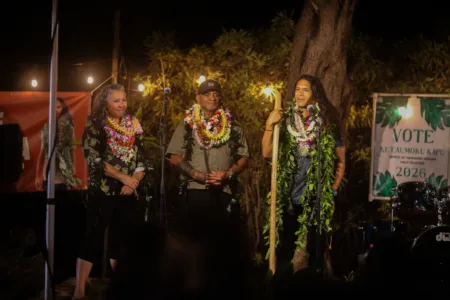
Kiakona is the first third-party candidate elected to Hawaii's state House. His family's generational home is in Mala, and he campaigned on restoring balance to West Maui's land, water and people.
Kiakona ran as a Green Party candidate, saying it doesn't make sense to use the American two-party system to govern in Hawaii. Kiakona led a grassroots campaign, and as an elected representative, he said he will continue to operate at a grassroots level, developing policies from the ground up.
Instead of serving political parties, he said he aims to serve the people of Lahaina.
And the messaging seems to have paid off.
Kiakona won the election to represent House District 14 at Hawaii's state House, winning 3,025 votes (41.2%) to Democratic candidate Sne Patel's 2,906 votes (39.6%) and incumbent Republican candidate Elle Cochran's 1,242 votes (16.9%), according to the latest totals released Tuesday.
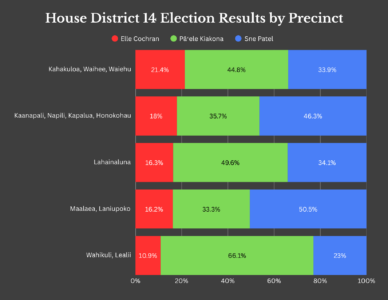
Kiakona performed strongest in West Maui's mixed-income residential neighborhoods and all districts affected by the 2023 Lahaina fire, including Lahainaluna; Wahikuli and Lealii; and Kahakuloa, Waihee and Waiehu.
Patel performed best in districts with higher property values, hotels and vacation rentals, including Maalaea and Laniupoko; and Kaanapali, Napili, Kapalua and Honokohau.
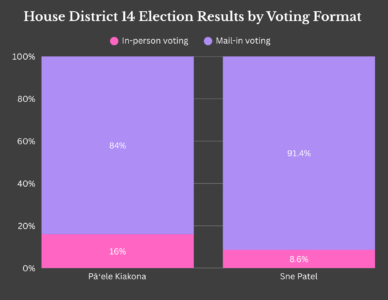
Results also differed by voting format. Patel maintained a slight lead in mail-in votes, but Kiakona pulled ahead with more in-person voters. Cochran finished third in all districts.
"I believe it was a landslide win because there were community members that never even paid attention to politics and what was going on out there, but because of the movement we built, I'm seeing even kids get excited about me getting elected to office,” Kiakona said.
Reflecting on the results, Patel said the close race showed how strongly Lahaina needs a change in representation.
"One lesson that you can take away is that you just can't take anyone's support for granted because of party designation," Patel said. "That applies to a Democratic candidate, a Republican candidate, a Green Party candidate -- you have to earn people's trust by showing up, knocking on doors, listening to them."
From knocking on doors, Patel and Kiakona have encountered a lot of similar issues. People are struggling to afford to stay on Maui, people in Lahaina need to rebuild their homes and businesses, and they need stronger fire-mitigation infrastructure to feel safe.
"There was a lot of overlapping need we both saw," Patel said. "Regardless of party affiliation, or what we wanted to do, there's the need of what the community needs to happen. I wish him the best. We need him to succeed because the families and businesses across this district still need help."
If elected to a third term, Cochran said in an email to the Maui News that she would have proposed bills to address fraudulent contractors and disruptive noises in residential neighborhoods.
New perspectives
Growing up, Kiakona never saw himself as a politician. He loved fireworks and explosions as a kid. When he was about 2 years old, he already knew how to say "pyrotechnician." In grade school, he fell in love with math and chemistry.
Kiakona grew kalo alongside his uncles as a young adult in Honokōhau. At the University of Hawaii at Hilo, Kiakona started as an agriculture major to support his farming background. But a proposed development expansion above Hanakaō’ō Beach pushed him into politics and public testimony for the first time.
After posting a social media video protesting the development, Kiakona later switched his major to environmental science, then environmental studies, hoping to work toward a law degree to protect his home.
After the 2023 Lahaina fires, Kiakona emerged as a community leader with Lahaina Strong. He helped coordinate and advocate for resources at the grassroots level after the fires, including the "Fishing for Housing" campaign where locals camped on beaches in front of resort hotels for 175 days. At times more than 200 people occupied the beach, pushing state and county governments to address housing for fire-displaced locals before opening Lahaina back up to tourism.
Kiakona then worked with state lawmakers to help draft and pass SB 2919, a bill that grants counties the authority to regulate, restrict or phase out short-term rentals and transient accommodations. Since then, he said he's kept a close eye on the county, state and federal governments as they coordinate recovery policies.
"Everybody says, 'I don't do politics,' but when you're in a space of recovery like we are, you realize real quick how much politics comes into play in your own community," Kiakona said.
Kiakona said he didn't think he'd be running to represent Lahaina at the state House, but when he saw his home not getting proper representation at a time of critical need, it was time for him to take a leap of faith.
The 31-year-old brings a new perspective to the Hawaii State House.
"Maybe I don't have as much experience being a government official myself," Kiakona said. "But does your knowledge of how to write bills trump your knowledge of how to care for ʻāina? How to be part of this community? How to bring people together? Understanding the science and all the little intricacies that connect everything from mountain to sea? All of these things come into play when you are trying to create policy that is effective."
Kiakona said his understanding of these topics comes from his life knee-deep in kalo patches, learning about West Maui's land, water and balance from his previous generations.
"You can be amazing at writing policy, but you might be writing the wrong piece of legislation," Kiakona said. "I can learn that, but these things that I've grown up learning are things that you have to grow up learning to really know."
When learning new things, Kiakona describes himself as "kind of a nerd." As a UH Hilo student, he read a book a week. And as a young kid, he liked taking apart his remote-control cars and putting them back together again.
"Also sometimes I'd break things on accident and have to put them back together before I got in trouble," Kiakona said. "So a lot of it was reactionary to me, like I better figure out how this thing works so I can fix it before mom gets home and I get lickings."
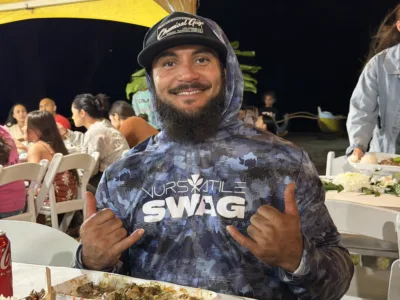
Timothy-Joe Gonsales grew up playing sports with Pāʻele Kiakona and paddles with him at Kahana Canoe Club. This year was his first time voting, and he feels inspired to look more closely at local politics. Yiming Fu/The Maui News
First-time voters
Gonsales was among many people who voted for the first time, or voted for the first time in years, to support Kiakona.
Willy Keokalani, a Lahaina waterman and surf instructor who lost his shop in the fire, voted for the first time for Kiakona. Keokalani has known Kiakona since Kiakona was a young boy.
Keokalani wasn't interested in politics before this election year. Growing up, he would hear phrases like "every vote counts," but he never took them to heart. His parents never pushed him to vote, and picking the right leader takes a lot of research, he said.
For most of his life, Keokalani viewed politicians as working against the interests of people. But Keokalani said Kiakona was a good candidate he could believe in for the Hawaiian people and the island of Maui.
"Our town got burnt," Keokalani said. "And we got a good leader in the position."
Kawika Lobes' family is of Lahaina, but he lived on Oahu at Hawaiian Homes Nānākuli. Lobes returned to Lahaina four years ago to live on his family's 100-acre Kuleana land at Kahoma Ranch. He attended Kiakona's election night party with six family members, including his wife, daughter, grandson and great-grandchildren.
The Lahaina fires were a "blessing in disguise," Lobes said. After disaster struck, he immediately began volunteering at recovery hubs and said he saw Lahaina start to feel like one family again.
Lobes said he considers himself Kanaka. He does not consider himself an American and does not like participating in the American political system. He feels like politicians have failed Hawaii and he hasn’t voted in a long time.
"I not vote long time," Lobes said. "This year, I voted."
Tina Blando believes Kiakona will be a positive change for West Maui. She describes him as intelligent, committed to Lahaina and committed to uplifting Hawaiian culture.
Blando is Indian American and not from Maui originally. She's lived in Lahaina for more than 30 years and works with special needs children at Princess Nāhiʻenaʻena Elementary School and paddles with Kahana Canoe Club. Blando is friends with Kiakona's mom and has known him since he was a child.
Whatever Kiakona puts his mind to, he gets it done, Blando said.
"I really think we need change, and he's the man to do it."
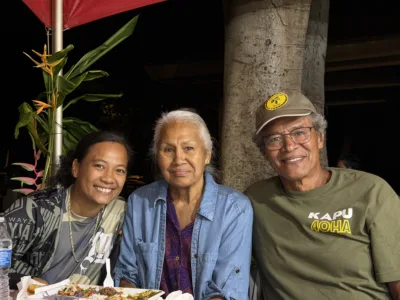
Kawika Lobes attended Kiakona's election night party with six family members, including his wife, daughter, grandson and great-grandchildren. He said this year was his first time voting in about eight years. Yiming Fu/The Maui News
Looking forward
As Kiakona prepares to take on his new role, he also feels the expectations to deliver for his home.
"People are so happy," Kiakona said. "That also puts a little bit of an extra layer of pressure on me because I want to make sure I'm doing what I'm hoping that I can do. It's a whole different realm and a whole different world that I'm walking into and trying to learn it as quickly as I can while balancing life."
Kiakona also said he hopes the community stays engaged, especially in local politics.
Gonsales said a lot of local people don't grow up in families that encourage them to vote, but he's noticed a lot of people who move to Maui turn out in large numbers to vote for their interests.
Gonsales said he voted for the first time because Kiakona invited him to his election party on Hanakaō’ō Beach with live music and catering. Kiakona insisted Gonsales didn't have to bring anything, but in Hawaiian culture, you're not supposed to show up to a party empty-handed. Instead of preparing a dish, Gonsales went to the Lahaina Civic Center to drop off his ballot.
"That's what these parties do," Gonsales said. "They bring the locals to come and vote for the first time."
From here, Gonsales said he wants to pay attention to what Kiakona and other elected officials do. And he hopes to become more involved in politics moving forward.
Gonsales doesn't think that ever means running for office.
"But if I can educate my kids, myself and my kids, maybe I can make a difference that way," Gonsales said. "Try to give them what I never had."
While Keokalani said he doesn't think he will vote in future elections, he was able to find other candidates this year that he likes. One of them was Bobby Pahia, a Hawaiian kalo farmer of more than 40 years who won election to Maui County Council.
After a long campaign season, setting up and taking down his own election party, and starting a new job at the state Capitol, Kiakona has missed a lot of time with family.
"I want to make sure that I’m making time for the people who put me where I am to begin with," he said.
Kiakona will visit his mom, sisters and grandma on the Big Island for Thanksgiving, Christmas and New Year's.
Every Christmas morning, Kiakona's dad, who is a chef, cooks breakfast. It could be the classic bacon, eggs and rice, or sometimes breakfast with a twist, like a seafood omelet or crab legs. His family wakes up to stockings they filled for each other and gathers around the Christmas tree, sharing gifts, gratitude and love.
"It is that experience that really means family for me," he said.