
Ornaments from Maui Waena Intermediate School to bedeck the Whitehouse in D.C.
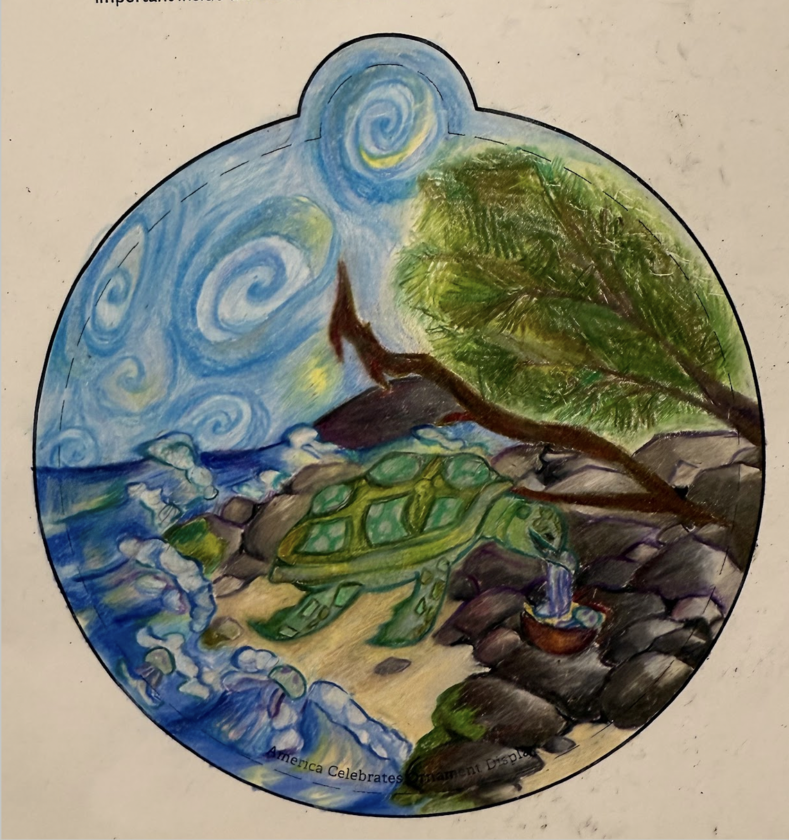
Jaycee Neriah Mendoza, 12yrs, I came up with my design by thinking about animals that are often seen at the beaches of Hawaiʻi, especially sea turtles. My drawing shows Maluaka Beach, also known as Turtle Town in Maui, a place I remember visiting many times to swim and see turtles in the ocean. Maluaka Beach is known for its natural beauty and as a resting place for turtles. The turtles are protected, and it is illegal to touch them. I drew the turtle eating a moon jellyfish because turtles really do eat jellyfish, and moon jellyfish can be found in Maui. I also added a coconut bowl for creativity, showing the honu enjoying its meal.
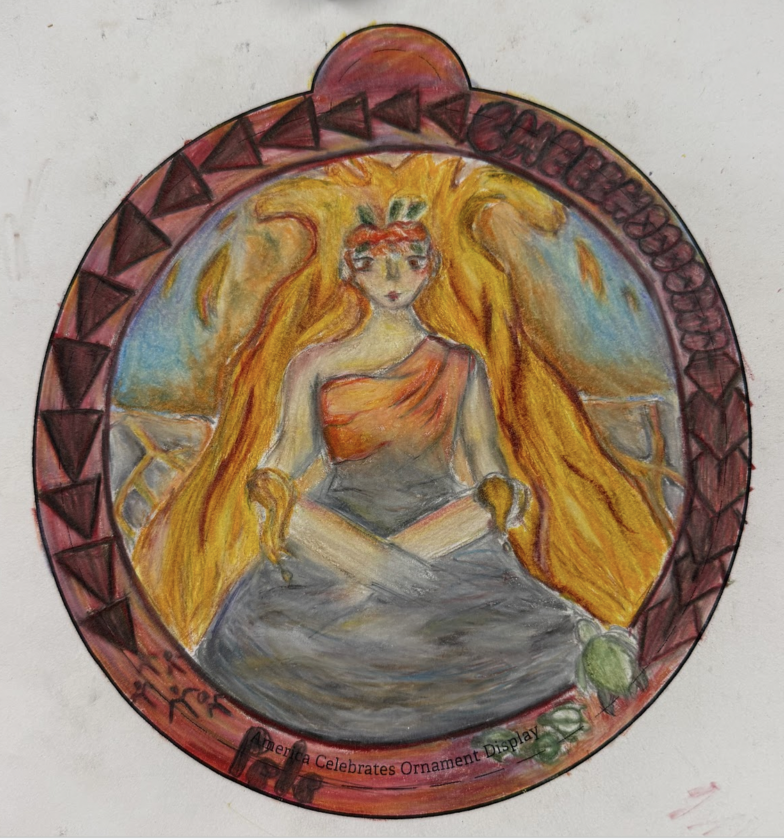
Talia Tiale Crespin-Tufaga 12 yrs, I drew the Hawaiian goddess Pele because the legends about her in Hawaiian mythology are very beautiful and powerful. I was inspired by stories about how she became connected to volcanoes, how she turned her ex-lover into a lehua tree, and the curse she placed on her “children,” the rocks. These legends show how strong and important she is in Hawaiian culture. I drew her hair as a volcano with lava flowing out and gave her a lei poʻo made of lehua flowers. I used a red border because red represents her bold, fiery, and passionate personality. She is also wearing a lavalava that connects to the volcano she lives in.
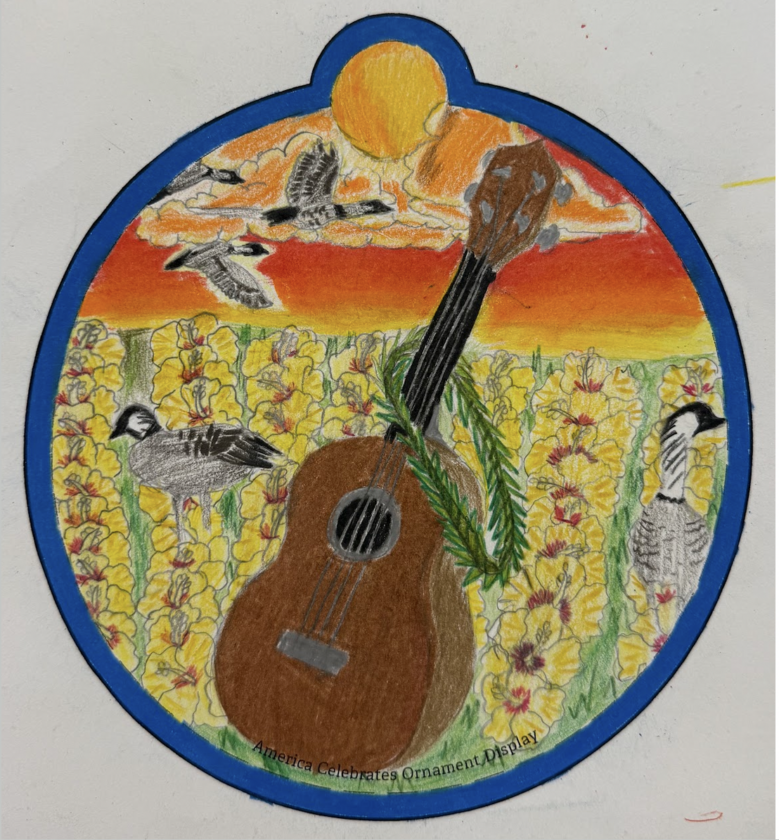
Jaiden Ceria, 12 yrs., My art represents the “beauty of Hawaiʻi” by showing just a small part of Hawaiʻi’s nature. I included the yellow hibiscus because it plays an important role in Hawaiian history and culture. It represents royalty, power, and aloha. It was chosen as the state flower in 1988 to honor a rare native species. I also drew the nēnē goose, Hawaiʻi’s state bird, because it is beautiful and important to Hawaiian culture. It once nearly went extinct, but now there are over 3,000 today, even though it is still endangered. The main focus of my art is the ukulele, Hawaiʻi’s state musical instrument, which represents aloha, storytelling, and culture.
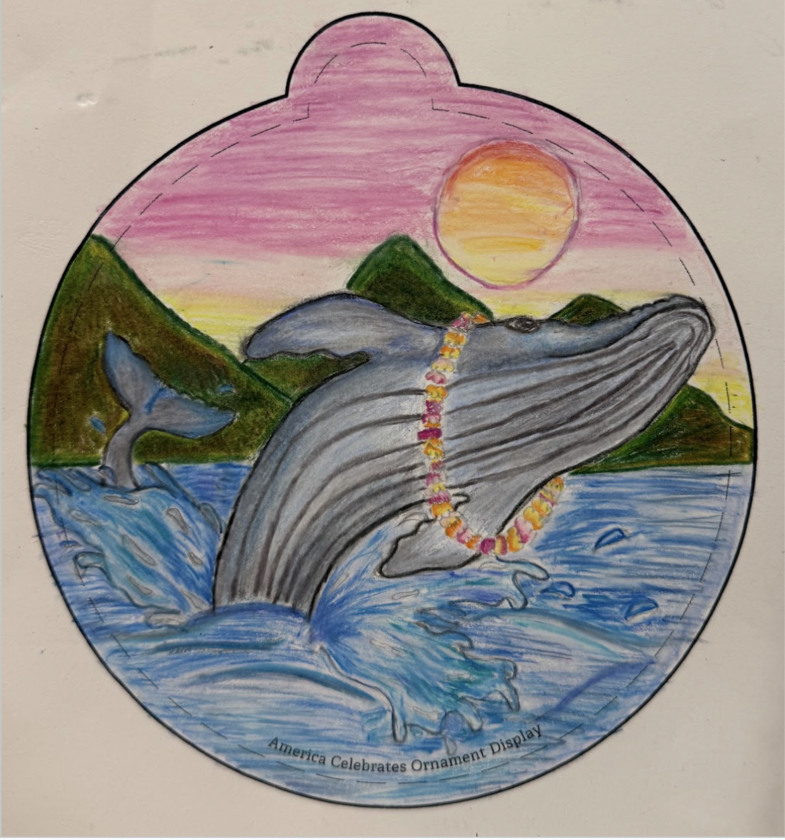
Jaclyn Alexander, 11 yrs, Many ideas came to my mind when I first heard about this project, but I chose to draw a mother and baby whale to show how caring and supportive Hawaiʻi can be. It is not everywhere that you see this kind of love and help, especially during difficult times. I also included a lei to represent how welcoming Hawaiʻi is. A lei is often given to celebrate achievements or to welcome visitors, and it shows respect and aloha. For the background, I drew mountains because Hawaiʻi has many beautiful mountain ranges. I find it peaceful and calming to wake up and see the mountains every day.
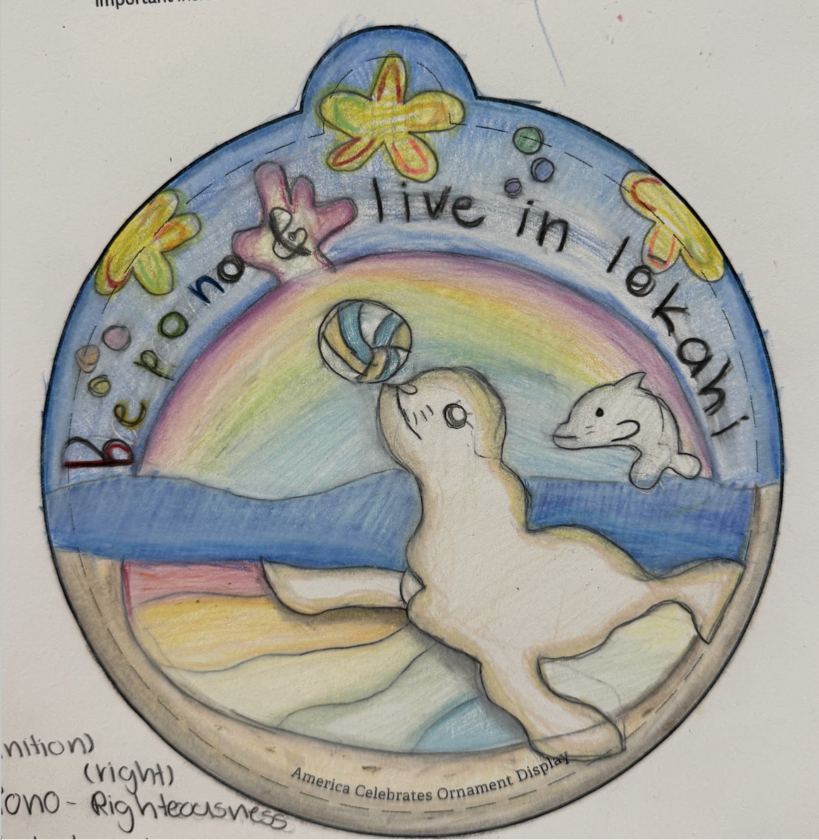
Aiden Sureo, 11 yrs, Many ideas inspired me for my Hawaiʻi ornament, but one main idea came to mind. I chose the Hawaiian monk seal because it represents cultural heritage and ecological health in Hawaiʻi. The volleyball the seal is playing with represents cultural identity because volleyball is a big part of life in Hawaiʻi, and some people even call Hawaiʻi the “Volleyball State.” I also added a rainbow sunset because it represents hope and change, and Hawaiʻi is known as the “Rainbow State.” The words “Be pono & live in lokahi” mean “be right and live in harmony.” Pono means doing what is right, and lokahi means living in balance with yourself, others, and the environment.
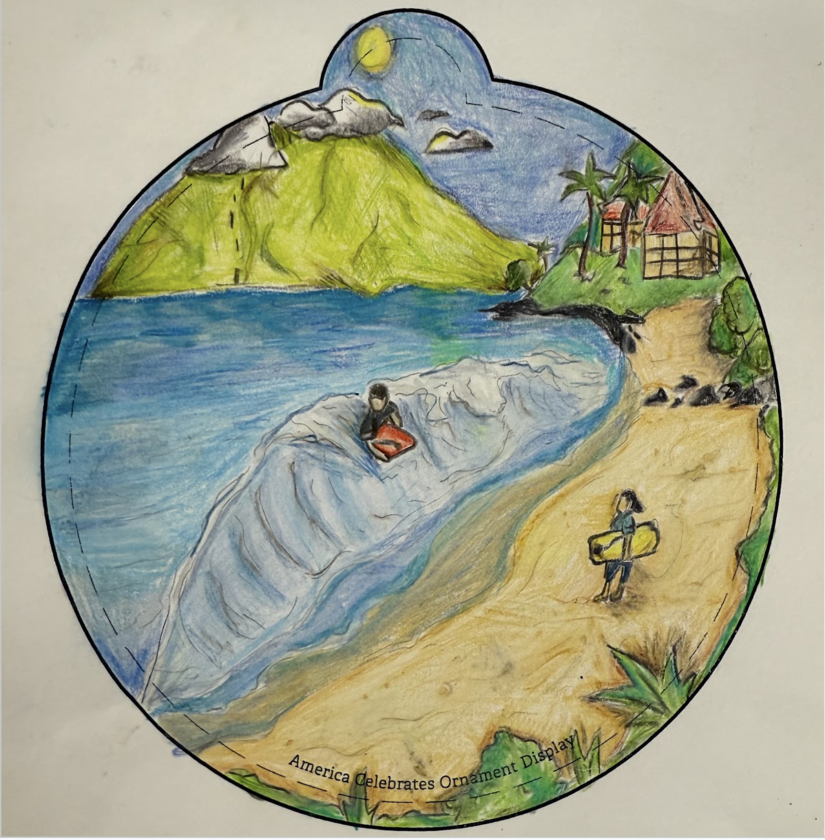
Joe-James Ulufale, 12 yrs, A lot of ideas inspired me to create my Hawaiʻi ornament. One idea I included was a person bodyboarding at the beach because when you go to the beach in Hawaiʻi, you often see people surfing and bodyboarding. I also added it because I like bodyboarding with my friends when I go to the beach. Another idea I included was Lahaina in the background. I added it because from the beaches in Kihei, Maui, you can see Lahaina in the distance. Overall, my ornament shows parts of Hawaiʻi that connect to beach life, fun activities, and the places I see around me.
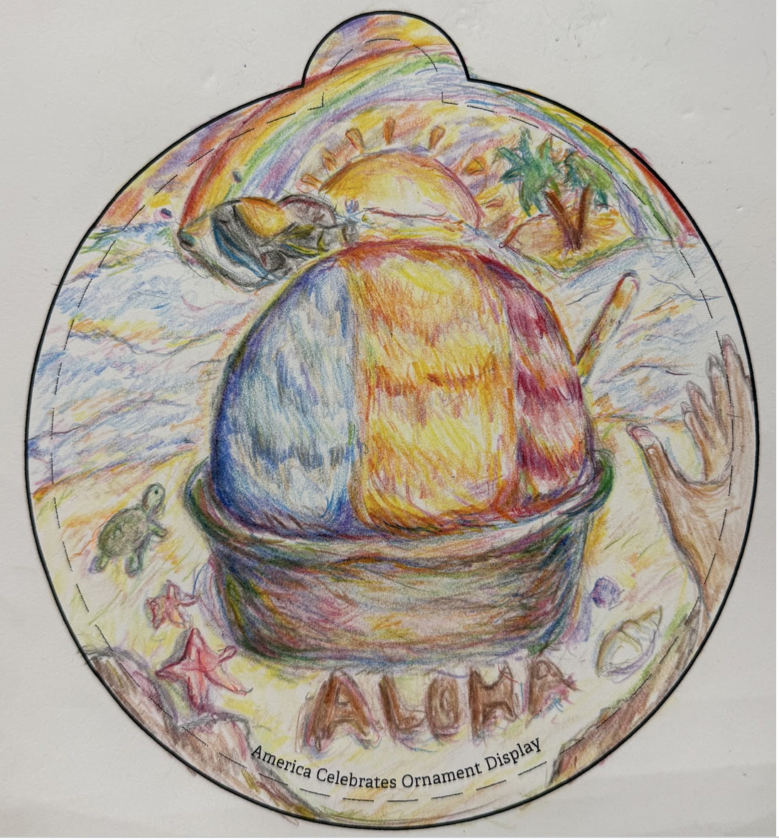
Bea Ildefonso, 11 yrs, My ornament idea was inspired by a Hawaiian beach scene because Hawaiʻi has many beautiful tropical beaches. To match this setting, I added shave ice, a sweet treat with colorful flavors and a Hawaiian history, because it fits the tropical environment. I colored it with bright shades to show the variety of flavors, and I added a hand reaching for it to show how popular it is. In the background, I drew the humuhumunukunukuāpuaʻa, Hawaiʻi’s state fish, jumping out of the ocean with a rainbow behind it. On the sand, I added turtles, seashells, and the word “Aloha” to show kindness and love. I also included an island, rocks, and a sunset to represent Hawaiʻi’s natural beauty.
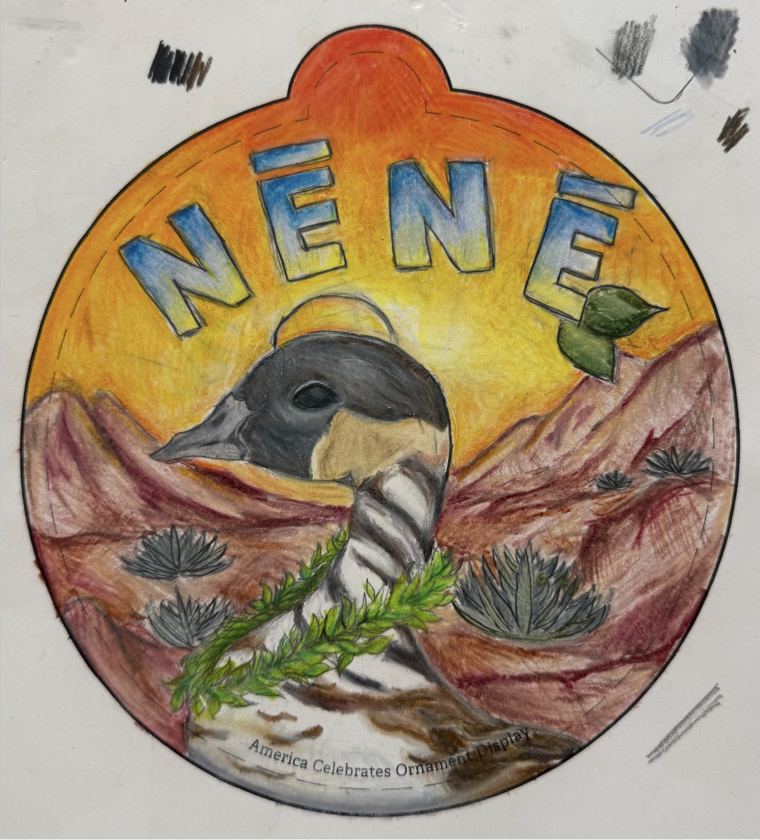
Ella Weeks, 12 yrs, Tons of things have inspired me to draw my Hawaiʻi ornament. Up front and center is the Nēnē goose because it is Hawaiʻi’s state bird and is endemic to the islands. I drew it wearing a ti leaf lei, which is like a necklace or garland. Leis can be made from shells, flowers, or leaves, and they often represent love, friendship, or peace. The background shows Haleakalā, an inactive volcano, with a sunset shining over the mountain range. I added the sunset because its vibrant colors match the landscape. In that area you can also find Nēnē and silverswords. Silverswords grow on volcano slopes, survive tough conditions, and bloom once before dying.
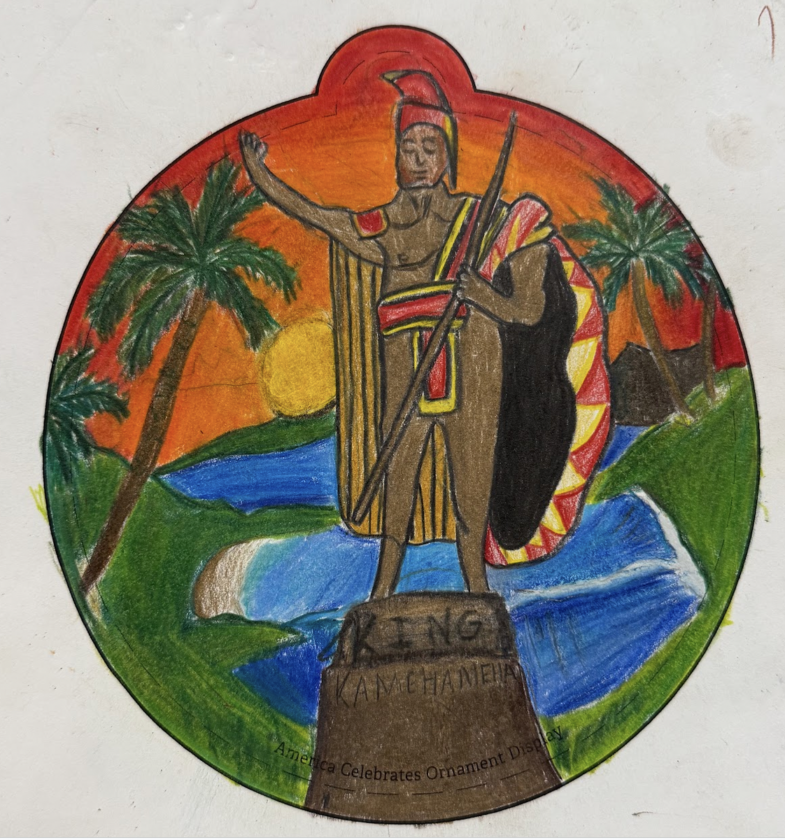
Cody Rico, 12 yrs, Some things inspired me when creating my Hawaiian ornament. I was first inspired by King Kamehameha I, who united all the Hawaiian Islands into one kingdom and is known as a strong and important leader in Hawaiian history. I included his statue in my design because it represent leadership, Hawaiian pride, and his role in creating the “Law of the Splintered Paddle,” which protected people’s safety. I also added a sunset because Hawaiʻi is known for its beautiful sunsets over the Pacific Ocean. Lastly, I included palm trees, especially the niu (coconut tree), which symbolizes life and resilience and was very important in early Hawaiian life for food, shelter, and materials.
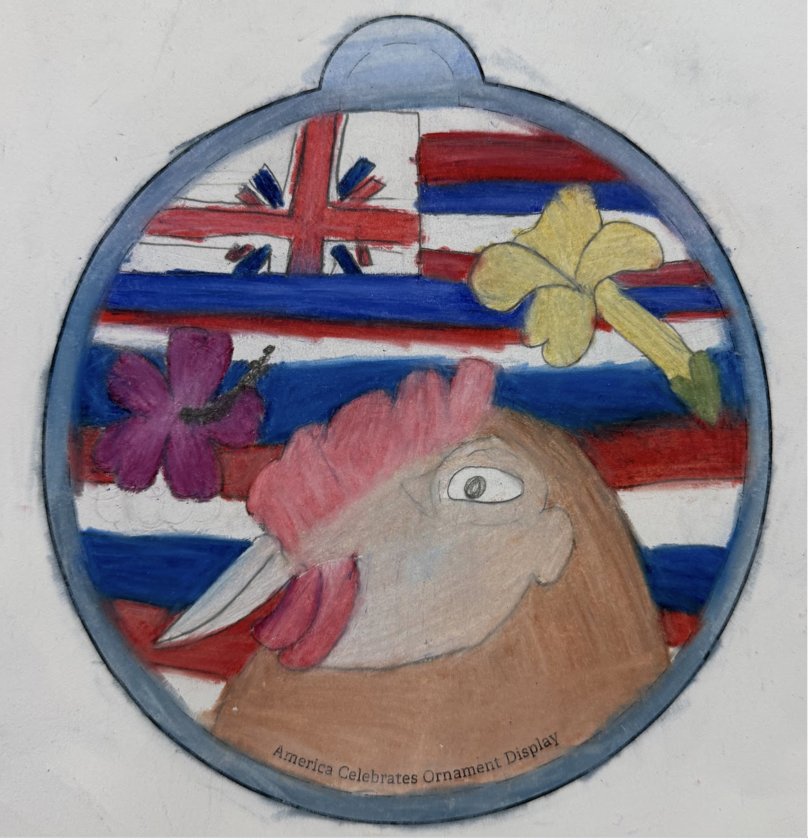
Storm Siyuja, 12 yrs, For my ornament, I didn’t have many ideas at first, but I eventually chose different things that represent Hawaiʻi. I included a chicken because in Hawaiʻi, chickens are commonly seen around the islands and are part of local everyday life. I also added the Hawaiian flag in the background because it represents Hawaiian culture and history. I drew a puakenikeni flower because it is often used to make leis and jewelry, and it is a popular flower in Hawaiʻi. Lastly, I included the hibiscus flower because people like to wear it, take pictures with it, and it represents the beauty of Hawaiʻi.
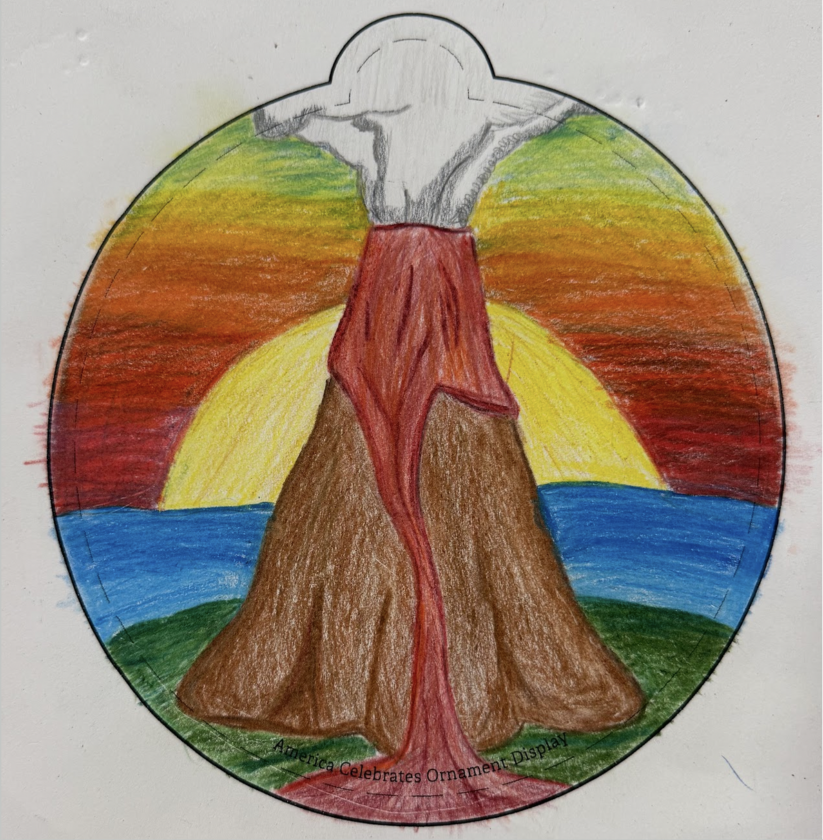
Julynn Sylvester, 12 yrs, In my ornament, I included several things that represent Hawaiʻi. First, the volcano is inspired by the many volcanoes that formed the Hawaiian Islands. Second, the colorful sunset represents the bright and beautiful colors found in Hawaiʻi’s natural environment. Lastly, the large sun symbolizes the joyful and energetic vibes of the islands. Overall, my ornament shows the unique and rare beauty of Hawaiʻi and the natural features that make it so special.
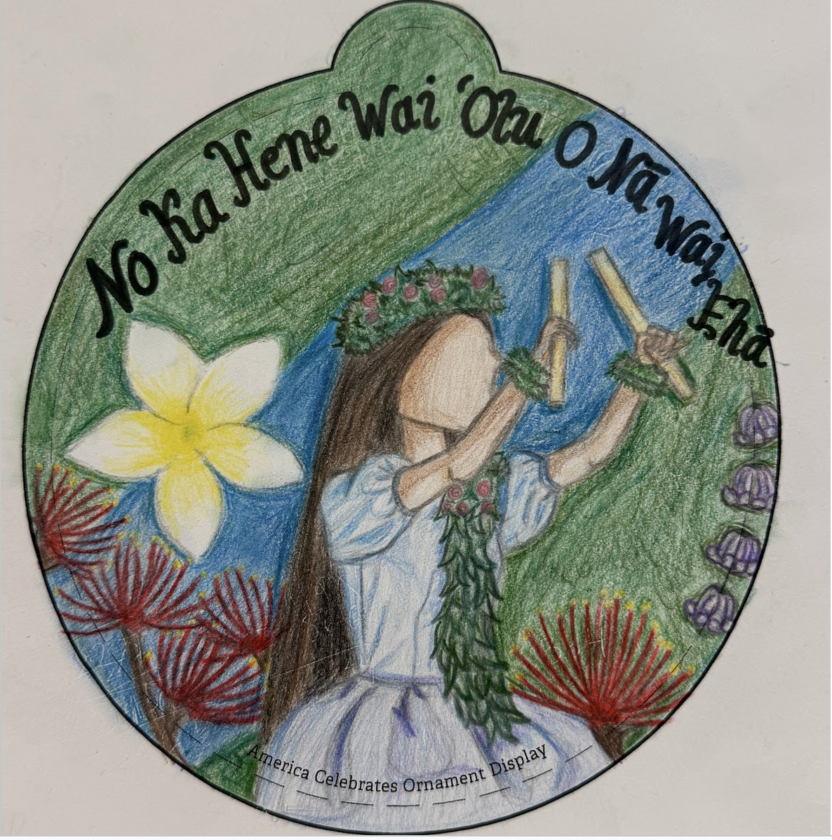
Juliann Palpallatoc, 12 yrs, In my ornament, there are many symbols that show the beauty of Hawaiʻi. The hula dancer is performing kahiko hula, the traditional style of hula that includes chanting and using an ipu for rhythm. The words above the dancer say, “No Ka Hene Wai ʻOlu O Nā Wai ʻEhā,” which means “the peaceful waters of the four waters,” referring to the streams of Waikapū, Wailuku, Waiehu, and Waiheʻe. The red lehua flowers at the bottom are from the Big Island and represent endurance, love, resilience, and rebirth. I also included plumeria flowers, which symbolize love, beauty, grace, and the spirit of aloha. The purple crown flowers represent royalty, respect, and remembrance, and are connected to Queen Liliʻuokalani.
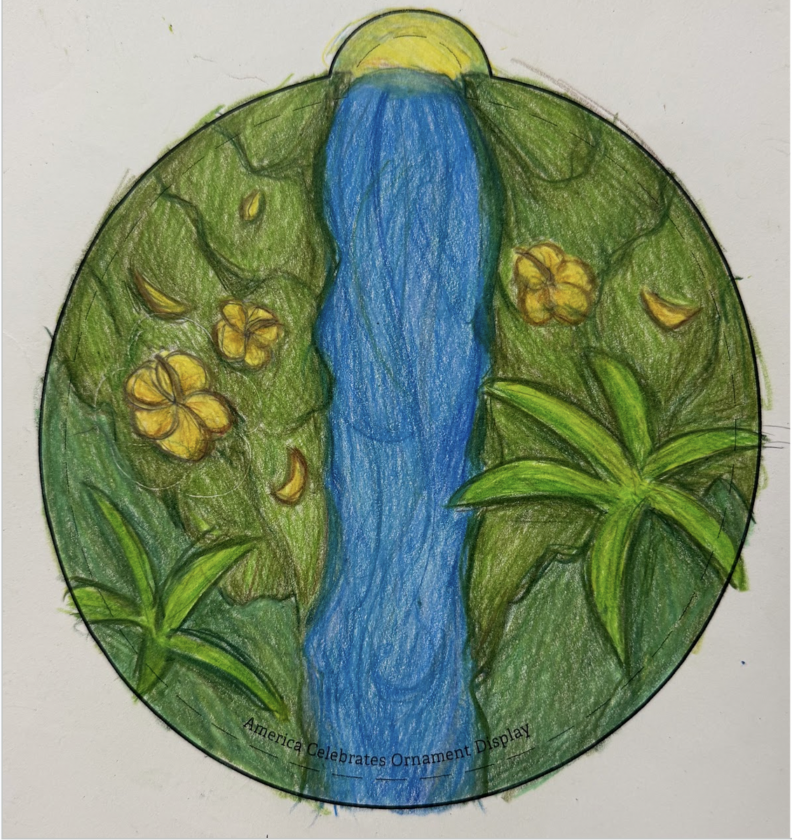
Faith Vinoray, 12 yrs, There are many things that symbolize Hawaiʻi, and some of them inspired me to create my Hawaiʻi ornament. First, my ornament includes a flowing waterfall, which represents the freshwater and natural beauty of the land. Second, I added flowers inspired by the state flower, the yellow hibiscus, which symbolizes sunshine, joy, and good luck. Lastly, I drew a lush green mountain in the background to show the beautiful landscapes and hills of Hawaiʻi. These elements helped me feel inspired and made my ornament more meaningful and unique while showing the natural beauty of Hawaiʻi.
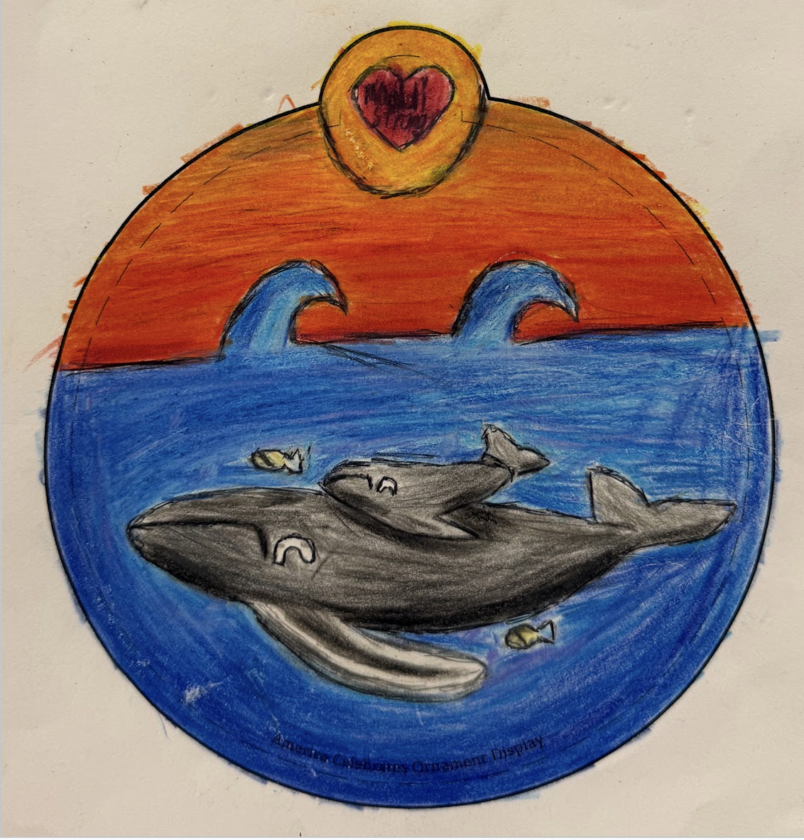
Clyde Agbayani, 12 yrs, When I was thinking about my ornament, I thought of my mother and me, so I decided to focus on humpback whales. Humpback whales represent protection, strength, and a deep connection to the ocean. They also represent ʻohana and the love between a mother whale and her calf. These whales migrate about 3,000 miles from Alaska to Hawaiʻi, especially around Maui, where the warm, shallow waters help protect their babies. They stay in Hawaiʻi from October to May, with peak season from January to March. They mainly eat krill and small fish. To protect our koholā, we need to reduce threats like fishing gear, ship strikes, and climate change.
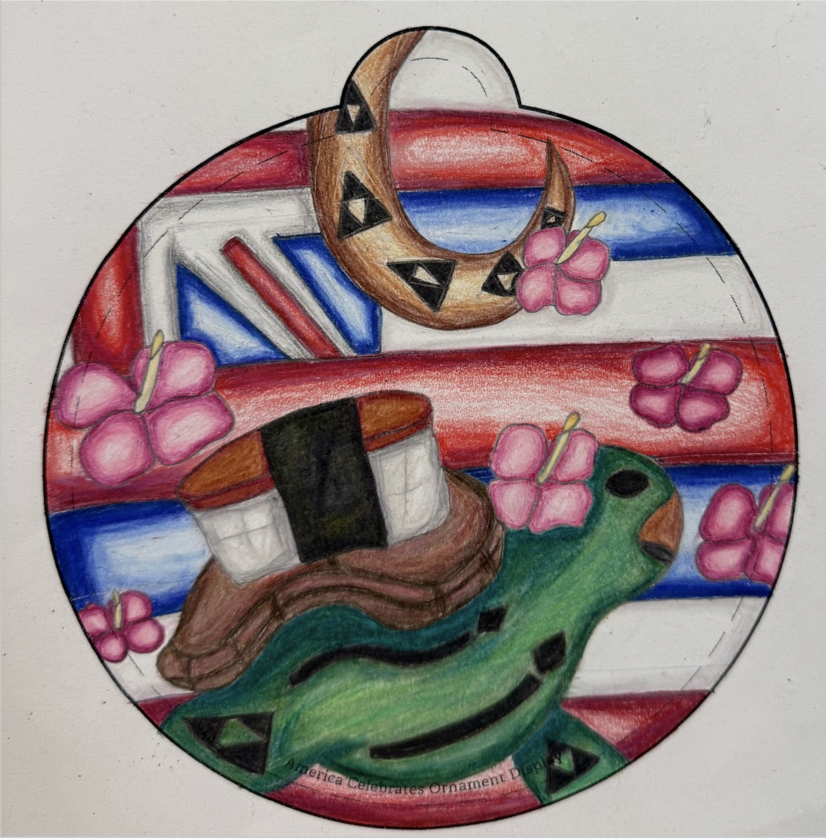
Serenity-Jordyn Puli-Ulufaleilupe, 12 yrs, The main focus of my ornament is the honu (turtle) because it represents good luck and protection from evil spirits. The black spear-like markings on the honu also symbolize long-lasting protection. On the honu’s shell, I added a musubi design because it is very popular and “onolicious” in Hawaiʻi. Around the ornament and on the honu’s head, I included Hawaiʻi’s state flower, the hibiscus, which represents the beauty of Hawaiʻi. At the top is a makau (Hawaiian fishhook), which symbolizes strength, good fortune, and protection. The makau and honu are connected through the ocean and their cultural meanings. In the background is the Hawaiʻi state flag, representing the history of the islands.
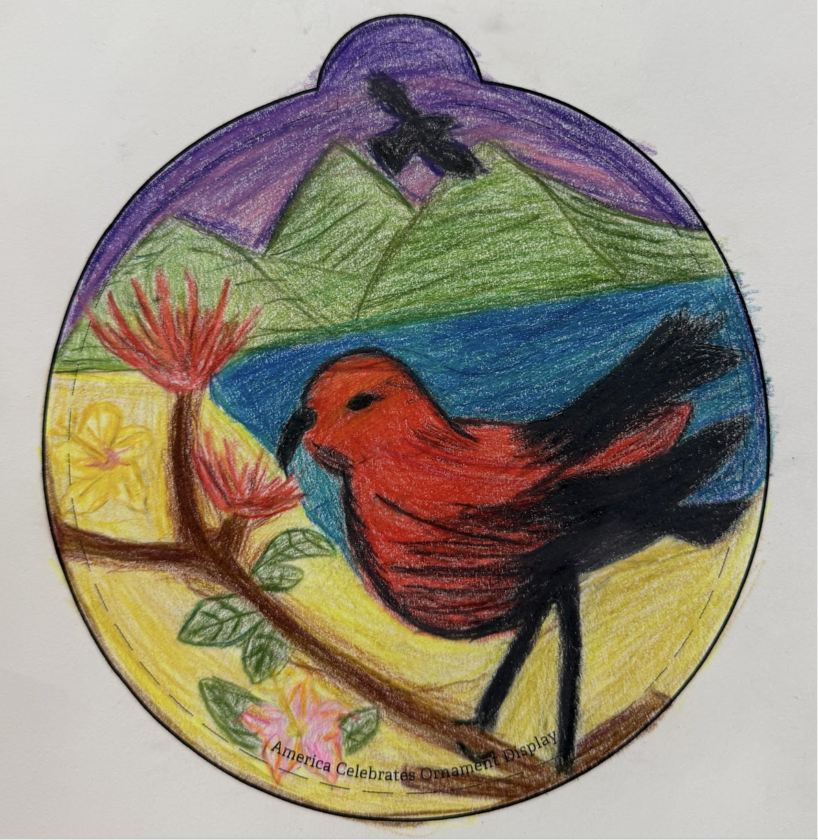
Mariah Jahnelle R. Garcia, 12 yrs, I created this design of an ʻApapane bird because I find it very special. The ʻApapane is native to Hawaiʻi and plays an important role in helping to pollinate ʻōhiʻa forests, which helps the ecosystem stay healthy. I also like the bird because of its bright crimson red color, which is beautiful and stands out in nature. In Hawaiian culture, this red color is also linked to nobility because its feathers were once used in traditional Hawaiian featherwork. I wanted my design to show both the importance of the ʻApapane and its connection to Hawaiian culture and nature.
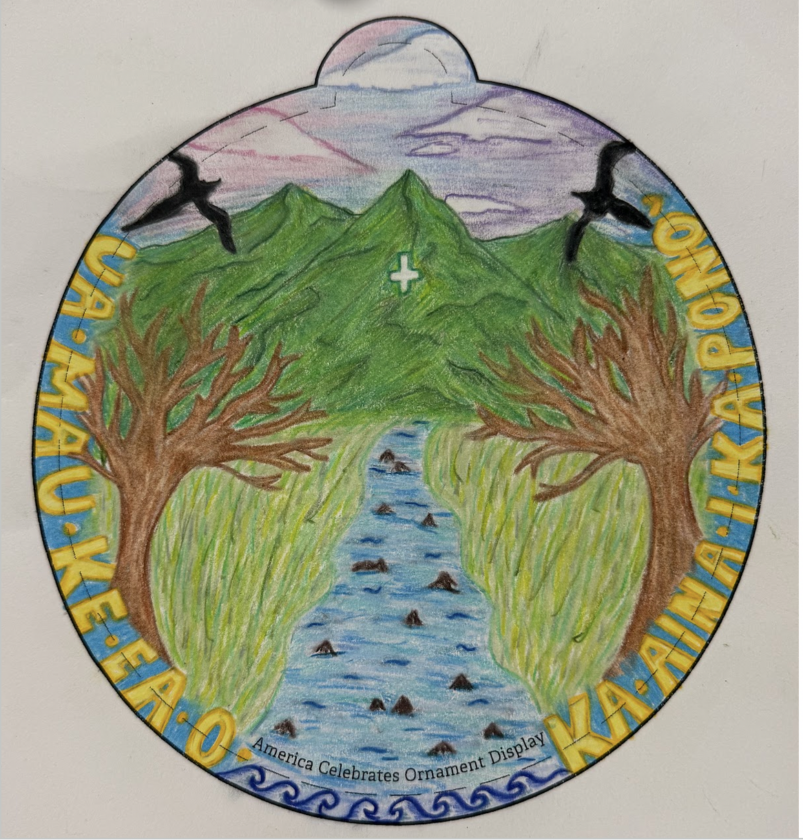
Aissa-Mae Reinhardt, 13 yrs, I love Hawai‘i, and all the beautiful and meaningful things about it. But what I love most, is the lovely green mountains of Maui, West Maui mountains, also known as Mauna Kahālāwai, which means “meeting of the waters” because of Maui’s 4 major rivers, which is important to the people on Maui. And deep within the mountains is ‘Īao valley, which also is a sacred battle ground from many years ago. The Iwa birds, which is Hawai‘i’s native bird, symbolize Guidance and Pathway. The trees that I drew represent’s the big lush trees of Hawai‘i, and the roots of its people — connecting to our Hawaiian culture and spirit. I also wrote — Ua Mau ke Ea o ka ʻĀina i ka Pono — that means “The life of the land is perpetuated in righteousness,” and to do what is right to the people and the land.
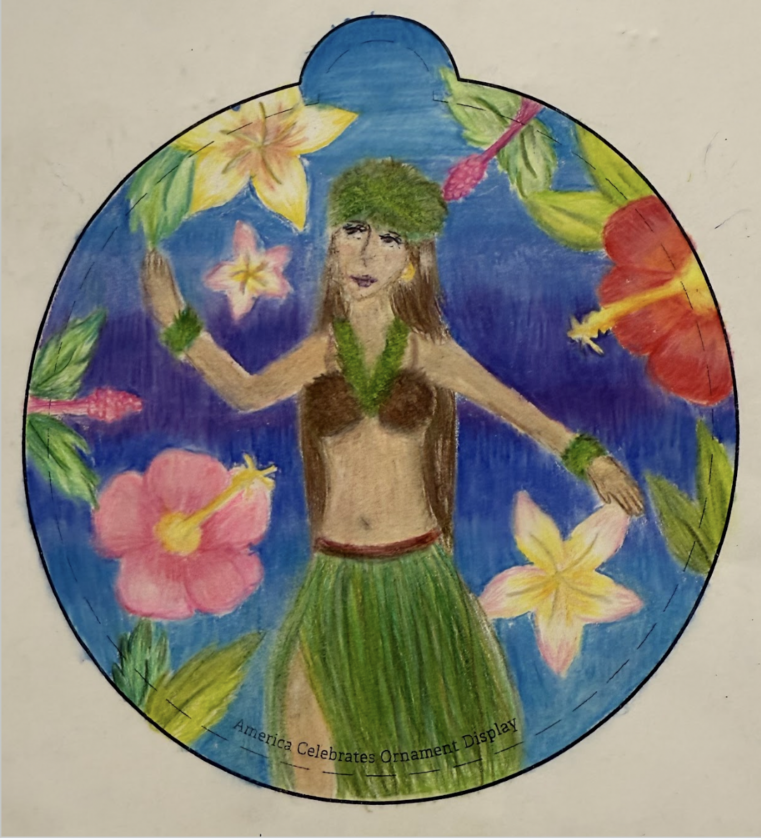
Rhianne Sarol, 13 yrs, When I thought about what to create for my ornament, I was inspired to draw a hula dancer because hula is an important part of Hawaiian culture in Maui. Hula is a traditional dance that tells stories and shares Hawaiian values through movement and music. I added flowers in the background because they represent Maui’s beauty, peace, strength, and love. Lastly, I used a blue and purple gradient for the background to represent the beautiful waterfalls we have in Maui, especially in Hāna. This helped me show the culture and natural beauty of Hawaiʻi in my ornament.
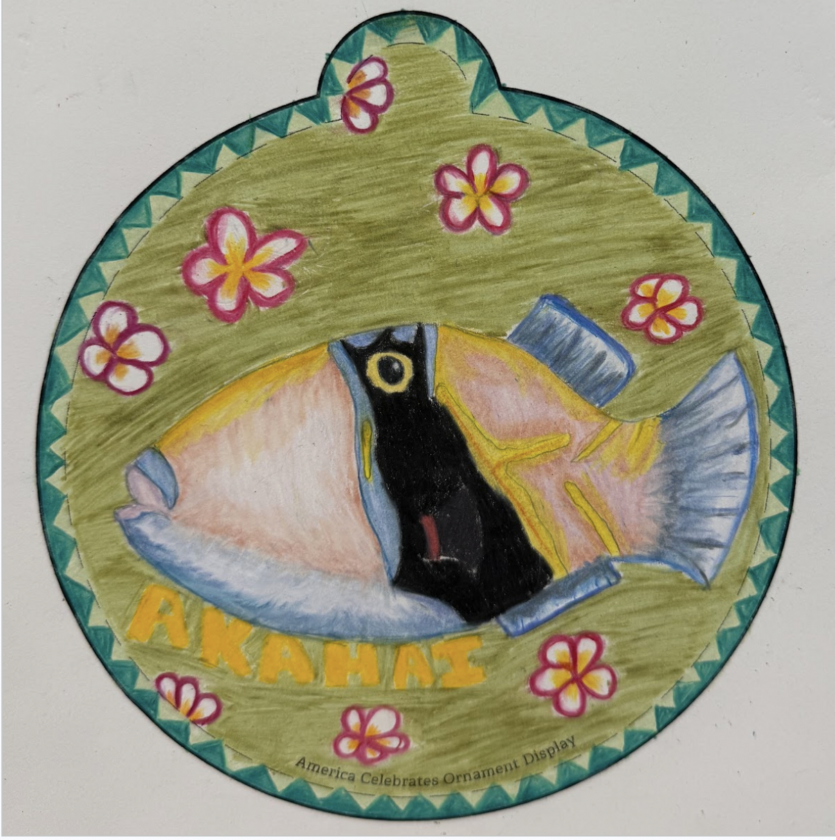
Miekayla Constantino, 13 yrs, I chose Hawaiʻi’s state fish because I was inspired by what we learned in Hawaiian Studies. I drew the humuhumunukunukuāpuaʻa, also known as the reef triggerfish. It has been Hawaiʻi’s state fish since 1984 and shows the beautiful ocean life around the Hawaiian Islands. It is often seen near Maui’s Black Rock. I surrounded it with plumeria flowers because they represent love, beauty, grace, and the spirit of aloha. I also added the word “Akahai” under my drawing because it means kindness, which is an important value that many people in Hawaiʻi live by.
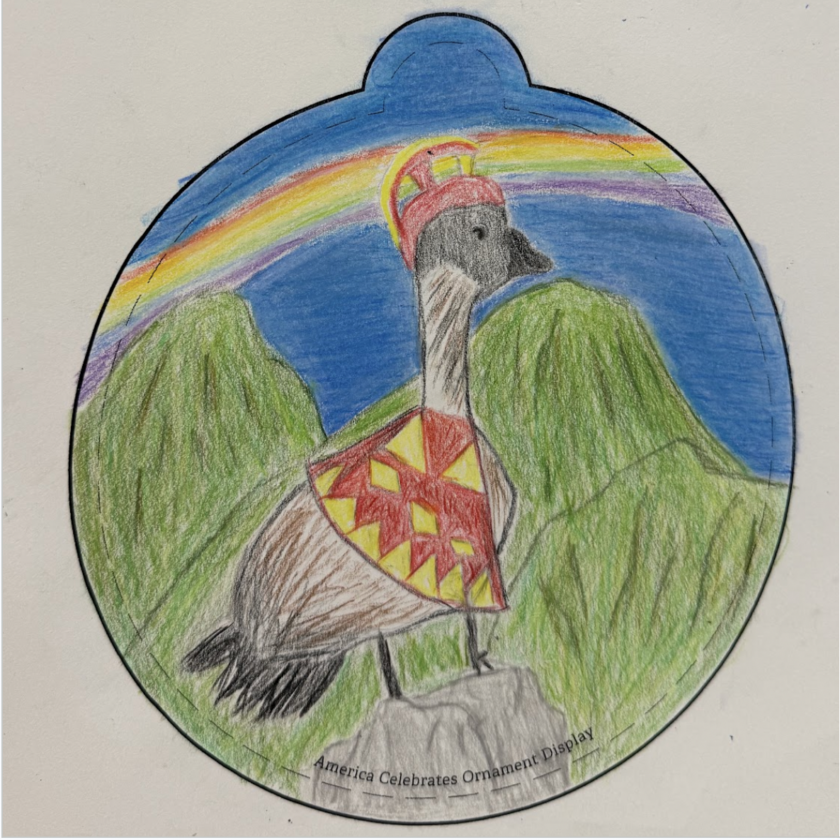
Peyton Klask, 13 yrs, Some things that inspired me to design my Hawaiʻi ornament are the Nēnē goose and Hawaiʻi’s beautiful scenery. The Nēnē goose is an endemic and endangered animal in Hawaiʻi and is also the official state bird. I drew it wearing traditional Hawaiian clothing, the ʻahu ʻula and the mahiole, which represent high status and Hawaiian royalty. Hawaiʻi’s mountains and valleys are also important because they remind us of our ʻāina, which means having a sacred relationship with and caring for the land. I also drew a rainbow because in Hawaiian belief, rainbows, or ānuenue, represent a connection to the gods and a path between heaven and earth.
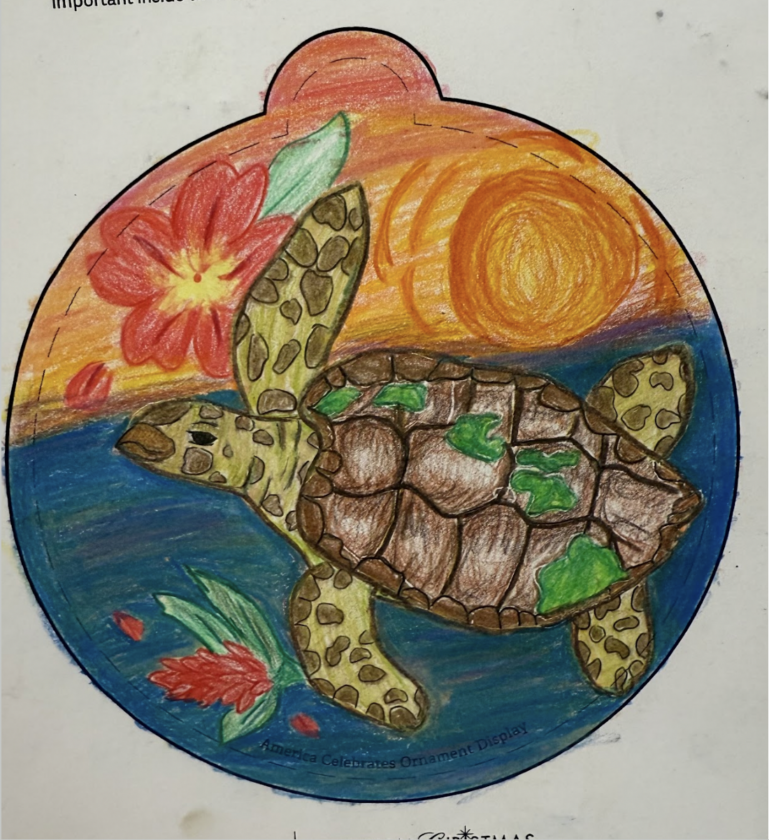
Amerie Otake, 13 yrs, There are many things in Hawaiʻi that inspired me to draw the Hawaiian turtle, or Honu, because it represents the beauty of Hawaiʻi. In Hawaiʻi, the Honu is believed to be a symbol of good luck and long life. It is also seen as a sacred guardian for the people of Hawaiʻi. That is why I drew the Hawaiian Islands on the turtle’s back, to show the Honu protecting the islands. I also added plumeria flowers because they represent the spirit of aloha, love, beauty, and positivity. I included a sunset in the background because Hawaiʻi sunsets are beautiful and make the islands special.
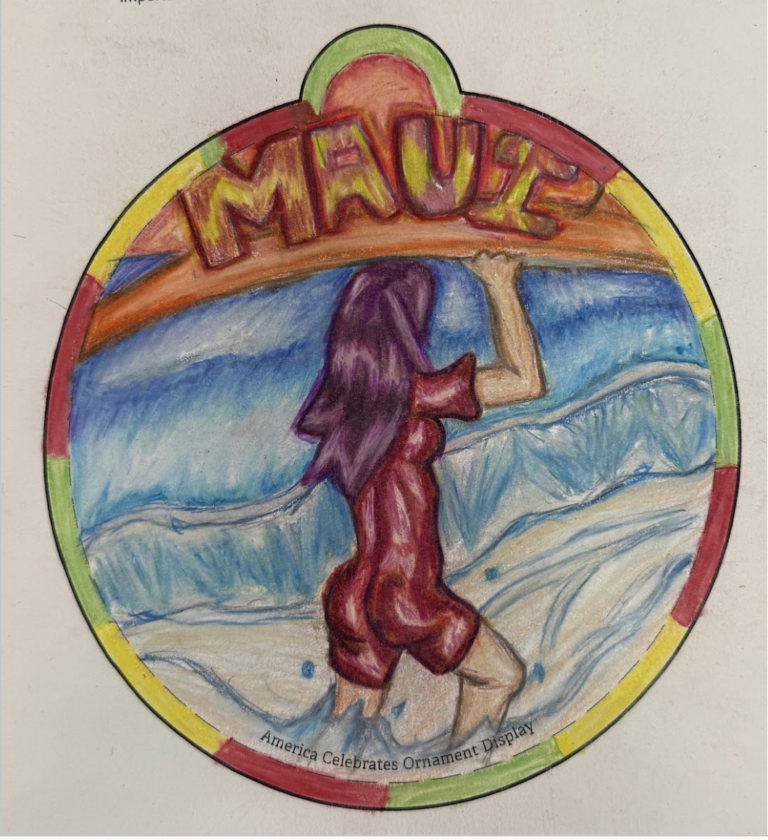
Zalia Santos Bras, 12 yrs, My drawing is based on my love for surfing and honoring our waterman, Duke Kahanamoku. Duke was an important figure in Hawaiʻi who had a deep passion for the ocean and always showed aloha to others. In 1925, he saved 8 people from drowning in strong waves. I created this project to show his aloha spirit and how important surfing is in Hawaiʻi. The side pattern represents Native Hawaiian heritage through the colors yellow, red, and green. The bold word “Maui” represents my home island, the Valley Isle, and my connection to it.
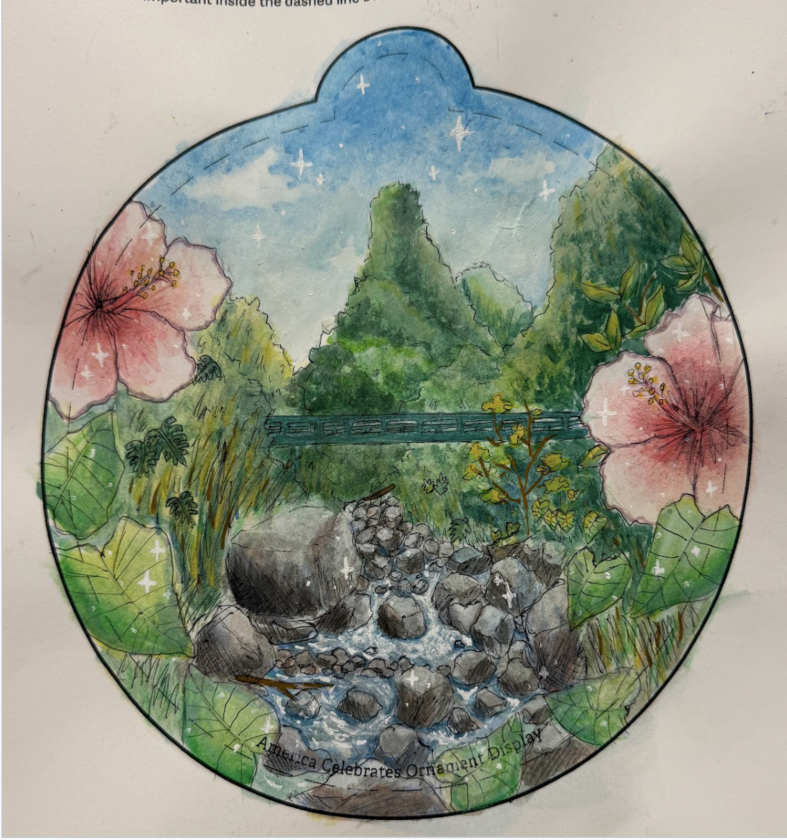
Kitana Takamura, 13 yrs, The ornament I made is of ʻĪao Valley on the island of Maui. This place is very sacred and important to the history of Hawaiʻi. In ʻĪao Valley, there was a battle called Kepaniwai, which is one of the most important battles in Hawaiian history because it helped unite the Hawaiian Islands. Around ʻĪao Valley, I drew kalo plants because kalo is one of the most important crops in Hawaiʻi. It is used in many dishes and also for medicinal purposes. I also included hibiscus flowers because the state flower of Hawaiʻi is the yellow hibiscus. I colored them pink because pink is the color most associated with Maui.
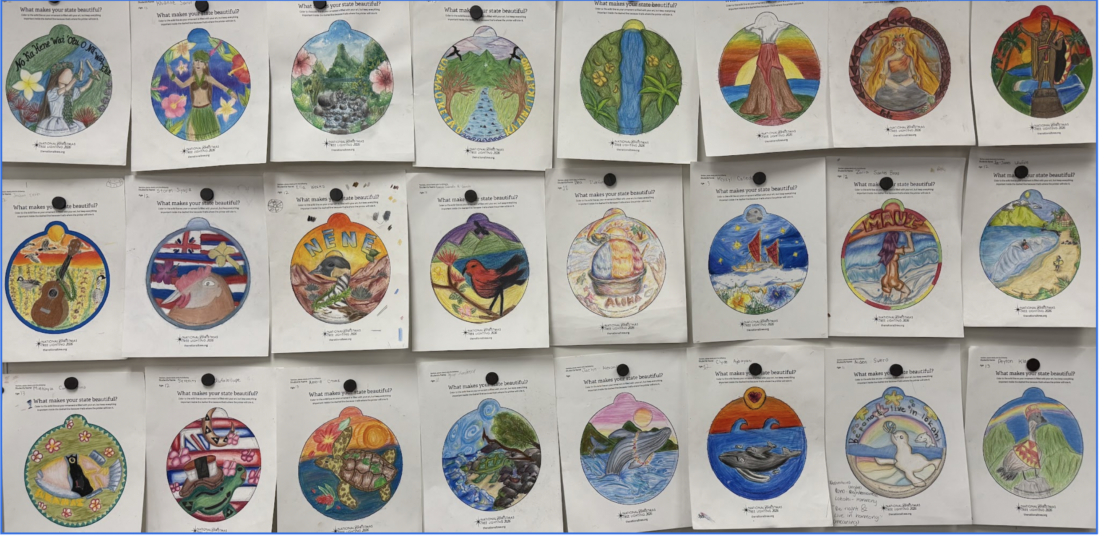
Ornaments from Maui Waena Intermediate School to bedeck the Whitehouse in D.C.
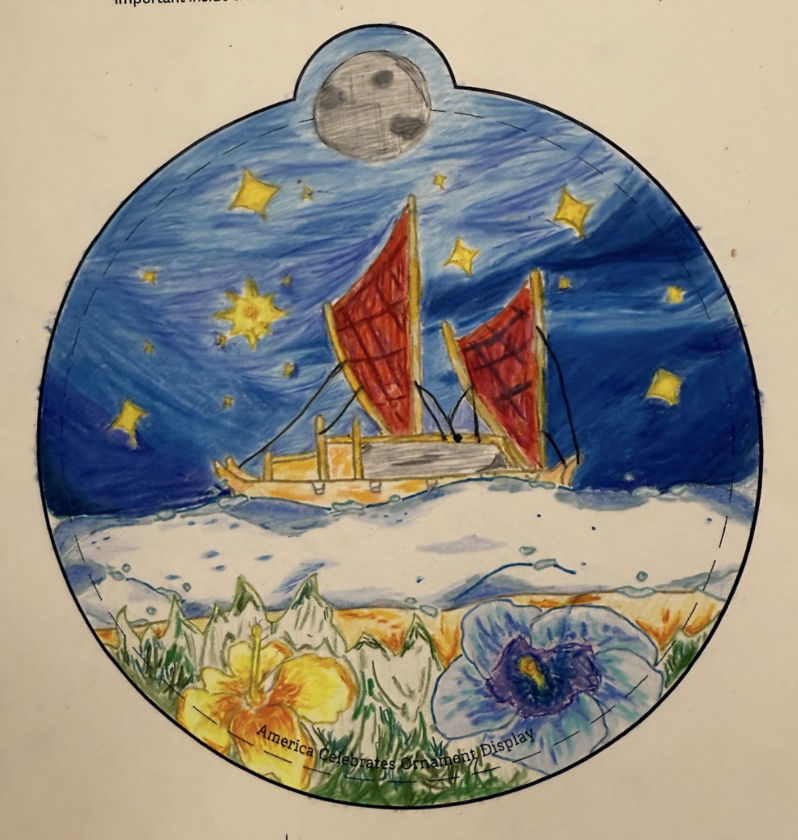
Mcxzyl Calleda, 13 yrs, I drew a Hōkūleʻa with native flowers. I was inspired by the Hōkūleʻa because, in Hawaiian history, it traveled to Tahiti and proved that ancient Polynesians deliberately settled Hawaiʻi using non-instrument navigation. This means they traveled without any modern navigation tools. I think this shows how people can overcome hard challenges with knowledge, courage, and determination. I made this art because the Hōkūleʻa is important to Hawaiʻi. It is a symbol of the Hawaiian Cultural Renaissance, especially for non-instrument navigation and traditional canoe building.
Jaycee Neriah Mendoza, 12yrs, I came up with my design by thinking about animals that are often seen at the beaches of Hawaiʻi, especially sea turtles. My drawing shows Maluaka Beach, also known as Turtle Town in Maui, a place I remember visiting many times to swim and see turtles in the ocean. Maluaka Beach is known for its natural beauty and as a resting place for turtles. The turtles are protected, and it is illegal to touch them. I drew the turtle eating a moon jellyfish because turtles really do eat jellyfish, and moon jellyfish can be found in Maui. I also added a coconut bowl for creativity, showing the honu enjoying its meal.
Talia Tiale Crespin-Tufaga 12 yrs, I drew the Hawaiian goddess Pele because the legends about her in Hawaiian mythology are very beautiful and powerful. I was inspired by stories about how she became connected to volcanoes, how she turned her ex-lover into a lehua tree, and the curse she placed on her “children,” the rocks. These legends show how strong and important she is in Hawaiian culture. I drew her hair as a volcano with lava flowing out and gave her a lei poʻo made of lehua flowers. I used a red border because red represents her bold, fiery, and passionate personality. She is also wearing a lavalava that connects to the volcano she lives in.
Jaiden Ceria, 12 yrs., My art represents the “beauty of Hawaiʻi” by showing just a small part of Hawaiʻi’s nature. I included the yellow hibiscus because it plays an important role in Hawaiian history and culture. It represents royalty, power, and aloha. It was chosen as the state flower in 1988 to honor a rare native species. I also drew the nēnē goose, Hawaiʻi’s state bird, because it is beautiful and important to Hawaiian culture. It once nearly went extinct, but now there are over 3,000 today, even though it is still endangered. The main focus of my art is the ukulele, Hawaiʻi’s state musical instrument, which represents aloha, storytelling, and culture.
Jaclyn Alexander, 11 yrs, Many ideas came to my mind when I first heard about this project, but I chose to draw a mother and baby whale to show how caring and supportive Hawaiʻi can be. It is not everywhere that you see this kind of love and help, especially during difficult times. I also included a lei to represent how welcoming Hawaiʻi is. A lei is often given to celebrate achievements or to welcome visitors, and it shows respect and aloha. For the background, I drew mountains because Hawaiʻi has many beautiful mountain ranges. I find it peaceful and calming to wake up and see the mountains every day.
Aiden Sureo, 11 yrs, Many ideas inspired me for my Hawaiʻi ornament, but one main idea came to mind. I chose the Hawaiian monk seal because it represents cultural heritage and ecological health in Hawaiʻi. The volleyball the seal is playing with represents cultural identity because volleyball is a big part of life in Hawaiʻi, and some people even call Hawaiʻi the “Volleyball State.” I also added a rainbow sunset because it represents hope and change, and Hawaiʻi is known as the “Rainbow State.” The words “Be pono & live in lokahi” mean “be right and live in harmony.” Pono means doing what is right, and lokahi means living in balance with yourself, others, and the environment.
Joe-James Ulufale, 12 yrs, A lot of ideas inspired me to create my Hawaiʻi ornament. One idea I included was a person bodyboarding at the beach because when you go to the beach in Hawaiʻi, you often see people surfing and bodyboarding. I also added it because I like bodyboarding with my friends when I go to the beach. Another idea I included was Lahaina in the background. I added it because from the beaches in Kihei, Maui, you can see Lahaina in the distance. Overall, my ornament shows parts of Hawaiʻi that connect to beach life, fun activities, and the places I see around me.
Bea Ildefonso, 11 yrs, My ornament idea was inspired by a Hawaiian beach scene because Hawaiʻi has many beautiful tropical beaches. To match this setting, I added shave ice, a sweet treat with colorful flavors and a Hawaiian history, because it fits the tropical environment. I colored it with bright shades to show the variety of flavors, and I added a hand reaching for it to show how popular it is. In the background, I drew the humuhumunukunukuāpuaʻa, Hawaiʻi’s state fish, jumping out of the ocean with a rainbow behind it. On the sand, I added turtles, seashells, and the word “Aloha” to show kindness and love. I also included an island, rocks, and a sunset to represent Hawaiʻi’s natural beauty.
Ella Weeks, 12 yrs, Tons of things have inspired me to draw my Hawaiʻi ornament. Up front and center is the Nēnē goose because it is Hawaiʻi’s state bird and is endemic to the islands. I drew it wearing a ti leaf lei, which is like a necklace or garland. Leis can be made from shells, flowers, or leaves, and they often represent love, friendship, or peace. The background shows Haleakalā, an inactive volcano, with a sunset shining over the mountain range. I added the sunset because its vibrant colors match the landscape. In that area you can also find Nēnē and silverswords. Silverswords grow on volcano slopes, survive tough conditions, and bloom once before dying.
Cody Rico, 12 yrs, Some things inspired me when creating my Hawaiian ornament. I was first inspired by King Kamehameha I, who united all the Hawaiian Islands into one kingdom and is known as a strong and important leader in Hawaiian history. I included his statue in my design because it represent leadership, Hawaiian pride, and his role in creating the “Law of the Splintered Paddle,” which protected people’s safety. I also added a sunset because Hawaiʻi is known for its beautiful sunsets over the Pacific Ocean. Lastly, I included palm trees, especially the niu (coconut tree), which symbolizes life and resilience and was very important in early Hawaiian life for food, shelter, and materials.
Storm Siyuja, 12 yrs, For my ornament, I didn’t have many ideas at first, but I eventually chose different things that represent Hawaiʻi. I included a chicken because in Hawaiʻi, chickens are commonly seen around the islands and are part of local everyday life. I also added the Hawaiian flag in the background because it represents Hawaiian culture and history. I drew a puakenikeni flower because it is often used to make leis and jewelry, and it is a popular flower in Hawaiʻi. Lastly, I included the hibiscus flower because people like to wear it, take pictures with it, and it represents the beauty of Hawaiʻi.
Julynn Sylvester, 12 yrs, In my ornament, I included several things that represent Hawaiʻi. First, the volcano is inspired by the many volcanoes that formed the Hawaiian Islands. Second, the colorful sunset represents the bright and beautiful colors found in Hawaiʻi’s natural environment. Lastly, the large sun symbolizes the joyful and energetic vibes of the islands. Overall, my ornament shows the unique and rare beauty of Hawaiʻi and the natural features that make it so special.
Juliann Palpallatoc, 12 yrs, In my ornament, there are many symbols that show the beauty of Hawaiʻi. The hula dancer is performing kahiko hula, the traditional style of hula that includes chanting and using an ipu for rhythm. The words above the dancer say, “No Ka Hene Wai ʻOlu O Nā Wai ʻEhā,” which means “the peaceful waters of the four waters,” referring to the streams of Waikapū, Wailuku, Waiehu, and Waiheʻe. The red lehua flowers at the bottom are from the Big Island and represent endurance, love, resilience, and rebirth. I also included plumeria flowers, which symbolize love, beauty, grace, and the spirit of aloha. The purple crown flowers represent royalty, respect, and remembrance, and are connected to Queen Liliʻuokalani.
Faith Vinoray, 12 yrs, There are many things that symbolize Hawaiʻi, and some of them inspired me to create my Hawaiʻi ornament. First, my ornament includes a flowing waterfall, which represents the freshwater and natural beauty of the land. Second, I added flowers inspired by the state flower, the yellow hibiscus, which symbolizes sunshine, joy, and good luck. Lastly, I drew a lush green mountain in the background to show the beautiful landscapes and hills of Hawaiʻi. These elements helped me feel inspired and made my ornament more meaningful and unique while showing the natural beauty of Hawaiʻi.
Clyde Agbayani, 12 yrs, When I was thinking about my ornament, I thought of my mother and me, so I decided to focus on humpback whales. Humpback whales represent protection, strength, and a deep connection to the ocean. They also represent ʻohana and the love between a mother whale and her calf. These whales migrate about 3,000 miles from Alaska to Hawaiʻi, especially around Maui, where the warm, shallow waters help protect their babies. They stay in Hawaiʻi from October to May, with peak season from January to March. They mainly eat krill and small fish. To protect our koholā, we need to reduce threats like fishing gear, ship strikes, and climate change.
Serenity-Jordyn Puli-Ulufaleilupe, 12 yrs, The main focus of my ornament is the honu (turtle) because it represents good luck and protection from evil spirits. The black spear-like markings on the honu also symbolize long-lasting protection. On the honu’s shell, I added a musubi design because it is very popular and “onolicious” in Hawaiʻi. Around the ornament and on the honu’s head, I included Hawaiʻi’s state flower, the hibiscus, which represents the beauty of Hawaiʻi. At the top is a makau (Hawaiian fishhook), which symbolizes strength, good fortune, and protection. The makau and honu are connected through the ocean and their cultural meanings. In the background is the Hawaiʻi state flag, representing the history of the islands.
Mariah Jahnelle R. Garcia, 12 yrs, I created this design of an ʻApapane bird because I find it very special. The ʻApapane is native to Hawaiʻi and plays an important role in helping to pollinate ʻōhiʻa forests, which helps the ecosystem stay healthy. I also like the bird because of its bright crimson red color, which is beautiful and stands out in nature. In Hawaiian culture, this red color is also linked to nobility because its feathers were once used in traditional Hawaiian featherwork. I wanted my design to show both the importance of the ʻApapane and its connection to Hawaiian culture and nature.
Aissa-Mae Reinhardt, 13 yrs, I love Hawai‘i, and all the beautiful and meaningful things about it. But what I love most, is the lovely green mountains of Maui, West Maui mountains, also known as Mauna Kahālāwai, which means “meeting of the waters” because of Maui’s 4 major rivers, which is important to the people on Maui. And deep within the mountains is ‘Īao valley, which also is a sacred battle ground from many years ago. The Iwa birds, which is Hawai‘i’s native bird, symbolize Guidance and Pathway. The trees that I drew represent’s the big lush trees of Hawai‘i, and the roots of its people — connecting to our Hawaiian culture and spirit. I also wrote — Ua Mau ke Ea o ka ʻĀina i ka Pono — that means “The life of the land is perpetuated in righteousness,” and to do what is right to the people and the land.
Rhianne Sarol, 13 yrs, When I thought about what to create for my ornament, I was inspired to draw a hula dancer because hula is an important part of Hawaiian culture in Maui. Hula is a traditional dance that tells stories and shares Hawaiian values through movement and music. I added flowers in the background because they represent Maui’s beauty, peace, strength, and love. Lastly, I used a blue and purple gradient for the background to represent the beautiful waterfalls we have in Maui, especially in Hāna. This helped me show the culture and natural beauty of Hawaiʻi in my ornament.
Miekayla Constantino, 13 yrs, I chose Hawaiʻi’s state fish because I was inspired by what we learned in Hawaiian Studies. I drew the humuhumunukunukuāpuaʻa, also known as the reef triggerfish. It has been Hawaiʻi’s state fish since 1984 and shows the beautiful ocean life around the Hawaiian Islands. It is often seen near Maui’s Black Rock. I surrounded it with plumeria flowers because they represent love, beauty, grace, and the spirit of aloha. I also added the word “Akahai” under my drawing because it means kindness, which is an important value that many people in Hawaiʻi live by.
Peyton Klask, 13 yrs, Some things that inspired me to design my Hawaiʻi ornament are the Nēnē goose and Hawaiʻi’s beautiful scenery. The Nēnē goose is an endemic and endangered animal in Hawaiʻi and is also the official state bird. I drew it wearing traditional Hawaiian clothing, the ʻahu ʻula and the mahiole, which represent high status and Hawaiian royalty. Hawaiʻi’s mountains and valleys are also important because they remind us of our ʻāina, which means having a sacred relationship with and caring for the land. I also drew a rainbow because in Hawaiian belief, rainbows, or ānuenue, represent a connection to the gods and a path between heaven and earth.
Amerie Otake, 13 yrs, There are many things in Hawaiʻi that inspired me to draw the Hawaiian turtle, or Honu, because it represents the beauty of Hawaiʻi. In Hawaiʻi, the Honu is believed to be a symbol of good luck and long life. It is also seen as a sacred guardian for the people of Hawaiʻi. That is why I drew the Hawaiian Islands on the turtle’s back, to show the Honu protecting the islands. I also added plumeria flowers because they represent the spirit of aloha, love, beauty, and positivity. I included a sunset in the background because Hawaiʻi sunsets are beautiful and make the islands special.
Zalia Santos Bras, 12 yrs, My drawing is based on my love for surfing and honoring our waterman, Duke Kahanamoku. Duke was an important figure in Hawaiʻi who had a deep passion for the ocean and always showed aloha to others. In 1925, he saved 8 people from drowning in strong waves. I created this project to show his aloha spirit and how important surfing is in Hawaiʻi. The side pattern represents Native Hawaiian heritage through the colors yellow, red, and green. The bold word “Maui” represents my home island, the Valley Isle, and my connection to it.
Kitana Takamura, 13 yrs, The ornament I made is of ʻĪao Valley on the island of Maui. This place is very sacred and important to the history of Hawaiʻi. In ʻĪao Valley, there was a battle called Kepaniwai, which is one of the most important battles in Hawaiian history because it helped unite the Hawaiian Islands. Around ʻĪao Valley, I drew kalo plants because kalo is one of the most important crops in Hawaiʻi. It is used in many dishes and also for medicinal purposes. I also included hibiscus flowers because the state flower of Hawaiʻi is the yellow hibiscus. I colored them pink because pink is the color most associated with Maui.
Ornaments from Maui Waena Intermediate School to bedeck the Whitehouse in D.C.
Mcxzyl Calleda, 13 yrs, I drew a Hōkūleʻa with native flowers. I was inspired by the Hōkūleʻa because, in Hawaiian history, it traveled to Tahiti and proved that ancient Polynesians deliberately settled Hawaiʻi using non-instrument navigation. This means they traveled without any modern navigation tools. I think this shows how people can overcome hard challenges with knowledge, courage, and determination. I made this art because the Hōkūleʻa is important to Hawaiʻi. It is a symbol of the Hawaiian Cultural Renaissance, especially for non-instrument navigation and traditional canoe building.
Trending
Artwork by students at Maui Waena Intermediate School will represent Hawaiʻi in the 2026 National Christmas Tree display in Washington, D.C.
The students' original ornaments will decorate Hawaiʻi's tree alongside the National Christmas Tree in President's Park, near the White House. The annual holiday display features 58 trees representing U.S. states, territories and participating federal education communities, with ornaments created by K-12 students to reflect their communities' cultures, histories and identities.
Maui Waena students created ornaments inspired by Hawaiʻi's culture, landmarks and history, bringing elements of the islands to the nation's capital.
"This project gave students a powerful opportunity to express their pride in Hawaiʻi while understanding that art can preserve stories, honor tradition, and create meaningful connections across communities," said Rachel Shin, the school's art teacher.
The display is free and open to the public in Washington, D.C. Images of the student ornaments are available at www.thenationaltree.org/ornaments.