
Presiding Bishop Rowe to visit Lahaina
Trending
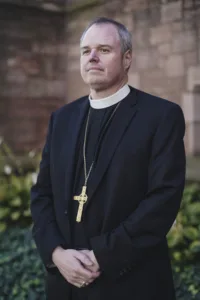
The Most Rev. Sean Walter Rowe, the 28th presiding bishop and primate of the Episcopal Church in the United States, plans to celebrate the Eucharist Nov. 15 at the site of Holy Innocents Church, whose buildings were destroyed in the 2023 Lahaina wildfire.
The service will take place at the church site under a tent with chairs.
Rowe also will travel to St. Andrew's Cathedral in Honolulu to preside over the ordination and consecration of Elizabeth "Libby" Berman as the new bishop of the Episcopal Diocese of Hawaii on Nov. 14.
Berman, who will succeed Bishop Robert Fitzpatrick, will become the first woman to serve as bishop of the Episcopal Diocese of Hawaii.
The church is facing some major decisions about the future of Holy Innocents Church and its parishioners.
Sunday services
The Holy Innocents Church congregation currently holds worship at the Honolua United Methodist Church in Napili at 8 a.m. on Sundays. Holy Innocents Deacon Kalani Holokai said the United Methodist congregation has been generous.
"We are grateful for their continued support and feel immensely blessed to have a place to worship," Holokai said.
The duties of the church are shared with the Rev. Amy Crowe, Vicar of Trinity Episcopal Church by-the-Sea in Kihei, and the combined Holy Innocents Episcopal Church community.
"Both Amy and I take turns leading worship one Sunday a month with Holy Innocents in Napili," Holokai said. "Other Sundays are covered by worship leaders and supply clergy."
Wildfire destroyed church, other buildings
The 2023 fire destroyed all the buildings at Holy Innocents, including the preschool, office and the church, but the church sign portraying the Madonna and child had little damage and was recently repaired, church officials said.
Officials were also able to recover the metal cross at the top of the church and a piece of stained glass window above the doorway.
What remains are loyal parishioners and more than 160 years of history that has helped shape Maui, including its educational institutions like Seabury Hall in Makawao and St. Andrew's Schools and Iolani School on Oahu.
During his three years at Iolani School and a semester at Punahou School, Chinese immigrant Sun Yat-sen was introduced to Christianity and democratic principles that he used to overthrow the Qing Dynasty to become the first provisional president of the Chinese Republic in 1912.
Still serving as a reminder of a once thriving Chinese immigrant community in Kula is an abandoned reservoir on the former ranch owned by Sun's brother and the hall of the Kwock Hing Society whose members supported the revolution.
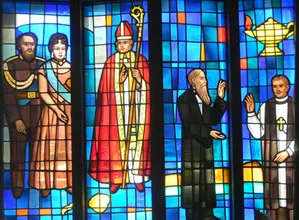
A stained-glass window at St. Andrew's Cathedral in Honolulu depicts Anglican Bishop Thomas N. Staley, King Kamehameha IV and his wife, Queen Emma, who supported the establishment of the Anglican mission in Hawaii in 1862. The church later came under the jurisdiction of the Episcopal Church following the overthrow of the Hawaiian monarchy and the annexation of Hawaii in 1898. At right are Sanford Dole, first governor of the Territory of Hawaii, and Henry Restarick, the first Episcopal bishop of Hawaii. Photo courtesy Episcopal Church of Hawaii
Monarchy invited mission to Hawaii
The Anglican Church of England was invited to establish a mission in Hawaii at the invitation of King Kamehameha IV and Queen Emma.
King Kamehameha IV offered land and money to the church to allow Hawaiians to maintain their identity, amid rising tensions with European and North American planters.
England's Queen Victoria granted a license to establish the church in 1861, leading to the arrival of Bishop Thomas Staley in October 1862.
The first church building for Holy Innocents was built in 1872, and a new sanctuary building was completed in 1927.
Upon the overthrow of the Hawaiian monarchy in 1893 and Hawaii's annexation by the United States in 1898, support from the Church of England was withdrawn and jurisdiction passed to the Episcopal Church in the United States.
Edward Lani Hanchett became the first Native Hawaiian bishop of Hawaii, serving from 1969 to 1975.
Bishop Hanchett, as a newly ordained deacon in 1952, served at Holy Innocents in Lahaina before being ordained a priest in 1953. He served at Holy Innocents until 1959 when he was called to St. George's on Oahu.
A bishop of the Hawaii church from 1976 to 1985, Edmund Browning became the presiding bishop of the Episcopal Church from 1985 to 1997, ushering in social changes, proclaiming: "This church of ours is open to all -- there will be no outcasts."
During his tenure, the Episcopal Church took a pro-choice stance on abortion, championed female priests and started the conversation about full inclusion for gay individuals.
The Episcopal Church later sanctioned same-sex marriage and codified it in 2015.
Holy Innocents future plans on hold
Holokai said Holy Innocents is now part of Trinity By The Sea in Kihei, and the Rev. Amy Crowe is now vicar of Trinity and Holy Innocents
The Episcopal Diocese said rebuilding at the former historic site will depend on several factors and their rebuilding task force is facilitating that conversation with the diocese.
Holokai said Holy Innocents doesn't have a timeline for rebuilding the church.
"There are restrictions such as the erosion hazard lines that have created a setback as well as a seawall certification that must be addressed before rebuilding," Holokai said.