
Tale of the athletic tape
MIL’s athletic trainers involved in many facets of student-athletes’ health and well-being

King Kekaulike High School athletic trainers tend to an injured player during the first half of Na Alii’s football game against Lahainaluna on Saturday at King Kekaulike Stadium. The Maui News / MATTHEW THAYER photos
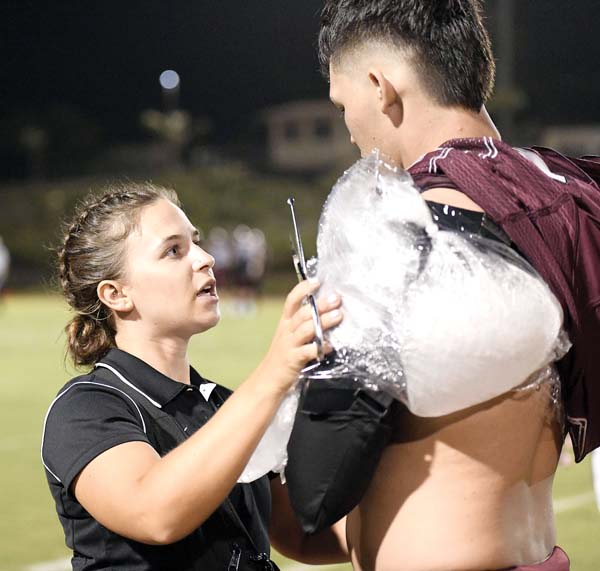
Baldwin athletic trainer Kendra Anderson ices a player’s shoulder during the Bears’ game against Edison (Calif.) earlier this month.
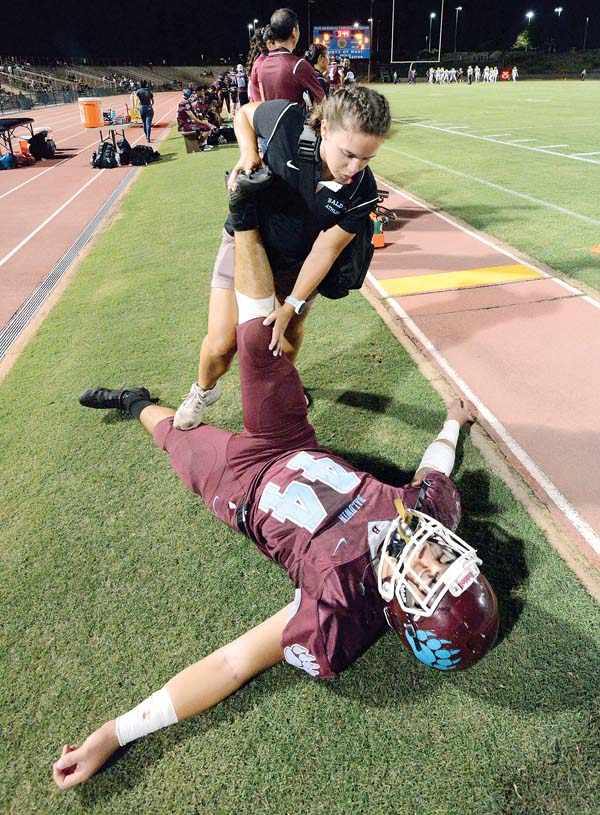
Baldwin athletic trainer Kendra Anderson stretches a player’s leg.
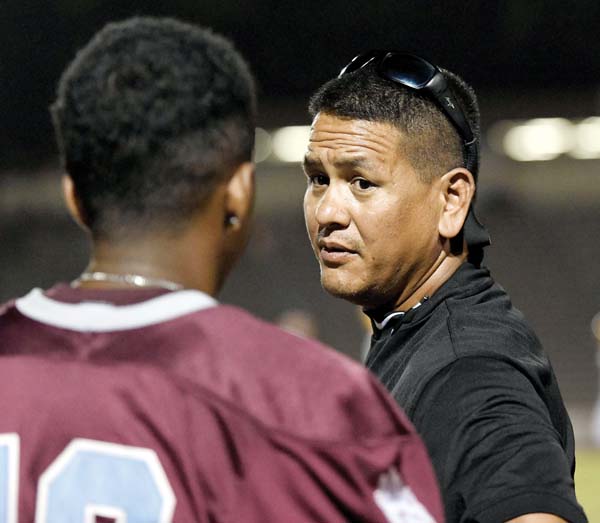
Bears athletic trainer Scott Pagdilao talks to a player.
King Kekaulike High School athletic trainers tend to an injured player during the first half of Na Alii’s football game against Lahainaluna on Saturday at King Kekaulike Stadium. The Maui News / MATTHEW THAYER photos
Baldwin athletic trainer Kendra Anderson ices a player’s shoulder during the Bears’ game against Edison (Calif.) earlier this month.
Baldwin athletic trainer Kendra Anderson stretches a player’s leg.
Bears athletic trainer Scott Pagdilao talks to a player.
Trending
As the high school sports year gets underway, much of the focus is on the hard-charging student-athletes who push their bodies to the limit.
Much less heralded are the people responsible for ensuring their health and tending to their injuries.
There are only 16 athletic trainers across the Maui Interscholastic League, and it's their job to balance several responsibilities when it comes to players' health, which is why they stress the importance of communicating with coaches, school administration, families and doctors.
"I absolutely love my job, but sometimes it's disheartening that many people don't understand who we are and what we do," Lanai High School athletic trainer Alicia Bennett said. "Many people see us just slapping tape on athletes or wrapping ice on athletes, but what you are seeing is a very small facet of what we know and are capable of doing."
Athletic trainers focus on prevention, clinical evaluation and diagnosis of pain and injury. Additionally, they are professionally trained in immediate and emergency care, treatment and rehabilitation, and providing consultation of health and well-being of the athlete.
Since Bennet is the only athletic healthcare professional for Lanai High, she coordinates with trainers from Maui and Molokai to help Pine Lads and Lasses who are traveling for off-island competitions.
"Working on Lanai is unique. We are the only school on the island so there are no other athletic trainers I can collaborate with," she said. "We are always in communication with injuries and treatments with our athletes that are traveling back and forth."
According to the National Athletic Trainers' Association, athletic trainers are required to have an accredited bachelor's degree as well as additional certifications and clinical trainings. Seventy percent have a master's degree.
They also must complete all requirements to be registered and licensed in the state through the Department of Commerce and Consumer Affairs.
"It gives us a lot of latitude to do a lot because there's so much involved with preventing injuries and treating injuries because we're always the first ones there," said Seabury Hall athletic trainer Kevin Yamashiro, who is also the president of Maui County's Athletic Trainer Association. "Hawaii is a good place to work as an athletic trainer because every high school is required to have at least one, we're the only state in the country who does that."
On Aug. 5, prior to the fall athletics season, the Maui County Athletic Trainers' Association met to review material and equipment, learn new techniques and practice emergency care. They plan to meet again before the winter and spring seasons.
"Some of the things we focused on was the care for heat stroke and all the emergency care that goes into that," Yamashiro said. "There's a lot of new things where we have to measure core temperature. You have to rapidly cool the athlete and monitor their temperature before they are able to transport them to an ambulance."
Most schools also have an ambient air temperature device to accurately measure the heat and humidity. The data helps to determine whether it is safe for athletes to practice or compete at the given time.
Heat illness includes heat stroke, heat rash, heat cramps and heat exhaustion. Common symptoms are fatigue, headache, dizziness and confusion.
"Like concussions, heat illness is becoming a bigger issue, not just around the state, but across the country," he said. "We learn more about it, and now we have a really great protocol across the state on how to manage, recognize and treat concussions. Heat illness is the same thing, where we have to learn current treatment protocols.
"Also, educating everyone that we're working with, such as the EMS, coaches, parents, about all the steps we can do in case anything happens," he added.
For any medical injury, the athlete needs to be cleared through the MIL athletic training staff, even if an athlete is cleared by a physician or doctor.
Concussions, for example, requires an athlete to complete a seven-step process on a medical referral form before participating in practice or competition. Non-life-threatening concussions can take around two weeks to recover from.
"I don't know if we ATC want to say that we have the final say, we are just the ones that follow the seven-step process and at the end, we say return to play or follow up with your doctor for more study of your injuries," said Kamehameha Maui athletic trainer Charles Roggow.
Roggow was the first high school athletic trainer on the island, working at St. Anthony for 14 years before helping the Warriors for another 12 years. Maui High became the second school to hire an athletic trainer a couple years after Roggow's appearance in the field.
"Athletic training on Maui has changed so much," he said. "The need for trainers just sort of spread throughout the MIL."
Baldwin head football coach Pohai Lee knows that the Bears' athletic training staff do everything they can to make sure his players are healthy.
"Our athletic trainers, who is Scott Pagdilao and Kendra Anderson, they have a tough job," Lee said. "Anywhere from helping our players, communicating with the parents and coaches, and with other healthcare personnel."
With an injury-prone sport like football, it's especially important to educate parents, coaches and the players on the rehabilitation process, he said.
"We're constantly communicating with our players and staff about safety, sometimes it feels like a lot, but that's a good thing," Lee said. "The number one thing is, is that they always have the well-being of the athlete in mind."
MIL athletic training staff also engage in mentoring programs that help students who may be interested in a similar field of study.
At Maui High, the school's "College and Career Ready" mission involves school activities where students can learn more about their career interests, such as athletic training.
"Our athletic health care trainers play a huge role in the success of high school athletics," Sabers athletic director Mike Ban said. "Not only do they provide medical care for our student-athletes, they work in collaboration with coaches and administrators to provide preventative exercises, which includes educational opportunities and emergency action plans."
* Dakota Grossman is at dgrossman@mauinews.com.