
Newsom threatens California counties for failing to use his new mental health court
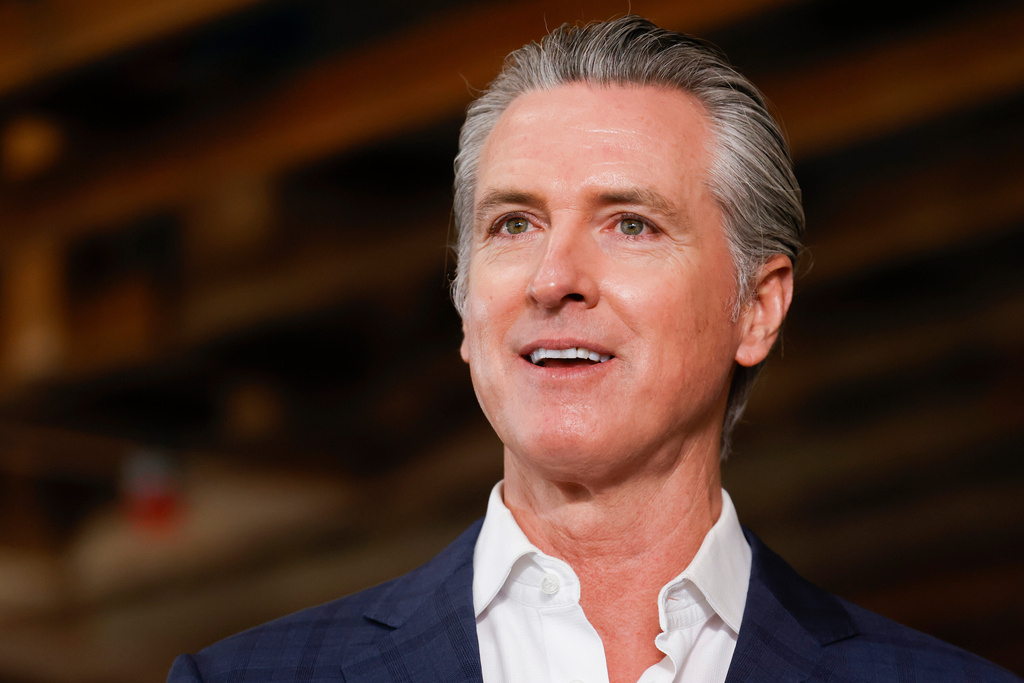
Governor Gavin Newsom speaks alongside local and state leaders during a press conference announcing new funding for communities across the state to address homelessness and mental health and stronger accountability measures for counties administering CARE Court during a press conference at BACS St. Regis Center in Hayward, Calif., Monday, March 2, 2026. (Jessica Christian/San Francisco Chronicle via AP)
Frustrated by the slow adoption of one of his signature efforts to get Californians with severe mental illness off the streets, Gov. Gavin Newsom on Monday threatened to take funding from counties he said aren’t doing enough.
Newsom called out 10 counties that he said are underperforming when it comes to CARE Court – a program he launched in 2023 that uses the courts to get people into mental health treatment. Counties that “haven’t gotten it done” in his view are: Los Angeles, Orange, San Francisco, Santa Clara, San Bernardino, Kern, Riverside, Yolo, Monterey and Fresno.
“I’m happy to redirect every damn penny in these programs to the counties that are getting things done, period, full stop,” Newsom said during a news conference. “Unless they stop doing what they’ve done. Don’t make any more excuses.”
Orange County was quick to dispute Newsom’s assertion that it was lagging on CARE Court. “Orange County is utilizing the CARE intervention fully,” the OC Health Care Agency, which leads mental health treatment for the county, said in an email to CalMatters.
CARE Court rolled out in eight counties at the end of 2023, and was adopted across the entire state by December 2024. The idea was to help some of the most vulnerable Californians – people who are in the grip of psychosis, languishing on sidewalks and unable to take care of themselves because all other treatment programs have failed them.
But a CalMatters investigation found CARE Court has served far fewer Californians than initially anticipated, and many families who had counted on the program to help loved ones with a severe mental illness have been disappointed. The program also has faced challenges in moving people off the streets and into housing, CalMatters found.
Through January, the state has received 3,817 petitions for care on behalf of someone with mental illness. The petitions can come from a person’s family, a first responder or a behavioral health provider. Judges have approved just 893 treatment agreements, Kim Johnson, secretary of the California Health and Human Services Agency, said during the news conference.
Judges have ordered 32 people into CARE plans, which can happen if a participant won’t agree to or doesn’t follow a voluntary treatment agreement.
Newsom’s administration initially estimated between 7,000 and 12,000 Californians would qualify for CARE Court.
More than 4,000 people were diverted away from the CARE program and got services in another way, Johnson said.
The governor also highlighted counties he said are doing a good job using CARE Court to connect people with treatment: Alameda, Humboldt, Santa Barbara, Tuolumne, Marin, Napa, Merced, Sutter, San Mateo and Imperial. He spoke from inside an under-construction wing of Regis Village in Alameda, a mental health campus that has, among other services, 44 beds prioritized for people in CARE Court.
“There are a number of counties that get it and are getting things done, proving it can be done when you have leadership that cares enough to get it done,” Newsom said.
The administration calculated the number of CARE Court petitions received per capita to determine success, dubbing the 10 counties with the highest number as “CARE champions,” and relegating the 10 with the lowest to the “CARE ICU.”
The administration also updated its public accountability website to include that metric for each county.
But that data doesn’t take other important measures into account, such as the number of CARE agreements reached in each county, the number of petitions that are dismissed without someone getting treatment, or the number of people who have graduated from CARE Court. San Diego County, for instance, didn’t make the “CARE champion” list, even though, as of last summer, it had the most graduations of any county in the state, with 10. Riverside, which was a close second with seven graduations, was on the governor’s “CARE ICU” list.
Newsom promised that counties on his “CARE ICU” list would get extra help through the state’s CARE Improvement and Coordination Unit. He didn’t specify what that help would look like, but said the state already is working with some communities to provide technical support and training.
San Francisco, which landed on Newsom’s “CARE ICU” list, welcomes support from the state to strengthen its CARE Court program, Charles Lutvak, a spokesman for Mayor Daniel Lurie, said in an email to CalMatters.
“Since day one, our administration has been using every tool in our toolbox to address the crisis on our streets — reimagining street outreach and adding recovery and treatment resources so we can get people off the street and connected to the support they need,” he said.
Orange County has received 231 CARE Court petitions and has 79 participants who have agreed to treatment and are receiving housing, medication and other services, according to the OC Health Care Agency.
“Orange County has utilized this effective treatment option for those adults who meet the requirements of the program itself,” the agency wrote in an email. “It’s not just about how many petitions you have, which we have the fifth highest in the state, it’s about the services provided helping change the trajectory of untreated disease.
Newsom didn’t specify specify what funding might be at risk in communities that don’t step up their CARE Court game. But he gave some ideas when he said new money would be going toward programs that can support CARE Court participants. That includes $131.8 million in Homekey+ awards, funded by Proposition 1, to create 443 homes for people who need substance use and mental health services. The administration also rolled out another $159 million in Homeless Housing, Assistance and Prevention dollars – part of the $1 billion allocated in the 2024-25 budget.
In highlighting counties that he says have made good use of state funds so far, the administration invited Alameda County Judge Sandra Bean, who oversees the county’s CARE Court program, to share success stories.
The judge described one woman who lives with a developmental disability, a substance use disorder and a significant mental illness, who now has her own apartment and is taking medication.
“We’ve had a number of people who have done really, really well,” she said.
___
This story was originally published by CalMatters and distributed through a partnership with The Associated Press.