
Your best bet for a pest-free Christmas tree is locally grown
KIA'I MOKU
Trending
By Dec. 3, near the end of the shipping season, 93,000 Christmas trees had arrived in Hawaii, according to Chris Kishimoto, Oahu-based entomologist with the state Department of Agriculture. The trees will be adorned with ornaments and shelter packages in time for Christmas, but the preparations to ensure the trees harbor no unwanted pests begins months earlier.
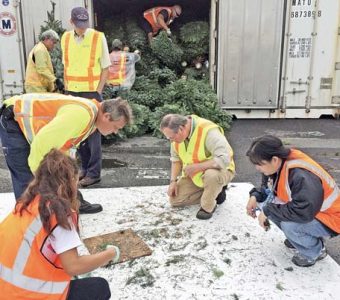
Most of the Christmas trees imported to Hawaii come from farms in Oregon, some from Washington. As fall starts to sweep across the Mainland, Kishimoto reaches out to the Christmas tree growers to see what kind of fall weather is happening -- a long, extended summer or cool and frosty. This helps him to determine how active potential hitchhiking pests may have been before the trees are cut. Inspectors from the Oregon Department of Agriculture (DOA) and Washington State Department of Agriculture (WSDA) inspect trees that are vigorously shaken over a light-colored barrier, such as a white tarp or sheet, looking for pests before they are loaded onto containers. The trees are then carried by train to California and loaded onto barges destined for Hawaii.
Every year, in the weeks before Christmas, 160 to 180 containers arrive after a two- to three-week voyage. The first stop is Honolulu, where Kishimoto and the state Department of Agriculture inspectors check the trees yet again. Department staff randomly select a few trees from each container, unwrap them, and give them a few shakes over white sheets for the second time. If what falls out should not be in Hawaii, the container is quarantined until the importer can have all trees subjected to an appropriate treatment, shipped out of state, or destroyed. If no pests are detected and everything is in compliance, the containers are released and sent to their final destinations.
In mid- to late December, Kishimoto talks with his colleagues in the Oregon and Washington agriculture departments to relay the various species that DOA detected. The partnering agencies and Christmas tree industry revise practices and standards based on the feedback.
Kishimoto thinks the efforts are effective. ìChristmas trees are not necessarily any higher risk than cut flowers or foliage,î he says. Ultimately, any time material is imported there is a risk a new plant or animal may slip through -- take for example the southern alligator lizard found atop a Christmas tree being carried home by a Hilo resident on the recent Thanksgiving weekend.
The best decoration for your home, regardless of the time of year, is the locally sourced option. Local purchases support local farmers, the material is fresh -- therefore, longer-lasting -- and won't be carrying a new pest to Hawaii. There are locally grown options for Christmas trees on Maui -- both from a Christmas tree farm in Kula as well as volunteer options to remove invasive pines. If you do find that your holiday decorations come bearing unwanted presents, capture the pest and report it, either through the statewide pest hotline: 643-PEST (7378), online: 643PEST.org, or Maui Plant Quarantine Office at 872-3848.
* Lissa Strohecker is the public relations and education specialist for the Maui Invasive Species Committee. She holds a biological sciences degree from Montana State University. ìKia'i Moku,î or ìGuarding the Island,î is prepared by the Maui Invasive Species Committee to provide information on protecting the island from invasive plants and animals that can threaten the island's environment, economy and quality of life.