
Maui Brand
The end of a sweet success story

Hawaiian Commercial & Sugar Co. crew member Mario Pisalvo lifts a 50-pound bag of Maui Brand sugar for Michael Fernandez at Puunene Mill. The Maui News / MATTHEW THAYER photo
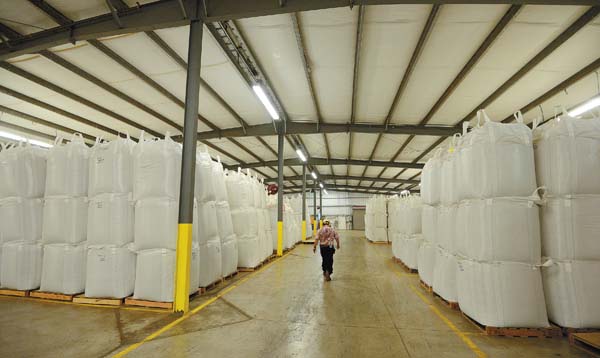
Robert Luuwai, vice president of factory operations, walks between stacks of 1-ton bags of Maui Brand sugar. The Maui News / MATTHEW THAYER photo
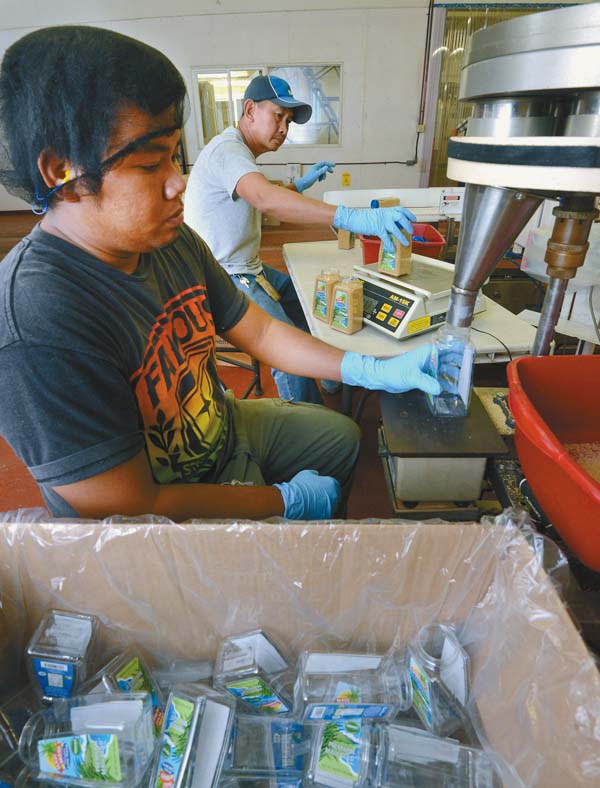
Vic Santiago (foreground) fills Maui Brand bottles while Ben Garduque weighs and seals them. The Maui News / MATTHEW THAYER photo
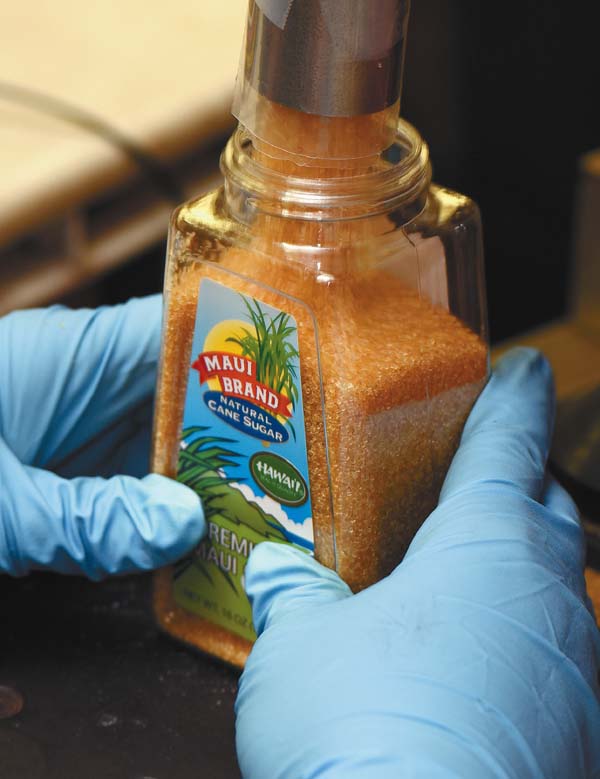
A 1-pound bottle of Maui Brand sugar (right) is filled at Puunene Mill. The Maui News / MATTHEW THAYER photo
Hawaiian Commercial & Sugar Co. crew member Mario Pisalvo lifts a 50-pound bag of Maui Brand sugar for Michael Fernandez at Puunene Mill. The Maui News / MATTHEW THAYER photo
Robert Luuwai, vice president of factory operations, walks between stacks of 1-ton bags of Maui Brand sugar. The Maui News / MATTHEW THAYER photo
Vic Santiago (foreground) fills Maui Brand bottles while Ben Garduque weighs and seals them. The Maui News / MATTHEW THAYER photo
A 1-pound bottle of Maui Brand sugar (right) is filled at Puunene Mill. The Maui News / MATTHEW THAYER photo
Trending
PUUNENE -- Large amber-colored sugar crystals pour into containers like glistening jewels carefully handled by Maui Brand workers at the Puunene Mill.
The label, owned by Hawaiian Commercial & Sugar Co., is well-known for its distinct appearance and natural taste, adding a richness to coffee and tea, as well as a robust flavor to baked goods. However, production of the natural cane sugar will come to an end in August as HC&S prepares for its final harvest later this year.
"It's going to be collector's items, all these (Maui Brand) bottles," said Robert Luuwai, vice president of factory operations, inside the facility.
Producing just over 1,000 tons of food-grade sugar in the late 1980s, Maui Brand produced around 25,000 tons at its peak around 2010, and currently pumps out roughly 12,000 to 15,000 tons. The sugar is used by thousands of restaurants and food and beverage companies, and is believed to be used by President Barack Obama.
"It's kind of neat, especially when we know it's on Air Force One," Luuwai said.
The company plans to fulfill orders until the end of the year.
Work on the brand began when Robert Kwok, a former vice president of manufacturing, arrived from Mauritius and had a "vision to make turbinado," or sugar from pure cane sugar extract, Luuwai said. The sugar gets its name from being spun in a cylinder or turbine to remove almost all of its molasses.
"When we started making it, this wasn't really a food-grade facility," Luuwai said. "(Kwok) made us put stainless steel on everything."
Kwok sought to use the company's raw sugar and manufacturer it for food companies, he said via email. He said that California and Hawaiian Sugar Co., which served as HC&S' marketing and refinery co-op company, could not make turbinado, so the idea was to make the sugar and have it packaged and sold under the C&H label.
HC&S eventually founded Maui Brand, which was spearheaded by Controller/Office Manager Lyle Wilkinson.
Walking around the facility, Luuwai opened a storage container containing samples of the company's two signature products: Turbinado and ECJ.
"It's a fancy way of calling (evaporated) cane juice," he said.
ECJ, which is white-colored as opposed to the brown turbinado, is used by food and beverage companies such as Hawaiian Sun and ITO EN. Small bakeries and Maui Upcountry Jams and Jellies use the sugar as well as Kona Queen Hawaii -- the world's leading producer of quality queen bees -- which feeds the sugar to its bees.
The turbinado is sold to manufacturer brands such as Sugar In The Raw.
"Sugar is one of the few foods that your body will process," Luuwai said. "It doesn't get stored. Too much sugar is no good, don't get me wrong, but it's one of the few calories that won't get stored in all your fat."
HC&S grinds sugar cane for nine months out of the year as opposed to places like Colombia and Louisiana, which only operate for three months, Luuwai said. He said that the longer cycle helps HC&S store enough material and volume to "feed customers all year long."
Manufacturing ECJ only occurs when there are "good, clean conditions," going from cane juice straight to crystal, Luuwai said. He said that the process cannot be done with unburned cane.
So what's the difference between C&H Sugar and Maui Brand?
The color, taste and size.
"The C&H brown sugar is dark and sticky," Luuwai said.
The C&H sugar is about 99.9 percent pure, while Maui Brand's turbinado is about 99.6 percent. The 0.4 percent being ash, molasses, moisture and other things.
Maui Brand boils molasses into the crystal, whereas other companies will typically paint the molasses on the outside.
"It adds a distinct flavor to it," he said. "I make teriyaki with this and have it with coffee and tea. There's a difference. . . . That's why I got to buy my last 10 bags before we shut down. It's gotta last me."
Another trick to identifying Maui Brand sugar is to check the bottom of the cup after drinking coffee or tea. If there are black specks at the bottom, then it is likely a different sugar company, Luuwai said.
"It's done through filtering," he said, noting the specks are bits of iron. "Sometimes stuff is so small it'll go through our filters, but we watch that constantly. We have really stringent standards, so when it comes like that we don't even produce it."
In terms of the size of its crystals, Maui Brand needed to extend its boiling time exponentially. Although Luuwai may not look the part of a scientist in his bluejeans, hard hat and aloha shirt, he and his predecessors helped engineer some of the largest sugar crystals in the world.
Sitting down at his desk, Luuwai grabs a pencil and folds over a calendar to sketch a line graph. He explains chemistry terms such as "super saturation curve" and "boiling-point elevation," which he says are the keys to growing the larger crystals.
Maui Brand's crystals are about 2 to 3 millimeters in size, or about two to three times the size of most sugar crystals. However, the process takes much longer; about 18 to 24 hours compared to three to four hours.
Workers must carefully monitor the sugar's boiling point when it's heating up. It is a delicate balance between temperature, pressure and density.
"You don't want to go too high too fast or it'll start crystalizing on its own," he said. "Boiling is not a science, it's an art; and these guys have a knack for it now."
Maui Brand's popularity steadily grew over the years and, by the turn of the century, HC&S had poured millions into expanding its facilities, including a separate plant for ECJ production. At its peak, the brand had nearly 20 workers trying to fulfill orders.
"We can't make enough of it at times" Luuwai said. "The customer base for raw sugar got so big we couldn't get enough of it and once in a while we would have production problems."
Shortly after building the facility and many others, the market began to dry up and the price of raw sugar dove, Luuwai said. Some of the pieces of equipment that had been purchased got little use and are for sale.
Lina Sandi, packaging crew chief for Maui Brand, is sad to see her job with the company coming to an end. She has been with HC&S for some 40 years, starting in the fields and moving into the facility when Maui Brand began.
"I really enjoyed my work and dealing with the bosses. Especially that guy, he is nice to me," Sandi said pointing to Luuwai.
"Don't say that just because this guy is here," he responded.
"No, honest. You know all the trouble that I've been through and you're always there for me," she said.
Luuwai, 56, has been with the company for about three decades and said that, with three of his five children in college, he will have to find another job. He said that the things he will miss most are his co-workers and helping to build Maui Brand into what it is today.
"The people is good. That's the best part," he said. "You get lifelong friends. That'll be the toughest. I mean we saw it coming with all this no-burn coming at us, it was just a matter of time."
Kwok, who worked for the company for 20 years, said that his fondest memories were working with the pan boilers and moving through the ranks of the company. He left the company in 2000 and now does consulting work for sugar companies around the world.
"The changes, improvements and innovations that I introduced to (HC&S) have made me well-known in the sugar industry worldwide," he said.
Maui Brand is currently selling 1-pound containers at HC&S for $4. The 50-pound and 100-pound bags used to be sold to the public at the mill, which was cheaper than Costco or Island Grocery Depot, but those are now available only to employees.
Michael Fernandez, manager of the agricultural service plow and utility section, was seen picking up a 50-pound bag of sugar for his sister. He said that she prefers it for baking, but they have not bought the brand in a few years.
"My nephew bought some to take back home to New York," Fernandez said, putting the bag over his shoulder. "You got to buy 'em now because they're going to shut down pretty soon."
* Chris Sugidono can be reached at csugidono@mauinews.com.
Originally published July 10, 2016