
Feeling the burn
The last harvest also means an end to cane burning

Fermin Domingo uses a propane torch to light small fires along the perimeter of a Hawaiian Commercial & Sugar Co. cane field. The Maui News / MATTHEW THAYER photo
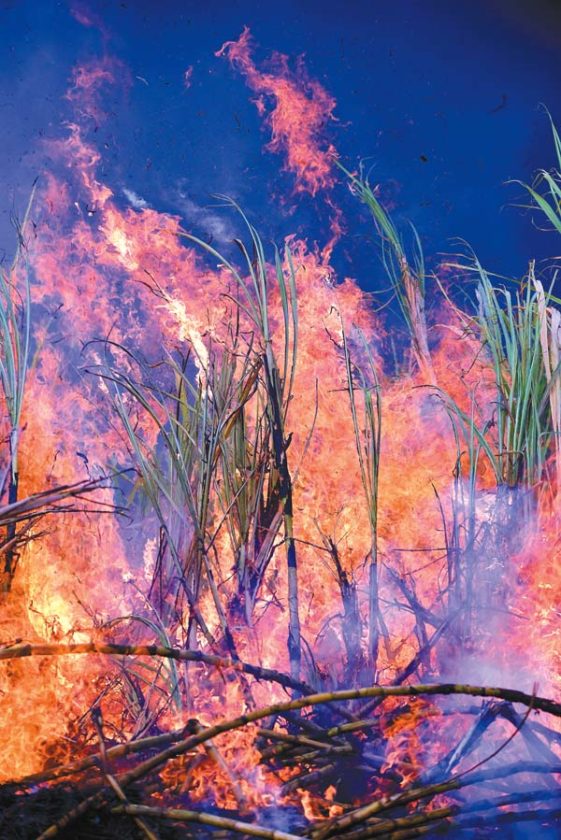
Flames crackle as fire engulfs a sugar cane field. The Maui News / MATTHEW THAYER photo
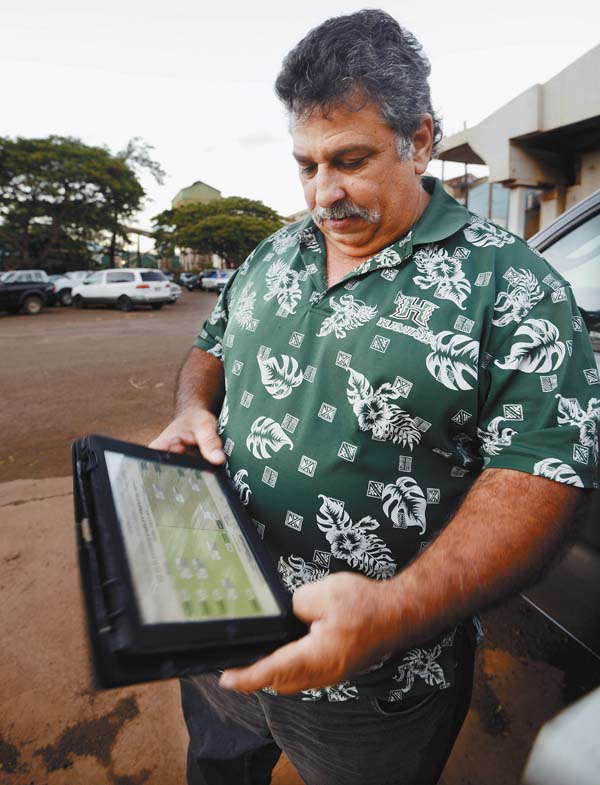
Harvesting Manager Mark Lopes checks the weather conditions before getting the go-ahead to light an August cane fire. The Maui News / MATTHEW THAYER photo
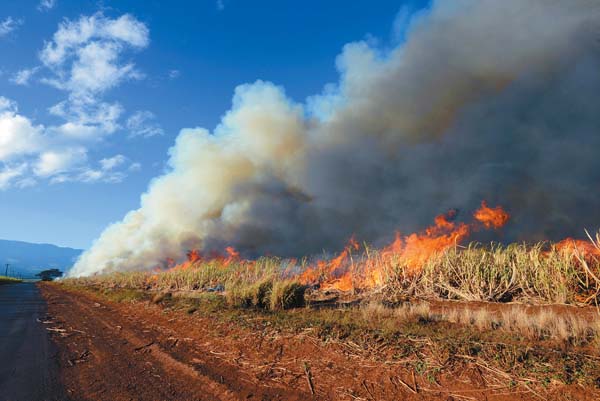
Flames and smoke rise from an HC&S field at the start of a burn. Breaks cut with bulldozers keep the fire from impacting cane-haul roads, power poles and irrigation pipes. The Maui News / MATTHEW THAYER photo
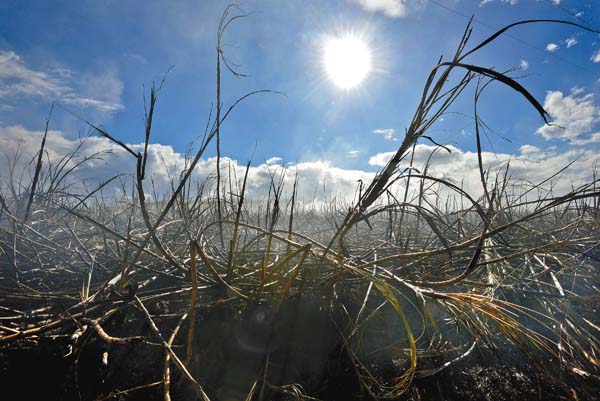
In less than an hour, a green sugar cane field is reduced to blackened stalks. The Maui News / MATTHEW THAYER photo
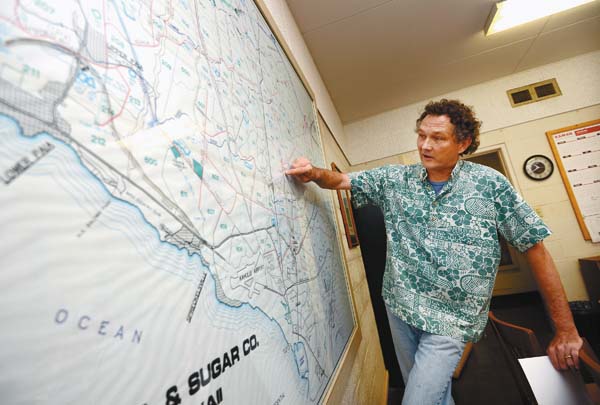
Alexander & Baldwin Director of Environmental Affairs Sean O’Keefe uses a map of the plantation to explain the different burn restrictions placed on fields that are near schools, highways or churches. The Maui News / MATTHEW THAYER photo
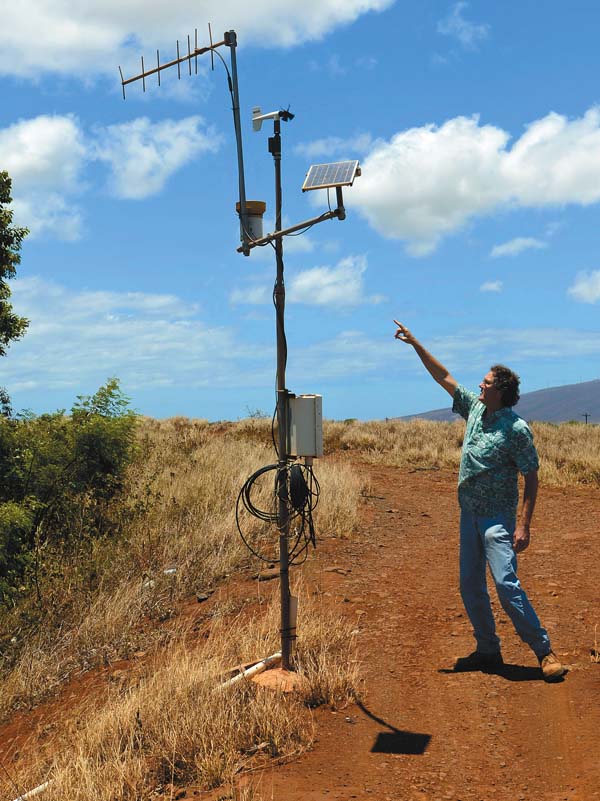
O’Keefe points out the features of one of the plantation’s weather monitoring stations. HC&S first installed a network of 10 weather stations in 1988 and began what was known then as “nowcasting” in support of its harvest operations, he said. The Maui News / MATTHEW THAYER photo
Fermin Domingo uses a propane torch to light small fires along the perimeter of a Hawaiian Commercial & Sugar Co. cane field. The Maui News / MATTHEW THAYER photo
Flames crackle as fire engulfs a sugar cane field. The Maui News / MATTHEW THAYER photo
Harvesting Manager Mark Lopes checks the weather conditions before getting the go-ahead to light an August cane fire. The Maui News / MATTHEW THAYER photo
Flames and smoke rise from an HC&S field at the start of a burn. Breaks cut with bulldozers keep the fire from impacting cane-haul roads, power poles and irrigation pipes. The Maui News / MATTHEW THAYER photo
In less than an hour, a green sugar cane field is reduced to blackened stalks. The Maui News / MATTHEW THAYER photo
Alexander & Baldwin Director of Environmental Affairs Sean O’Keefe uses a map of the plantation to explain the different burn restrictions placed on fields that are near schools, highways or churches. The Maui News / MATTHEW THAYER photo
O’Keefe points out the features of one of the plantation’s weather monitoring stations. HC&S first installed a network of 10 weather stations in 1988 and began what was known then as “nowcasting” in support of its harvest operations, he said. The Maui News / MATTHEW THAYER photo
Trending
PUUNENE -- Fermin Domingo points his gas blowtorch out the window of his dusty red truck and ignites the dried sugar cane.
He then methodically drives 20 feet to light another stack of cane, then another and then another.
Domingo and two other "fire boys" from Hawaiian Commercial & Sugar Co. move separately in different directions as they light the perimeter of a portion of field 703, which is about a two-minute drive mauka of the Puunene Mill.
As the flame from Domingo's 3-foot-long torch contacts the yellow cane bunches, they start smoking. A few crackles and pops last for a minute then crescendo into hundreds of crackles and pops similar to firecrackers on New Year's Eve.
At the same time, the 2-foot-tall flames grow to 4 feet and glow a vibrant orange against the grayish background of smoke that has appeared. Black ash starts to float out of the fields as the fire erupts and flames go higher and the crackling and popping get louder. The heat is intense and can be felt on one's face 20 feet away.
"It goes all on its own," said Harvesting Manager Mark Lopes last week as he surveyed the fire at field 703. There is no accelerant used, like some would think, he said.
The burn seems like a science to anyone unfamiliar with it. But ask longtime locals and those who grew up in the plantation camps and they'll tell you how it's done.
The fire boys armed with propane torches -- in the old days it was bundles of lit rubbish -- start igniting fires beginning downwind along the field's perimeter. This is to prevent the fire starters from being smoked out; the wind will fan the smoke away from the fire boys as they move against the wind and continue to light more patches of cane on the field's perimeter.
Water trucks follow as a precaution.
The fire moves deeper into the field, consuming more fuel as it goes. Firebreaks cut around the fields prevent the fire from jumping. The fires burn inward from the field's perimeter and eventually run into each another. Without more cane to consume, the fire will burn out on its own.
A plume of smoke, like the atom bomb mushroom cloud, goes straight up into the air as predicted. The smoke floats toward the West Maui Mountains and then toward the ocean.
By this time, the fire boys have driven away from the smoke and heat to monitor the burn upwind. Domingo was joined by Clyde Anakalea, a 60-year-old harvesting supervisor, who at one time worked for the now closed McBryde Sugar Co. on Kauai, and 27-year-old Benjie Agpaoa, an equipment operator.
Minutes after the fury of activity, the fire quiets, leaving just billowing white smoke, charred sugar cane and unburned stalks in its wake.
White cattle egrets descend near the fields, catching spiders and bugs that have fled the fire.
A large bulldozer, or the "rake," starts pushing the cane stalks into rows, even as parts of the field still smolder, not even an hour after the burn. Cranes will soon arrive and lift the stalks onto the 14-foot-tall and 84-foot-long Tournahaulers that transport the cane to the mill.
The smaller "kolili" rake scurries around the larger equipment to gather the smaller pieces of cane not captured by the bigger rake. Lopes, whose family has deep roots in the plantation and immigrated from Portugal to work in the fields, said different plantations around Hawaii had different names for the smaller rake but on Maui it is called kolili. Lopes wasn't sure of the definition of the term, but said it was carried down from the old sugar days.
In Hawaiian, ko means sugar cane. There is no translation for "lili" but "li'i" means small or tiny. "Kolili" means to "flutter," to "wag."
Cane burning and Maui's culture
This longtime practice of cane burning, which is woven into Maui's culture and history but bemoaned by some, will come to an end in December when HC&S will close its plantation after a 145-year run. Parent company Alexander & Baldwin said that its agribusiness sector faced $30 million in losses.
Lopes anticipates the last cane burn will happen in the early part of December.
Longtime local residents recall the spectacular beauty of cane fires at night with the glow of flames visible for miles against the black backdrop. As children, they recalled trying to catch the black ash falling from the sky. Some burns left a lingering smoky smell.
That smoky aroma could be smelled on clothes, which could be dirtied by the black ash while drying on clotheslines. The ash would litter driveways and garages. As Maui's population grew and changed, cane burning became the subject of lawsuits, mainly over health concerns, by new residents without ties to the old days when sugar was king.
In the end, HC&S' workforce will be reduced from 675 to only 15. A&B said that the company plans to turn to diversified agriculture for its 36,000 acres.
"I going miss the job, miss the boss, too " said Domingo, as he chatted with his boss, Lopes, during the burn. Domingo, 61, is a utility operator and has worked for HC&S for 40 years.
"This is my main man," Lopes said about Domingo, clad in a chambray shirt, jeans and a baseball cap.
"This guy does everything in the plantation. If had cows, he would milk them, too," Lopes said with a laugh. "We're family."
Besides starting fires, Domingo has many other duties, which include cutting firebreaks around irrigation lines and equipment to make sure they do not burn, and other field preparations.
"Right now, it's really crispy, easy to burn," he said of the cane he finished lighting.
Health and PVC
Acknowledging concerns about agricultural burning being a health hazard, Domingo said, "I don't have any health issues."
Lopes said many concerns and fears from the community come from a lack of information or misinformation about cane burning. For example, PVC pipes used for irrigation are not burned in the harvesting operation. Firebreaks are cut in advance around the piping PVC risers that are in the fields, Lopes said.
Both Lopes and Sean O'Keefe, director of environmental affairs for A&B, said the PVC pipes are expensive and are considered permanent components of the irrigation system so the plantation does not want to burn them. The PVC pipes are buried where they are protected from burning.
Connected to the PVC pipes that rise above ground are oval hoses and drip tubing. Both are made of polyethylene, which is made of carbon and hydrogen, the same basic elements that make up the sugar cane plant, O'Keefe said. "Unlike PVC, there is no chlorine present in polyethylene, nor are nitrogen or sulfur compounds present," he added.
The larger oval hoses sit above ground and are removed before harvesting. The drip tubing is buried 3 to 6 inches below the soil surface when the field is planted. This helps protect it from burning, although it is possible for some drip tubing to be exposed to the fire and burn or melt, O'Keefe said.
Products from combustion of polyethylene are similar to those from burning wood or sugar cane, with the major combustion product by far being carbon dioxide, he added.
Burns require documentation
The burn of 70 acres from field 703 did not take an hour. The preparation to burn fields takes months and culminates in a one-hour crunch time leading up to the burn as plantation officials make sure conditions are right.
At 6 a.m. Thursday, about half an hour before field 703 is scheduled to be lit, Lopes waits outside his Toyota Tacoma at the Puunene Mill offices with his iPad in hand. He says he needs to check one more weather component to make sure the portion of field 703 is OK to burn.
On his iPad, he pulls up weather sites, including those that monitor vog, wind conditions and air quality. When he sees that conditions are ideal from a 6:05 a.m. update, he places a call with his cellphone to his workers to let them know that the burn is on.
Hours prior, agricultural technician Clayton Isobe is also assessing similar data, including from Western Weather Group, based in Chico, Calif., which analyzes data from automated weather stations across the plantation. The company also predicts how smoke will rise and spread after a burn.
The plantation spends $40,000 a year for the Western Weather Group service, which also gives forecasting, audits and takes care of the repair and maintenance of the 43 weather stations across the plantation. Each weather station costs $6,000 and contains equipment to gauge rain, wind conditions and other elements, O'Keefe said.
HC&S first installed a network of 10 weather stations in 1988 and began what was known then as "nowcasting" in support of its harvest operations, he said.
There is also a "no burn" decision tree that HC&S follows. There are 17 events that would prohibit a burn, including a "no burn" day called by the state Department of Health; having sustained surface winds speeds less than 3 mph (although some fields require winds to be at least 5 mph); or air quality monitoring stations showing "unhealthy" conditions.
In addition to the 17 events, HC&S must also burn in accordance with its permits and under conditions that will minimize visible smoke in public areas. This includes scheduling burns around 3 a.m. for fields close to the Kahului Airport and starting burns around 4 a.m. for areas near the highways, Lopes said.
HC&S has many notifications to make when it burns a field.
Police and fire officials are told about a burn at least one hour prior. Two days before a burn, HC&S notifies residents and businesses when they've requested burn notifications. Calls also are made to nearby schools, churches and the airport when fields close to them are burned, O'Keefe said. For some fields, written notices are hand-delivered to adjacent schools, churches and businesses. Those areas include Skill Village, Kuau and Maalaea condominiums, he added.
HC&S also notifies the public about burns though emails and text messages. HC&S has a website showing the burns and ads are run in The Maui News.
Before the harvest season begins, HC&S turns in its burn permit applications to the Health Department. The application includes a harvest schedule, the fields HC&S expects to harvest and an estimated harvesting date for each field.
HC&S evaluates the complaints and considers ways to address them, O'Keefe said, but "there is only so much you can do."
"People will complain if you light a fire," he said. "We cannot answer all complaints. . . . Burning is a widely used agricultural practice. If you are going to grow sugar cane in the U.S. you are going to burn sugar cane."
Burning goes on in places that grow sugar cane such as Louisiana, Florida and Texas, he said.
This year, the permits were issued Feb. 1, and harvesting began March 1. There were more restrictions on this final harvest as part of a settlement of a lawsuit brought by the group Stop Cane Burning. They included no burning on leased public lands or old government roads after June 30.
Some of the sugar cane from field 703 grew close to the old Waiko Road that runs through some of the fields. HC&S pushed the cane away from the road so that the burn would not occur on or near it. Lopes took a photo of the burn and its proximity to the road; it will be submitted to the Health Department.
There also are burn monitors around the fields. They drive miles from the actual burn to monitor the smoke and note the shape of the smoke plume, locations where smoke is present, the level of public impact from the smoke and where the ash falls. Their data are sent to the Health Department as well.
The smell of burned sugar
On a recently harvested field last week, O'Keefe surveyed the work of heavy equipment gathering cane near Haleakala Highway.
O'Keefe, who has worked for the plantation and A&B for 23 years, called himself a "rookie" compared to other employees who have labored in the fields some 40 years. Unlike the more than 650 employees who will lose their jobs, O'Keefe is employed by parent company A&B and will have a job helping with the conversion to diversified agriculture.
He worked his way up the ladder, beginning as an environmental specialist for HC&S. He is originally from Florida, where he was familiar with cane burning growing up.
O'Keefe passed by stacks of recently burned cane that gave off a smoky yet sweet and sour aroma.
"Just a smell we are not going to have any more," he lamented. "So many things that are going away forever."
* Melissa Tanji can be reached at mtanji@mauinews.com.
Originally published August 7, 2016