
Many learned a trade
With the end of sugar on Maui, so too goes the apprenticeship program
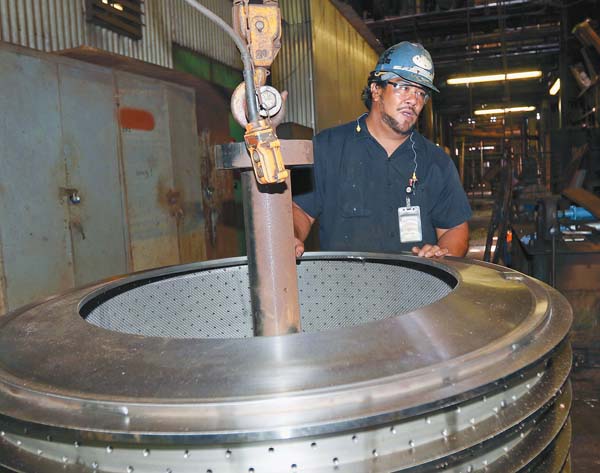
Millwright specialist Koa Martin stands next to a high-grade sugar basket inside Hawaiian Commercial & Sugar Co.’s Puunene Mill. The Maui News / CHRIS SUGIDONO photo
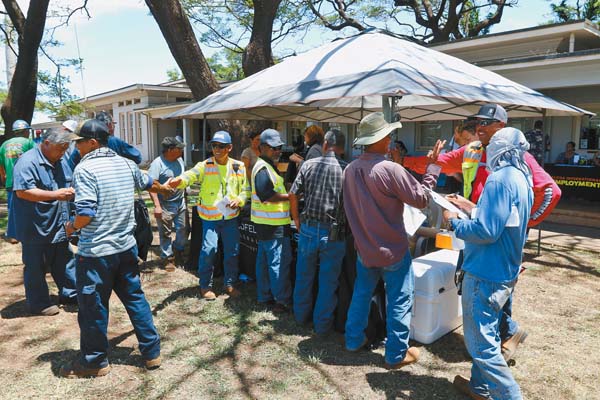
Hawaiian Commercial & Sugar Co. workers talk to Young Bros. officials during an August job fair at Puunene Mill. The Maui News / CHRIS SUGIDONO photo
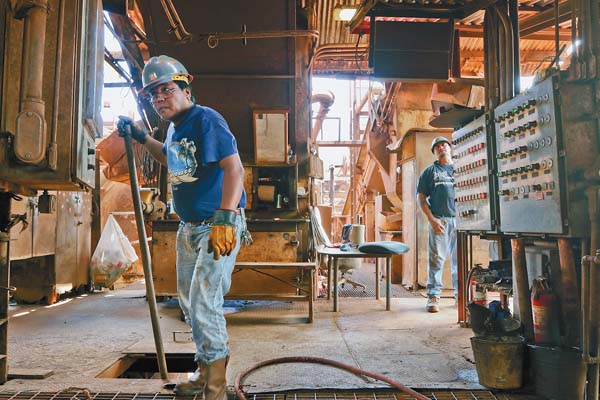
Hawaiian Commercial & Sugar Co. workers Obed Arimiego (left) and Shayne Kauhaahaa clean sugar cane (photo right) at Puunene Mill. The Maui News / CHRIS SUGIDONO photo
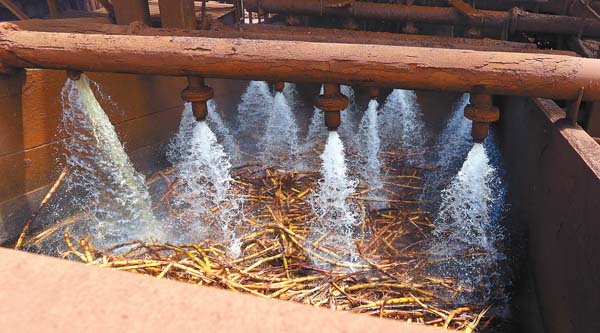
Sugar cane being cleaned at Hawaiian Commercial & Sugar Co.'s Puunene Mill. The Maui News / CHRIS SUGIDONO photo
Millwright specialist Koa Martin stands next to a high-grade sugar basket inside Hawaiian Commercial & Sugar Co.’s Puunene Mill. The Maui News / CHRIS SUGIDONO photo
Hawaiian Commercial & Sugar Co. workers talk to Young Bros. officials during an August job fair at Puunene Mill. The Maui News / CHRIS SUGIDONO photo
Hawaiian Commercial & Sugar Co. workers Obed Arimiego (left) and Shayne Kauhaahaa clean sugar cane (photo right) at Puunene Mill. The Maui News / CHRIS SUGIDONO photo
Sugar cane being cleaned at Hawaiian Commercial & Sugar Co.'s Puunene Mill. The Maui News / CHRIS SUGIDONO photo
Trending
When Koa Martin first started working for Hawaiian Commercial & Sugar Co. in the late 1990s, he and his co-workers had their hands full toiling over machines in both the Puunene and Paia sugar mills.
"I think I worked straight seven days a week, 12 hours a day, around the clock for probably about four months before I got a break," Martin said. "We were kind of running it hard at that time."
That wasn't counting the hours Martin spent on bookwork as part of his training to become a millwright in HC&S' apprenticeship program, and the time he spent changing diapers on his young son -- "my apprenticeship for being a dad."
Now, nearly 20 years after he completed the HC&S program, Martin can boast three-trades-in-one as a millwright specialist, a unique breed of worker that will no longer be trained when the sugar industry shuts down on Maui -- and with it, the only multi-trade apprenticeship program on the island.
Over five decades, the program has sent possibly thousands of workers to jobs at the sugar mill, in government and with private businesses all over the island.
"We just flooded the market," said Keith Goto, HC&S vice president of human resources. "We just kept training people, and people would leave, and we kept training more people. And so I think that's where the bigger impact is going to be on Maui. . . . Where's Maui Electric going to get their people from? Where's Hawaiian Cement going to get all their people from? . . . . They cannot look to HC&S anymore."
'Filling the pipeline'
After 145 years on Maui, HC&S will close its sugar plantation, the last in the state, at the end of the year. Parent company Alexander & Baldwin said its agribusiness sector was set to lose around $30 million this year. HC&S' apprenticeship program also will fold after the final harvest is completed at the end of year. The program, which allows apprentices to get paid while learning a trade, goes back to the late 1960s, Goto said. At the time, there were barely any community college or technical school options, and skilled jobs were filled mostly by people who "had learned on the job by themselves or worked with their grandfather in the backyard."
"People had to really go out on their own and get educated in the trades or work for some shop or something," Goto said.
HC&S worked with the unions and was able to create a formal, state and federally monitored program that didn't require the company to pay overtime to indentured apprentices, as long as books and training were required during off-hours, Goto said.
The company set up training programs for welders, machinists and mechanics. In the early 1970s, there were many trades workers on Maui who needed certification. HC&S again went to the unions, offering to promote workers to a higher level, given they could pass a practical test. A rag might be stuffed into the carburetor of a tractor, and the worker would have to figure out what was wrong with the vehicle. Anyone who didn't pass these types of tests was known as a "no go."
"In other words, you're not going to go anyplace for the rest of your career," Goto said. "Up to the '80s, there were a lot of 'no goes.' "
But as workers began to pass, the company was able to lay out requirements for its apprenticeship program and add trades, such as power plant operator. Through the years, HC&S has also created specific jobs as needed, including sugar boiler mechanic and the millwright position, which is a unique hybrid of machinist, mechanic and welder that was meant to make factory maintenance more efficient.
For some trades, it was difficult to find course materials, so former Paia Plant Manager Richard Staszak and former Factory Manager Hendrick "Hans" Poppinga wrote the sugar boiler mechanic and power plant mechanic course books themselves in the early 1990s, according to Goto.
The program benefitted new as well as already employed HC&S workers, some of whom were given the option to take a shorter course load, depending on skill level, and move up a pay grade.
"We went from 120 apprentices to about 325 trades jobs because everybody in the factory became a trade worker," Goto said.
Many who went through the apprenticeship program, however, didn't end up staying at HC&S. In fact, in the late 1980s, the company began to lose many of its newly trained workers to competitors with higher pay rates.
"As a sugar company, we couldn't compete with construction, with the county, with the state, with Maui Electric," Goto explained.
HC&S raised its pay as high as it could and decided to just "fill our pipeline of apprentices and just keep moving people through," so that competitors as well as HC&S could eventually get the workers they needed.
There are no exact numbers for the workers who have passed through the program.
"The best we can say is thousands since the program started," A&B spokeswoman Tran Chinery said.
Products of the program
The apprenticeship program now spans 10 different trades, including plumber, carpenter, electrician, millwright, power plant operator and sugar boiler/mechanic. HC&S also offers training for technical fields, such as mechanical drafters and electrical control technicians.
Apprentices undergo a five-year, 7,600-hour program that includes four years of textbook study and on-the-job training, followed by a year of "on-the-job skills refinement," according to HC&S' website.
Applicants must be 18 years or older with a high school diploma or high school equivalency test passage. The apprenticeship program is registered with the state and federal departments of labor.
Martin said it wasn't easy going through the program, juggling studies, picking up new skills and taking care of family at home. He often wondered how the veteran workers who mentored him remembered every step, every tool.
"Everybody kept telling me, the journeymen, 'Slow down, no worry, you going learn 'em,' " Martin said. "They said, 'No worry, boy, cause in time you going figure it out.' . . . . It becomes second nature to you if you do it enough times."
Working in a sugar mill is unlike any other type of environment, he said.
"All that equipment, running 24 hours a day, they break down. No matter how massive and huge and strong we build 'em, there's still mechanical failures," he said. "There is a book for how to repair things, how to build things, but how to deal with the problems of running a sugar operation, you just learn off of experience from others. . . . I grew up a lot here, dealing with the kind of situations that I've been forced to deal with."
Some of the former apprentices, like Martin, still work at HC&S, while others have taken up jobs around the island. One notable program alum is Stewart Stant, who became director of the county Department of Environmental Management last December.
Stant joined the HC&S program in 1990. His goal was to be an electrician, and HC&S had the only available apprenticeship program for the trade, Stant said. He completed just over half of the program before accepting a position as an electrician helper with the county's Wastewater Reclamation Division. He served in the Department of Environmental Management for 25 years, rising in the ranks until he was named director.
"I can honestly say that the HC&S electrician apprenticeship program was key in my success with the county today because it was the first step in what would turn out to be an incredible career for me," Stant said.
While he was maintenance manager in the Wastewater Division, the last seven positions for the maintenance section were all filled by HC&S-trained workers, Stant said, adding that many of the applicants coming out of HC&S' program were "usually overqualified."
"Sadly, losing the HC&S programs will not only have a huge impact on Maui today, but will for years and years to come," he said.
Roberto Andrion Jr., who came to Maui from the Philippines as a young boy in 1962, worked for HC&S for 30 years before becoming a business agent with the International Longshore and Warehouse Union.
Andrion had just gotten out of the military when he entered the apprenticeship program around 1985. He was the last machinist the company ever hired, he said. During the program he also balanced kids, work, apprenticeship studies and the college degree he was pursuing at the time.
"It took a lot of dedication . . . to get it done," Andrion said.
He added that while his machinist skills don't necessarily translate into his job as a business agent, the apprenticeship taught him lessons beyond the mill.
"It opened up my horizons a lot more," Andrion said. "It kind of gave me a better foundation as how to deal with people and basically set goals in life."
What comes next
According to Chinery, HC&S' current program has 55 apprentices. For each apprentice in the program, HC&S shells out about $200,000, which accounts for five years' pay, books and other expenses, Goto said.
"It's the largest privately sponsored apprenticeship in the state," he said. "It's like getting a four-year scholarship and playing for UH."
After HC&S closes, the options for aspiring trades workers are limited. Kahului Trucking & Storage, a subsidiary of A&B, has an apprenticeship program, but Goto said it only trains internal combustion mechanics. Getting a college degree can also teach workers skills, but it's hard to get a job without the experience an apprenticeship provides, he added.
Goto said the company is considering working with Maui Economic Opportunity to move apprentices to temporary jobs to get their hours. The apprentices can continue to study the books on their own, but they "need someone to certify their hours," Goto explained.
Another service gone from Maui will be the jobs "big and small" that workers do for clients at the Puunene Mill's machine shop, the second largest in the state. Everybody knows when they need something fixed, "they come see the HC&S guys," Martin said.
"The amount of talent and experience we have in this shop, there's nothing we cannot do," he said.
Martin knows a little something about everything. As he walked through the mill Thursday sporting his well-worn hard hat, he pointed to each rumbling machine and explained its role in transforming muddy, burnt cane stalks to sweet crystals of high-grade sugar. His experience with the machines has given him a front-row seat to the whole process.
"People have to understand how complex of an operation it is," he said. "We deal with tons and tons of cane an hour, and tons and tons of juice an hour. . . . To take in all that cane is a commitment."
Martin wasn't sure where he would go next, but said that his training at HC&S was something he will "take with me wherever I go."
"I'm glad I stuck it out," he said. "I was glad that people believed in me enough to give me opportunities. Everybody down the line has given me opportunities to step up and make something of myself. That's something I'll be forever grateful for."
* Colleen Uechi can be reached at cuechi@mauinews.com.
Originally published August 21, 2016