
Ige says state is working toward ‘smooth transition’ for hospitals
Arakawa, residents voice concerns
Trending
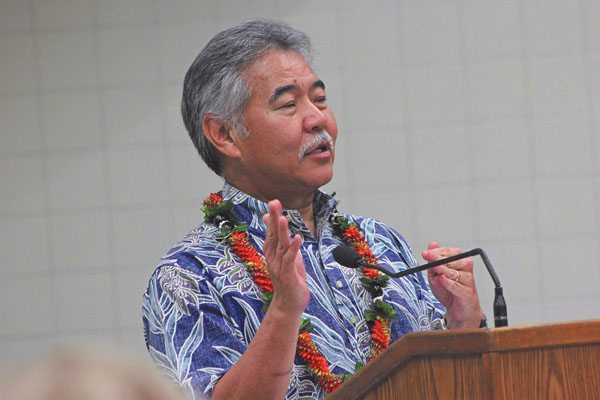
Gov. David Ige delivers his opening remarks Wednesday evening during a "Community Connection" meeting at the University of Hawaii Maui College. The meeting gave people a chance to ask questions of Ige and the heads of several state departments.
The Maui News COLLEEN UECHI photo
KAHULUI -- Gov. David Ige assured Maui residents Wednesday evening that the state is working with the unions on the long-delayed transition for three Maui County hospitals, but Mayor Alan Arakawa said that the county and its residents are "fed up" with the delays and lack of information.
"There's been no real communication from the governor's office except to tell us, 'We're negotiating, we're talking, you're going to hear from us,' and we've been hearing the same story for months and
months and months," Arakawa said following the governor's speech during a community meeting at the University of Hawaii Maui College.
Upward of 200 people, including county and state legislators, crowded the college's Pa'ina building to listen to and ask questions of Ige and the heads of several state departments. In his opening remarks, Ige acknowledged "that one of the big issues here is the status of Maui Memorial Medical Center," a comment that received round applause.
"That has been top of mind for me and the administration," Ige said. "Just reconfirming, we are committed to a smooth transition for the medical center. We are . . . negotiating with the unions to work through the details of the transition. We hope to be able to conclude those negotiations shortly."
A union lawsuit and months of negotiations put a serious crimp in plans to transfer operations of the quasi-public Maui Memorial Medical Center, Kula Hospital and Lanai Community Hospital to private health care provider Kaiser Permanente. Originally scheduled for July 1, 2016, the transition has been pushed to July 1, 2017.
Within the past two months, Ige's office has settled a lawsuit and signed a supplemental agreement with the United Public Workers union, which represents more than 530 blue-collar workers at the three hospitals. But now one of the major remaining hurdles is coming to an agreement with the Hawaii Government Employees Association, which represents 900 white-collar hospital employees.
Ige said after the meeting that the two parties are "trying to resolve the issues," which include severance, enhanced retirement and other topics.
"It's negotiations, so there's a back and forth," Ige said. "There's really not much that I can say publicly. . . . The supplemental agreements are fundamentally important to allowing us to move forward. Until we get those agreements in place, it's hard to determine what the transfer date can be."
But Arakawa said the fact that the governor is negotiating separately with the unions has left Kaiser, the county and the hospitals in limbo.
"Ultimately, Kaiser has to administer the programs," Arakawa said. "By not including everybody in the discussion, nobody knows what's going on. Nobody can plan."
Wesley Lo, chief executive officer of Hawaii Health Systems Corp. Maui Region, which currently runs the three hospitals, said it was "not fair for me to judge" because HHSC wasn't involved in negotiations, but he wondered if talks would move faster if more parties were involved.
"I'm sure the governor is doing the best job he can," Lo said. "But from our perspective, ultimately if (Kaiser and the unions) have to agree, shouldn't they all agree together as opposed to one at a time? Otherwise, we keep going from agreement to agreement."
Ige said that while his office does consult with Kaiser on a regular basis, "they're not a direct party."
"The agreement is between the state and the union," he explained. "I really don't see a role for the county or Kaiser in the negotiations at this point in time."
Residents' frustrations also spilled over during Ige's appearance at the Department of Health panel. Some asked whether "the weight of the state" was "fully aware of this discussion." Others said that the situation would've been resolved already "if it were happening on Oahu."
Ige said that the state was trying to respond to each of the unions' concerns.
"It takes two to get to a settlement," he said.
He added that the state was open to ideas and listened to suggestions such as setting up a hotline for doctors to find open beds at other hospitals.
Capacity has been a growing issue. At the end of August, the HHSC Maui Region board announced that it would have to cut some hospital services and about 10 percent of beds within the next year. The hospital has also reported staffing shortages and has had to rely on expensive traveling nurses who provide good care but are not familiar with the hospitals, Lo said.
Kihei resident Kay Anderson told Ige that she moved to Maui after she was diagnosed with a terminal disease, which she survived. However, she's had to go to Maui Memorial various times due to complications from stage IV liver cancer, and the care has visibly declined since she first arrived.
"It terrifies me what's happening here," Anderson said. "If news of this gets to the Mainland . . . tourism's going to be impacted. And that's really, really sad to say that if it impacts us the residents, nothing's happening. But once tourism's impacted, something's going to happen."
Because of the delay, Kaiser's transition team has left the island and is now on the East Coast, Arakawa said. He added that when House Bill 1075, now Act 103, was signed to allow the hospitals to find a private partner, "it was a way to make our hospital system better, not to deteriorate the hospital system by lack of attention, by lack of agreements."
"Instead of having a more responsible group, now we have nobody in charge," he said. "We're just fed up with the long delays, the wait and the noninformation. If we could understand what the delays were, why the delays were, then perhaps we could be a little more patient."
Ige said that one of the main hurdles is the supplemental agreement, and that the goal is to negotiate a transfer date sooner than July 1. Lo added there are a number of other contracts that also depend on upon the supplemental agreement. Ige explained that it's a "complex transaction."
"There are lots of information systems and other things that need to be put in place to allow the transition to move forward," the governor said. "I just want you to know that I'm fully aware that sooner is better than later."
Lo said that HHSC is putting together a proposal to bring to the board to address staffing issues. The departure of experienced employees has left many vacancies, which leaves certain shifts with less experience, he explained. The hospitals are trying to find a way to fix that gap, not simply by hiring more people but by finding ways to work with the experienced employees already at the hospital. While the details have not been hammered out yet, Lo said they could include creating new positions or establishing incentives for current staff.
"We have to flip the switch," he said. "We cannot just wait for a transition to happen. The goal is to have better health care, not to finish negotiations. Ultimately, the right thing to do is the transition to Kaiser, but just waiting till July 1 is not the answer."
* Colleen Uechi can be reached at cuechi@mauinews.com.