
Prospects for a Trump economy mulled
Economist says he has no idea what campaign rhetoric will become policy
Trending
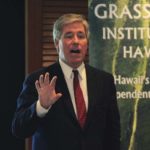
KAHULUI -- President-elect Donald Trump's economic policies have earned mixed reviews from analysts, but whether he will actually turn his campaign rhetoric into action is anyone's guess, Dan Mitchell, an economist and senior fellow with the Cato Institute, said Tuesday at the Maui Arts & Cultural Center.
Mitchell came to Maui to speak on what a Trump presidency might mean for America's economy at an event held by the Grassroot Institute of Hawaii, an independent nonprofit think tank. The Cato Institute is also an independent think tank based in Washington, D.C.
The country's long-term economic picture is grim, Mitchell said. But there are things the U.S. can do to avoid ending up like struggling countries such as Greece.
"If we leave policy on autopilot, we're in deep trouble," Mitchell said. "But if we do the reforms today, a lot of these bad, long-run numbers will disappear."
Now, Americans are living longer and having fewer children, Mitchell said. This makes programs like Social Security and Medicare "unaffordable."
"A welfare state just doesn't work unless you have lots of young people and relatively few old people," he explained.
The U.S. is currently about $19.8 trillion in debt, according to the U.S. Department of Treasury's Bureau of the Fiscal Service. But Mitchell said he's more concerned about spending than debt -- over the next 15 years, government spending on health and pensions is projected to rise at above-average rates as compared to other countries, according to data from the International Monetary Fund.
"What difference does Donald Trump make in all this?" Mitchell asked. "This is where we get to the speculative part of my presentation because . . . nobody has a good idea of what the answer is."
Some of the promises Trump has made on the campaign trail don't add up, Mitchell said. He's promised big tax cuts but said he won't touch entitlement programs, which are part of government spending.
In addition, Trump's business ventures have left a long trail of debt. He's filed for bankruptcy multiple times, and in August The New York Times reported that Trump-owned companies were at least $650 million in debt.
Mitchell also wondered if Trump's populist tendency of catering to the people would keep him from making moves with short-term economic consequences. When Ronald Reagan was president, he "had to bite the bullet" and wean the economy off high inflation, Mitchell said. It was painful in the short run, but better for the economy in the long term.
Perhaps "the most worrisome thing" for Mitchell was Trump's support of protectionism, a policy that aims to shield domestic industries from foreign competition by taxing imports. With countries like France considering taxing American exports, it could set off "a protectionist trade war" that would not benefit the economy, Mitchell said.
But he added that what "gives me hope" is that Trump has somewhat endorsed a spending cap known as the "penny plan," by which government can only spend 99 percent of what it doled out the year before.
Reigning in government spending is key -- if the government spends too much while the private sector isn't growing, it leads to tax increases, which Mitchell said isn't the answer.
"When you give politicians more money to spend, . . . they spend it," Mitchell said. "It's sort of like thinking you're going to cure your alcoholic brother-in-law by giving him keys to a liquor store."
Across Western European countries, the tax burden has grown by almost 10 percent since the late 1960s, Mitchell said. But during the same period, the amount of debt compared to national GDP has almost doubled.
Tax cuts have helped the American economy in the past. Shortly before Reagan took office, the top tax rate was 70 percent. Reagan lowered the top tax rates to 28 percent, despite concerns that the wealthy wouldn't pay enough.
In 1980, the year Reagan was elected, there were about 117,000 "rich people," those with income exceeding $200,000, Mitchell said. They reported $36.2 billion in income to the Internal Revenue Service and paid $19 billion in taxes, according to the IRS Statistics of Income Bulletin.
But near the end of Reagan's second term in 1988, there were about 724,000 rich people, who reported $353 billion in income and paid $99.7 billion to the federal government.
Part of the increase in taxes was because there were so many more wealthy individuals, Mitchell said. However, it was also because people were reporting higher income levels to the government than before, instead of investing in bonds to avoid taxes, as they often did when rates were high.
As time passes, the window for economic overhaul grows smaller, Mitchell said. With the Baby Boomer generation retiring, more people will rely on the government each year. The more people rely on government benefits, the more hesitant they'll be about things like entitlement reform, Mitchell explained.
"At what point have we gone too far down a path and we can't do the reforms that are necessary?" Mitchell asked. "Taxpayers can only produce so much if you have too many interest groups demanding to get fed."
Mitchell is a libertarian who supports small government, but he said that restraining government spending is a practical policy that goes beyond party beliefs.
Residents said Tuesday that it was hard to comment on an economic future under Trump.
"We're not quite sure what his policy is," Hana resident Chuck Thorne said. "I'm hoping for a lowering of taxes because mine are extreme right now. I think that's why most people voted for Trump because he promised to lower everybody's taxes. . . . I'm sure he's going to find a way to do that. He'll have to cut some programs."
"It's very difficult to state my opinion because it's changing every five minutes," Kihei resident Ralph Gorgoglione said of Trump's policies. "I'm seeing potential Cabinet positions being filled by people who have a certain ideology and somebody else who has a different ideology. I don't want to say it's too early to say, but it is."
* Colleen Uechi can be reached at cuechi@mauinews.com.