
Remembering Pearl Harbor: ‘We were scared’
Across the islands, it was a day of shock, sadness and fear
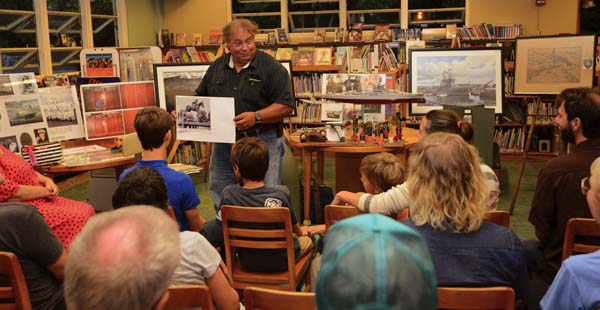
Maui naval aviation historian and former U.S. Marines Sgt. Alan DeCoite shares his experiences with a larger-than-expected crowd during a “Remember Pearl Harbor” event at the Lahaina Public Library on Tuesday evening. DeCoite spearheaded the preservation of the von Tempsky Wall, a 40-foot stretch of wall from the Kula home of Gordon and Alexa von Tempsky, which is now an exhibit in the National Naval Aviation Museum in Pensacola, Fla. The wall was signed by many of the Navy pilots who trained on Maui during World War II. He noted that around 1938, the Navy came to help build Maui’s airport, and fighter aircraft were brought in from the Mainland. Bunkers were built all over the island, from Makena to Paia and Upcountry. “The fingerprints were there,” DeCoite said. “Maui was already preparing to defend” before the Japanese attacked Pearl Harbor. The Maui News / MATTHEW THAYER photo

The USS West Virginia after the attack on Pearl Harbor on Dec. 7, 1941, on Oahu. The Library of Congress
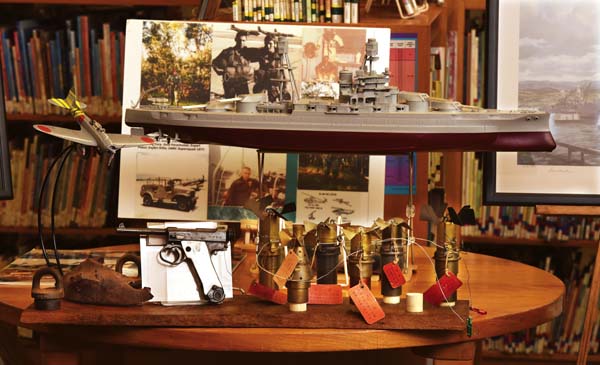
Alan DeCoite’s WWII exhibit is scheduled to be on display through today from 10 a.m. to 5 p.m. at the Lahaina Public Library. The display includes a model of the USS Arizona, which was sunk at Pearl Harbor on Dec. 7, 1941, and fuzes (front right) of the type that were used by Japanese bombers that attacked the American fleet. The bombs would plunge through the decks, lodge below deck and then explode, DeCoite explained. The Maui News / MATTHEW THAYER photo

U.S. Navy sailors stand among wrecked airplanes at Ford Island Naval Air Station as they watch the explosion of the USS Shaw in the background, during the Japanese surprise attack on Pearl Harbor on December 7, 1941. U.S. Navy photo via AP

U.S. Navy sailors work to repair the floating dock next to the USS Arizona Memorial in Pearl Harbor after the USNS Mercy hospital ship struck the memorial’s dock in May 2015, as it was leaving Pearl Harbor. Ceremonies commemorating the 75th anniversary of the Pearl Harbor attack continue on Oahu today through Sunday. The U.S. Navy photo via AP

The battleship USS California is afire and listing to port in the Japanese aerial attack on Pearl Harbor on Dec. 7, 1941. Library of Congress photo
Maui naval aviation historian and former U.S. Marines Sgt. Alan DeCoite shares his experiences with a larger-than-expected crowd during a “Remember Pearl Harbor” event at the Lahaina Public Library on Tuesday evening. DeCoite spearheaded the preservation of the von Tempsky Wall, a 40-foot stretch of wall from the Kula home of Gordon and Alexa von Tempsky, which is now an exhibit in the National Naval Aviation Museum in Pensacola, Fla. The wall was signed by many of the Navy pilots who trained on Maui during World War II. He noted that around 1938, the Navy came to help build Maui’s airport, and fighter aircraft were brought in from the Mainland. Bunkers were built all over the island, from Makena to Paia and Upcountry. “The fingerprints were there,” DeCoite said. “Maui was already preparing to defend” before the Japanese attacked Pearl Harbor. The Maui News / MATTHEW THAYER photo
The USS West Virginia after the attack on Pearl Harbor on Dec. 7, 1941, on Oahu. The Library of Congress
Alan DeCoite’s WWII exhibit is scheduled to be on display through today from 10 a.m. to 5 p.m. at the Lahaina Public Library. The display includes a model of the USS Arizona, which was sunk at Pearl Harbor on Dec. 7, 1941, and fuzes (front right) of the type that were used by Japanese bombers that attacked the American fleet. The bombs would plunge through the decks, lodge below deck and then explode, DeCoite explained. The Maui News / MATTHEW THAYER photo
U.S. Navy sailors stand among wrecked airplanes at Ford Island Naval Air Station as they watch the explosion of the USS Shaw in the background, during the Japanese surprise attack on Pearl Harbor on December 7, 1941. U.S. Navy photo via AP
U.S. Navy sailors work to repair the floating dock next to the USS Arizona Memorial in Pearl Harbor after the USNS Mercy hospital ship struck the memorial’s dock in May 2015, as it was leaving Pearl Harbor. Ceremonies commemorating the 75th anniversary of the Pearl Harbor attack continue on Oahu today through Sunday. The U.S. Navy photo via AP
The battleship USS California is afire and listing to port in the Japanese aerial attack on Pearl Harbor on Dec. 7, 1941. Library of Congress photo
Trending
Twenty-one-year-old Hiroshi Arisumi was heading out to Kihei for a morning of surfing on Dec. 7, 1941, when the news came in over the radio that Japanese planes had bombed the American naval base at Pearl Harbor.
Plans to go surfing were quickly shelved, and Arisumi stayed home with his family all day. They listened to the radio for updates, frightened that Maui would be next.
"We were scared. Everybody on the island was afraid of that," Arisumi said.
Perhaps the most sobering thought for Arisumi was that the country his parents had left 40 years ago was waging war on the land they now called home.
"It was a sad day," said Arisumi, now 96. "Our father and mother's country was attacking us. We were American citizens, and we had no intention of fighting for Japan, no matter what."
Shortly before 8 a.m. that Sunday, hundreds of Japanese fighter planes attacked Pearl Harbor, leaving 21 American naval vessels damaged or sunk, and 347 aircraft damaged or destroyed, according to the Naval History and Heritage Command. Including military and civilians, 2,403 Americans were killed, and 1,178 were wounded.
For residents throughout the islands, it was a day of sadness, shock and fear.
Years prior to that, there was a sense on Maui that war was approaching, said Alan DeCoite, local naval aviation historian. Around 1938, the Navy came to help build Maui's airport, and fighter aircraft were brought in from the Mainland, he said. Bunkers were built all over the island, from Makena to Paia and Upcountry.
"The fingerprints were there," DeCoite said. "Maui was already preparing to defend."
Maui also was a very strategic location for the U.S. Pacific Fleet, said Daniel Martinez, chief historian at the World War II Valor in the Pacific National Monument. The military had an anchorage site in Lahaina Roads, and "Japan's navy was very much aware of that." Early on the morning of Dec. 7, planes were sent to scout both Oahu and Maui to ensure the fleet's location.
"They were prepared to attack either side," Martinez said. "So had the fleet been at Lahaina Roads, maybe 'Remember Lahaina Roads' would be the battle cry today."
When the attacks unfolded at Pearl Harbor, residents on Maui were following their usual Sunday routines -- heading to church, relaxing with friends, milking cows and tending to horses, according to accounts gathered by the Nisei Veterans Memorial Center in Wailuku.
"We were crowded around a radio in one of the dorm rooms at Lahainaluna High School, listening in shock," said the late Stanley Izumigawa, a veteran of the 442nd Regimental Combat Team and the 100th Infantry Battalion.
Kazuichi Hamasaki, who served in the 442nd, also was glued to the radio on Dec. 7 when he heard a loud explosion outside. Thinking Maui was under attack, he and his brother Tadayoshi raced down to Kahului Harbor and caught sight of a small Japanese submarine offshore. A shell fired from the sub had landed in front of what is now the Maui Beach Hotel.
The Japanese military's focus that day was to attack the Pacific fleet, not invade, Martinez said. But many on Maui thought Pearl Harbor was just the beginning.
"There was great fear and trepidation that the Japanese were not finished with us," Martinez said. "They had attacked and invaded everyone else."
The island quickly launched into high alert. Col. Charles B. Lyman, head of the Maui military district, mobilized all armed forces, according to the first war extra published by The Maui News. Provisional police were called to monitor the coastline, and civilian pilots helped scout for invasion boats. Lyman urged residents "to remain calm, avoid hysteria and to continue their pursuits as usual."
Meanwhile, interisland travel was suspended, leaving the Punahou School football team stranded on Maui after its Sunday game against Baldwin High was postponed.
At a time when technology and communication were limited, uncertainty plagued many families, said Jeff Baldwin, whose grandmother Harriet "Haku" Baldwin shared stories with him of that day.
"My grandmother told me that one of the scary things for her was that nobody knew if (the Japanese) were coming back," said Jeff Baldwin, president of Piiholo Ranch Zipline. "History says they attacked and left. But the local people, they had no idea if the following day there was going to be boats landing on beaches."
Jeff Baldwin's grandfather Richard "Manduke" Baldwin was manager of Haleakala Ranch at the time. He and several Upcountry paniolo were asked to patrol the slopes of Haleakala in case of Japanese invasion in the days that followed.
As skilled horsemen and hunters, "they had the ability to develop food sources and find water for themselves and others," Jeff Baldwin said. "They knew how to get around quietly and unseen using the gulches and forest of Kula via horseback."
To his knowledge, they never had to fight any enemy troops.
On the night of Dec. 7, Maui underwent its first blackout. By nightfall, the island "was thoroughly and completely in utter darkness," according to a Maui News war extra. Not a single home violated the blackout order, according to police reports.
"It was a terrible thing to blackout your home," Arisumi remembered. "Everybody just prayed to God there wouldn't be any more (attacks)."
Two minor attacks off Maui would follow, but with no human casualties. On Dec. 15, a submarine fired several shells at the Kahului Harbor complex, causing minor damage to the Maui Pineapple Co. cannery and killing two chickens, wrote Charles Young in "Hawaii at War!" a 1942 special edition of the Honolulu Star-Bulletin. In the early hours of Dec. 31, a submarine again shelled Central Maui with no damage.
Life in the islands quickly changed after Dec. 7. Gas and food were rationed. Maui became a training base for pilots and ground troops. The sugar cane and pineapple industries continued despite the war, helping supply troops with food and other resources, Martinez said.
"For the first six months after Pearl Harbor, Maui and the rest of the islands played a critical role in the protection of the Hawaiian Islands," Martinez said.
Another change shortly after Pearl Harbor was the fear and suspicion toward Japanese-Americans, which led to the internment of hundreds of thousands mostly on the West Coast but some in Hawaii, and initially kept young men like Arisumi from serving in the war.
Arisumi, who would face combat as part of the highly decorated 442nd Regimental Combat Team, remembered exactly what his parents said to him and his nine siblings on Dec. 7, 1941.
"They told us, 'No matter what, we are Americans,' '' Arisumi said. "We were born in America, and we've got to fight for America. . . . Our heart was always with America."
Ceremonies commemorating the 75th anniversary of the Pearl Harbor attack continue on Oahu today through Sunday. For a full list of events and to watch today's ceremony live, visit pearlharbor75thanniversary.com/full-schedule-of-events/.
* Colleen Uechi can be reached at cuechi@mauinews.com.