
Shame often keeps sexual assault survivors quiet
Abuse leaves ‘a very big hole in my spirit’
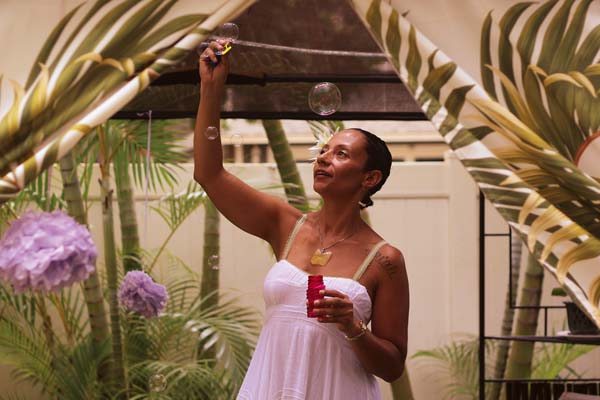
Kema Jamal fills the air with bubbles at the Maui Holistic Garden Center in Kihei, a place that’s helped her find peace and healing after the years of assault and abuse she’s overcome. As Sexual Assault Awareness Month draws to a close, Jamal is speaking frankly and honestly of her experience. -- The Maui News / COLLEEN UECHI photo
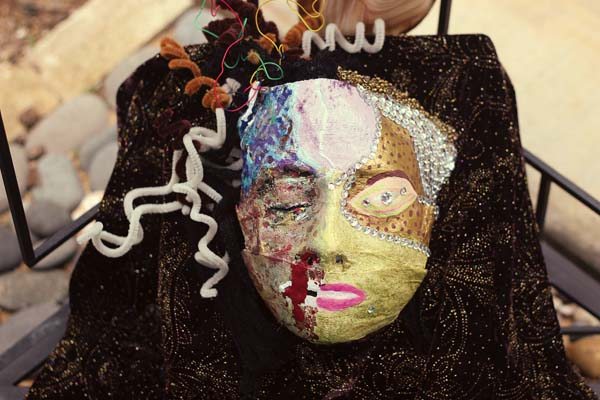
Jamal has used the arts to express her life’s story. This piece, titled “Amygdala, Disturbia, Flawless,” is a mold of her face and represents the secrets and pain of abuse and addiction, and eventual discovery of healing. -- The Maui News / COLLEEN UECHI photo
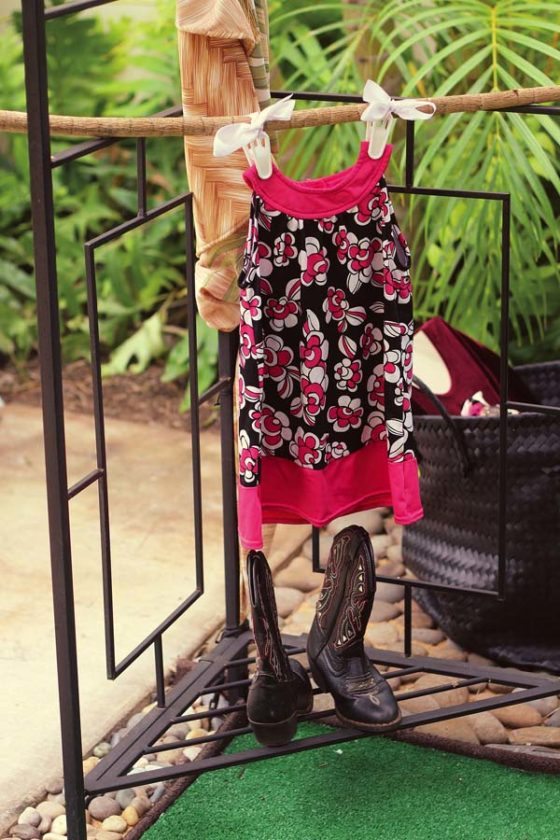
A child’s dress and cowboy boots (one deliberately turned backwards) represent a “tainted” childhood and innocence lost after a 4-year-old Jamal was molested by a step uncle. -- The Maui News / COLLEEN UECHI photo
Kema Jamal fills the air with bubbles at the Maui Holistic Garden Center in Kihei, a place that’s helped her find peace and healing after the years of assault and abuse she’s overcome. As Sexual Assault Awareness Month draws to a close, Jamal is speaking frankly and honestly of her experience. -- The Maui News / COLLEEN UECHI photo
Jamal has used the arts to express her life’s story. This piece, titled “Amygdala, Disturbia, Flawless,” is a mold of her face and represents the secrets and pain of abuse and addiction, and eventual discovery of healing. -- The Maui News / COLLEEN UECHI photo
A child’s dress and cowboy boots (one deliberately turned backwards) represent a “tainted” childhood and innocence lost after a 4-year-old Jamal was molested by a step uncle. -- The Maui News / COLLEEN UECHI photo
Trending
Editor's note: The Maui News does not usually identify people who've been sexually assaulted, but Kema Jamal consented to be identified and photographed as she shared her story of survival.
* * * * *
The abuse started when Kema Jamal was just 4 years old. She'd visit her father and his new wife in Colorado, and as soon as the adults were out of the house, her stepmother's teenage brother would molest Jamal. He told her never to tell anyone, or he'd kill Jamal's mother back home in Wyoming.
"As a young kid, you can't protect yourself," Jamal said. "Even though you feel like it's wrong, you can't verbalize it's wrong because of the fear that's put in you. I truly believe growing up that there was already a big hole in my spirit."
Jamal has spent her life escaping sexual assault and abuse. But she won't call herself a victim or let her history hold her back. And as Sexual Assault Awareness Month draws to a close, Jamal is trying something that for years she was too ashamed to do: talking about her past.
KEEPING SECRETS
Dani Riggs is the clinical director of Child and Family Services, which runs the Maui Sexual Assault Center. He said it's hard for survivors to speak out because many of their experiences don't fit the oft-reported story of a young woman getting attacked on her way home from a bar.
"While those kinds of stranger danger assaults happen, they are by far the minority of sexual assaults," Riggs said. "Most sexual assaults occur in the home. Oftentimes it's the victim's own home, and usually the victim knows the perpetrator. That can make it difficult to talk about if it's your uncle, your coach or somebody from church."
In the United States, 7 out of 10 rapes are committed by someone known to the victim, according to the Rape, Abuse and Incest National Network.
Knowing her attacker kept Jamal in silence for years. Jamal grew up in Casper, Wyo. Her parents separated when she was very young, and her father moved to Colorado and remarried.
During the holidays, Jamal would visit him. That's when her 17-year-old stepuncle began molesting her. As time went on, the attacks grew worse.
"I learned from a very young age what it is to be tainted," Jamal said. "I didn't trust adults. I held it in because he threatened to kill my mom. The older I got, the more I felt like it was my fault."
Jamal's mother had signed her up for ballet classes in Casper, and that became Jamal's saving grace. It empowered her.
"My beauty and my strength comes from movement," she said. "I think it saved me with my self-esteem and my confidence, because one thing I knew about me above anything else was that when the music came on and the choreography started, I could do it."
Her mother gave everything so Jamal could dance: enduring old pairs of shoes so Jamal could have new ones, offering to clean the studio when she got sick and couldn't afford Jamal's classes.
"She believed in every dream I possibly had," Jamal said.
The only thing Jamal never told her mother was that she'd been molested.
Jamal tried to avoid visiting Colorado. When she was 7 or 8, she convinced her mom to let her visit her grandmother in Los Angeles instead. California was a safe haven.
Jamal poured her heart and soul into the arts. After graduating from San Diego State University with a degree in dance, she moved to New York at age 26 to perform with the Alvin Ailey American Dance Theater Company. She and musician James Blood Ulmer created "Dialogue, Dance and Music," a unique blend that allowed Jamal to bring her story and messages to the stage. But parts of her past remained unresolved.
BREAKING THE CYCLE
Fast forward to age 32. Jamal's mother died, and she was left "in search of something other than truly what I needed." She turned to alcohol, unable to ask for help.
Jamal got married shortly after, and the abuse started immediately. During her first pregnancy, her husband beat her until she lost the baby at his aunt's house in Florida.
"Every pregnancy he beat me," Jamal said. "I was seven months pregnant with my third pregnancy, our son, and was holding our daughter in my arms, and he took the back of his gun and hit me in the head."
His constant abuse left her with permanent trauma to the left side of her face.
"He would tell me I made him do it and would tell me because I drink too much. That's why he beats me," she said.
"I see how people can go, 'How'd you let that happen? Why didn't you just leave? It starts young. The thinking, the behaviors, everything starts young. The psychological processing of what you'll allow in your life."
Jamal finally fled to Maui, where her son was born in 2009.
She faced another manipulative relationship before she decided she could take no more. Someone who was supposed to help Jamal took advantage of her instead, using a position of power to get sexual favors. For 4¢ years, she was told to keep silent.
"How do you get out? Nobody came down and said, 'Here's a life jacket.' I had to truly advocate for what happened to me . . . and say, 'No more.' I was so tired of making the same choices over and over again that got me the same results."
Women Helping Women threw her a life jacket, Jamal said. She took classes for survivors that helped her come to terms with her past. Despite winning sole custody of her children after her divorce in 2013, Jamal later lost parental rights in a move she believes did not go through the proper legal channels. Her children now live in Texas with her ex-husband.
"I haven't seen them in three years, and I'm working on that," she said. "And I refuse to allow my past to dictate how that will roll out. . . . I don't wish for my kids to not understand our family history, because it can't be erased. But it doesn't have to be a devastating horror film. It can be one of triumph."
She's determined that the abuse will not pass on to the next generation. She wants to raise her son to treat women equally and with compassion, to learn that relationships have "boundaries, respect and integrity." She wants to teach her daughter "that she doesn't have to hold secrets," and that her worth comes not from physical beauty but from "being a decent and honest young girl."
On Maui, she's branched into art therapy, molding honest pieces that reveal her backstory. She runs a dance class called "Kematherapy" at the Malama Family Recovery Center, and now sponsors two women who've dealt with similar issues. She's been sober for two years, though she makes it clear she's "a woman in recovery" from alcohol abuse and her past life.
Her biggest hope for survivors is that they realize "you can get help, and you can heal."
RAISING A VOICE
Dr. Lisa Ponichtera is the clinical director of the Malama Family Recovery Center, an addiction and substance abuse treatment center for women and children on Maui. She's helped Jamal and many other survivors of sexual assault. Those with jail or drug history struggle with speaking out because they know they'll be questioned "and all the negative in their life brought up," Ponichtera said.
"The people I work with are already at such a low place in their lives that they don't feel they can stand up for themselves," she said. "Many have been abused from when they were little, and their parents didn't believe them."
And as the cycle of abuse and disbelief continues, they stop asking for help and often turn to drugs or alcohol. Then, when the abuse comes to light, people will say, "You're an addict, and you asked for it," Ponichtera said. "That's not the case. Unfortunately, that's a lot of times what they get."
Experts like Ponichtera help survivors find healing by expanding their circle of trust. The more people they have listening and telling them what they experienced is "not OK," the more they'll be empowered to say no to the abuse.
"Healing happens at a community level," Ponichtera said. "We need to understand that it's not OK. We need to listen. We need to take care. And just because someone is an adult woman, (we shouldn't) shun her and say, 'You're a bad person.' It affects the woman's psyche on a deep level, and it makes it so she can't become her fullest and become her best."
Unfortunately, sexual assault is "universal," Riggs said. It can happen to children, adult women and men, heterosexual and lesbian, gay, bisexual, transgender and people who are questioning their sexuality. The transgender community is especially at risk.
The best thing that family and friends of survivors can do "is start by believing," Riggs said.
"Let the person know that you're there for them, that you believe them, that you want to help them and that you want to do whatever you can to see that they get help," Riggs said. "And then refer them to us. . . . That's the biggest message anyone can give a victim. And if it happens to be a child victim, do those same things and report it."
* Colleen Uechi can be reached at cuechi@mauinews.com.
_______________
Here are a few Maui social services agencies that specialize in helping survivors of sexual assault and domestic violence:
Child & Family Service -- Maui Sexual Assault Center
Location: 392 N. Market Street, Wailuku; or at 20A Ala Malama St., Kaunakakai
Website: childandfamilyservice.org/programs/msac/
Phone: 877-6888 for Maui office, 553-5529 for Molokai
• Hotlines for Maui: 873-8624, Molokai: 495-3340, Lanai: 1 (866) 443-5702
_______________
Friends of the Children's Justice Center of Maui
Location: 1773 Wili Pa Loop Unit A, Wailuku
Website: mauicjc.org
Phone: 986-8634
_______________
Malama Family Recovery Center
Location: 200 Ike Drive, Makawao
Website: malamafamilyrecovery.org
Phone: 877-7117 • Hotline: 1 (800) 753-6879
_______________
Parents & Children Together
Location: Family Peace Center (for domestic violence)
270 Hookahi St., Suite 201, Wailuku
Website: pacthawaii.org
Phone: 243-7001 or 244-2330
_______________
Women Helping Women
Location: 1935 Main St., Suite 202, Wailuku
Website: womenhelpingwomenmaui.com
Phone: 242-6600 • Hotline: 579-9581
For more resources, visit the state's anti-domestic violence and anti-sexual assault website at hawaiisaysnomore.org.