UH researchers: Popular methods not best for jellyfish stings
Specialized spray and cream or vinegar and tweezers recommended

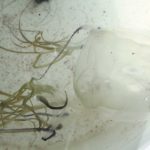
A sting from the Australian box jellyfish, the largest jellyfish species, can lead to death in as little as five minutes. A study by two University of Hawaii researchers says commonly recommended first-aid actions make a sting worse. Their recommended response is to apply Sting No More spray and cream or, in the absence of those products, apply vinegar, pluck the tentacles with tweezers and then soak in hot water. • ANGEL YANAGIHARA photo
After sensing the sharp pain of a box jellyfish sting at the beach, many people’s first instinct might be to pour some water on it and grab an ice pack to cool the burning patch of skin.
At least, those are some common practices floating around.
But some methods touted on medical websites and among beachgoing circles can actually do more harm than good, according to a recent study led by University of Hawaii jellyfish expert Angel Yanagihara.
“A lot of people think, ‘I’m burning, I’m burning, I should put some ice on it,'” said Christie Wilcox, who aided Yanagihara and is a postdoctoral fellow at the University of Hawaii’s John A. Burns School of Medicine. “The problem with ice is that, at best, it’s useless. At worst, it seems to somehow enhance the venom activity.”
When it comes to jellyfish sting treatment, there are many “wives’ tales” out there, and several aren’t based on evidence, Yanagihara said.
So, she and Wilcox set out to test several common methods of responding to stings from a species of Hawaiian box jellyfish and from the largest box jellyfish in the world, found in Australia.
Box jellyfish tentacles are packed with tiny stinging cells that discharge venom. When a person is stung, very few of these cells actually fire, so the first steps a person takes after being stung can have a major impact on how much venom is released.
Yanagihara designed a human tissue model containing living blood cells that jellyfish tentacles will sting. She and Wilcox studied a number of common methods that included scraping off tentacles with a credit card, rinsing with seawater and applying different solutions like alcohol or vinegar.
“The most surprising thing was that seawater makes things far worse,” Yanagihara said.
Seawater has been touted as a natural remedy by some, but it doesn’t prevent the stinging cells from shooting out venom, and can actually spread the cells.
“What happens is you end up getting stung over and over again,” Wilcox said.
Other liquids did the same thing — ethanol caused many more stinging cells to fire, and the tentacles stuck even more strongly to the fake skin model. Like seawater, freshwater also spread the cells.
“The cnidae (stinging cells) are ticking time bombs, and they will fire unless they are irreversibly inactivated,” Yanagihara explained.
In trials, vinegar and Yanagihara’s Sting No More spray did the best at inactivating these cells, so that the tentacles cause less damage when they’re removed.
(Yanagihara developed Sting No More spray and cream for the U.S. military, and part of the requirement of her funding was to offer it commercially to the public. Yanagihara was involved with testing her product, and said that Wilcox and international researchers also tested it independently.)
As for removal, tweezers triumphed over scraping with a credit card. While there was about half as many stinging cells on the skin after scraping, as opposed to using tweezers, a much higher percentage of stinging cells (around 85 percent) released venom when scraped than when plucked off (about 28 percent).
Researchers even studied the effects of applying urine to a sting site, another common recommendation. The answer?
“Please don’t pee on it,” Wilcox said with a laugh. “I wish I could understand how that particular bit of advice went viral. Urine is not a very good rinse solution because it kind of acts like seawater. It doesn’t inactivate the stinging cells. It just moves them around at best.”
So, what should beachgoers do when getting stung? There are two main first-aid steps — inactivating the stinging cells on the skin and treating the venom that’s gotten into the skin, Yanagihara explained.
Both researchers recommended rinsing the tentacles away with the Sting No More spray, then using the cream to treat the venom within the skin. However, in the absence of those products, vinegar does the trick, inactivating the cells so they can’t fire venom. Once that’s done, the tentacles can be plucked off with tweezers. Lastly, instead of reaching for the ice, researchers said to immerse the sting site in hot water for 45 minutes — preferably at 110 to 113 degrees Fahrenheit, or “as hot as you can stand,” Wilcox said.
“The venom proteins are heat sensitive,” Yanagihara said. “Hot water inactivates the venom that’s already injected.”
As for whether these methods could apply to stings from Portuguese man-o-war, a common sight on windward beaches, Wilcox said more research needs to be done.
In some ways, the study matches up with the steps that Maui County lifeguards take in response to stings. Ocean Safety Battalion Chief Colin Yamamoto recommended getting out of the colder ocean temperatures after a sting and applying heat, whether in the form of a shower, a Jacuzzi or a heat pack. Lifeguard stations have hot-water dispensers they can use to soak towels and apply to stings.
However, while Yamamoto saw vinegar as an option, he said its “efficacy is questionable.” He also recommended Motrin or Tylenol for the pain.
While jellyfish stings are more of a “nuisance” in the U.S., knowing the right treatment can mean the difference between life and death for people in countries like Thailand and the Philippines, Yanagihara said. Many outside of the U.S. take American medical advice as “gospel truth.”
“It really is a serious issue that we get this right,” Yanagihara said.
* Colleen Uechi can be reached at cuechi@mauinews.com.
-
- A sting from the Australian box jellyfish, the largest jellyfish species, can lead to death in as little as five minutes. A study by two University of Hawaii researchers says commonly recommended first-aid actions make a sting worse. Their recommended response is to apply Sting No More spray and cream or, in the absence of those products, apply vinegar, pluck the tentacles with tweezers and then soak in hot water. • ANGEL YANAGIHARA photo
Local News

Residents offer ideas, criticism at South Maui storm recovery meeting

Windsurfer Coraline Foveau is finally feeling good again years after suffering concussion
Mayor Bissen proposes $1.6B budget
Maui County Mayor Richard Bissen presented a proposed $1.616 billion budget for fiscal year 2027 to the Maui County ...

Students shine at Hawaii History Day district fair

Healthy Kids Running Series draws over 175 participants at kickoff event