
Forum examines the ins and outs of being a mom-and-pop shop
It takes hard work, ingenuity, persistence for Maui businesses to survive in big-box world
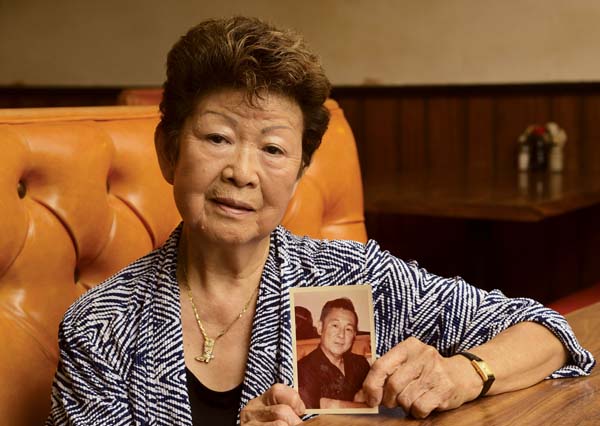
Hifumi Tanaka holds a picture of her late husband, Archie Tanaka, in this 2014 image. Together the couple operated Archie’s Restaurant in Wailuku. Their daughter and son-in-law, Margie and Tom Albete, took over the busy eatery around 2007 but last year, after 49 years in business, the mom-and-pop shop closed. -- The Maui News / MATTHEW THAYER photo

Perfection Bra Fitting Salon owner Terri Erwin is shown in the showroom of her Central Avenue business Thursday afternoon in Wailuku. Erwin uses social media sites to promote her small business. And, she’s confident. “I can pretty (much) sell a bra to anybody,” she says. -- The Maui News / MATTHEW THAYER photo
Hifumi Tanaka holds a picture of her late husband, Archie Tanaka, in this 2014 image. Together the couple operated Archie’s Restaurant in Wailuku. Their daughter and son-in-law, Margie and Tom Albete, took over the busy eatery around 2007 but last year, after 49 years in business, the mom-and-pop shop closed. -- The Maui News / MATTHEW THAYER photo
Perfection Bra Fitting Salon owner Terri Erwin is shown in the showroom of her Central Avenue business Thursday afternoon in Wailuku. Erwin uses social media sites to promote her small business. And, she’s confident. “I can pretty (much) sell a bra to anybody,” she says. -- The Maui News / MATTHEW THAYER photo
Trending
WAILUKU -- We've all seen it.
Locally owned businesses closing, one after another.
J.S. Kuge & Sons, a local jeweler open for 41 years, closed at the end of January. Local eatery Archie's Restaurant closed in September after 49 years.
John and Jean Kuge decided to retire. Plans for their sons to take over the business never materialized early on.
For Margie and Tom Albete at Archie's, they too had no one to take over the business named after Albete's late father, Archie Tanaka, who founded the business. The Albetes decided to move on to other things after putting countless hours into the restaurant.
These are some common examples cited by business owners for why local mom-and-pops, or independently owned shops, fold up. There is no one to take over the business. Sometimes it's not due to family members' different interests, but because local business owners have to work extremely hard. And, unlike years ago, business owners say there's more competition from big-box stores and additional hurdles such as rising costs and an ongoing trend for consumers to buy online.
Can mom-and-pop shop survive on Maui?
"Absolutely," says Dean Wong, executive director of the nonprofit Imua Family Services when asked if such small businesses can survive. Wong previously owned and operated the Green Banana Cafe in Paia around 2008. He and his partner later sold it.
"I believe that every good idea and every good business in essence began as a (mom-and-pop) business, it's those that became successful that then gain momentum and notoriety," he said in an email. "We always need new concepts, fresh ideas and great products to enter the marketplace. But you have to bring skills, great product and good planning to the table to enter the arena and last."
Wong, along with Maui No Ka 'Oi Magazine Publisher Diane Haynes Woodburn, an accomplished businesswoman herself, facilitated discussion last week on the state of Maui's mom-and-pop businesses at a Wailuku forum organized by Maui Business Brainstormers, a nonprofit organization aimed at helping individual, micro and small business.
The group organized free business forums last week around Maui County to focus on "The State of Mom-and-Pops in Maui." Another forum is scheduled for March 6 from 7 to 9:30 a.m. at the Travaasa Hana in East Maui.
For more information, see www.mauibusinessbrainstormers.org or Facebook at www.facebook.com/MauiBusinessBrainstormers.
Clyde Hamai, president of Hamai Appliance, was not at the forums, but he agrees with Wong that small businesses can survive on Maui -- his family business is going on its 49th year.
But he added that small businesses "need assistance," whether that be from the government or from other businesses.
Costs continue to climb for things such as medical plans and property taxes, Hamai said. Being on Maui, businesses have to deal with high freight costs too.
Hamai has kept pace with big-box stores, which brought in cheaper electronics, including televisions.
Hamai conceded that he couldn't compete with those electronics' pricing, even if he had the better quality stuff and has on-site repairs.
"We had to do adjustments. We changed our lineup a little bit," Hamai said. The store stopped selling televisions and radios, a staple for decades.
Instead, Hamai brought in mattresses and higher-end appliances and kitchen displays.
What also helps is that Hamai is part of a nationwide buying and marketing group with about 1,300 members.
Together, they have more buying power. The association also helps with providing information along with guidance and assistance, including marketing, salesmanship and credit-card processing.
Even as her nearly 30-year-old business, Party Paradise, is closing, Jamie Sato of Wailuku maintains that locally owned businesses can make it.
The store at Queen Ka'ahumanu Center is closing Monday. It's closing because Sato wanted to do something different.
She encouraged residents to help local businesses, "If you want them to stay around."
"It's everybody's decision," she said.
Sato was able to make it through the downturns in the economy by adapting to change and listening to what her customers wanted.
Consumer demand resulted in bringing in National Football League party items, which people were still looking to buy at the store recently.
Sato said local brick-and-mortar stores offer customers a chance to take a look at what they are buying, instead of seeing items on a screen online.
Often, customers would come into her store before an event to try to make up for an errant online purchase.
For example, a tablecloth cover would not be the color a customer desired.
Customers "can't just compare by price," Sato said of online goods and those found a big-box stores.
Smaller businesses such as hers tend to bring in the better-quality items or things the owners would like to use themselves.
"We care. We ask the questions," Sato said.
Overall, Sato said her closure is bittersweet.
Sato said Queen Ka'ahumanu Center has been great for local businesses. In fact, Sato said she encouraged another small business to follow her to Kaahumanu. Sato previously was at the Maui Mall after starting in a space at the Kahului industrial area.
Leigh Drewry, specialty leasing manager at Queen Ka'ahumanu Center, said the mall's overall success also depends on getting some Hawaii-based, family-owned stores.
Drewry, who attended the Wailuku mom-and-pop forum, said after the gathering that she was sad to see Party Paradise close. She said she hopes that someone with a similar concept would come to the mall.
Using and battling technology
Terri Erwin, owner and expert fitter at Perfection Bra Fitting Salon in Wailuku, is using social media sites to make her business more visible.
But at the Wailuku mom-and-pop forum she said that it's hard to keep updating her sites because she's busy running her solo business, which opened in 2010.
She also has to deal with customers who may come in for a personal fitting, which could last 45 minutes, but then go online instead to find and buy similar or the same bras for less.
Overall, dealing with these challenges, Erwin offers a specialty service that mom-and-pops also can tout.
She is also confident in her abilities.
"I can pretty (much) sell a bra to anybody," she said.
Although Erwin cannot devote too much time to social media and different technologies to promote her business, she is trying.
In fact, a recent Instagram video where she and her guest didn't know whether the camera was on or not garnered many likes.
Another small-business owner learning how to use technology better is Coleen d'Avignon, part of Art on Market, a Maui artist collective on Market Street in Wailuku.
The gallery has been open for 11 months and sells a variety of art, including jewelry and prints. And, it has a charity program, "Bucks for Ducks," in which sales of painted yellow rubber ducks benefit charity.
D'Avignon said at the Wailuku forum that she recently used Facetime on her cellular phone to sell ducks to someone off-island.
She took the cellular phone and used its camera/talk feature to show a customer the different types of ducks being sold in the gallery.
Wong also suggested d'Avignon use Facebook, with its live feature, to get exposure to many potential customers, rather than just one customer on the other line.
Drewry said businesses need a presence on social media and must keep updating photos and posts.
"Once a week isn't going to do it," she said.
Continuing a legacy
While younger mom-and-pop stores try to make a name for themselves on Maui and get more business, there are some business that just need to hang on to their legacy.
Thankfully, Tasaka Guri-Guri in the Maui Mall has had generations of eager customers to keep on scooping the tasty cold treat.
The Guri Guri recipe, which could be at least 90 years old, was concocted by Gunji Tasaka, whose father, Jokichi Tasaka, began Tasaka Confectionery Store in Kahului near the railroad tracks probably more than 100 years ago.
Gunji Tasaka's sons, Henry and Setsuo, took over the business. After Henry Tasaka’s death and Setsuo Tasaka’s retirement, Henry Tasaka's daughters, Cindy Tasaka-Ing and Gail Saito, took over the reins and are currently running the show.
Tasaka-Ing said it's second nature for them to work at the shop because they grew up there.
Because of the shop's enduring popularity, there hasn't been a need to promote it formally online or even have a presence on social media, Tasaka-Ing said.
* Melissa Tanji can be reached at mtanji@mauinews.com.