
UH-Maui College makes $6.3 million deal for on-site solar energy, battery storage
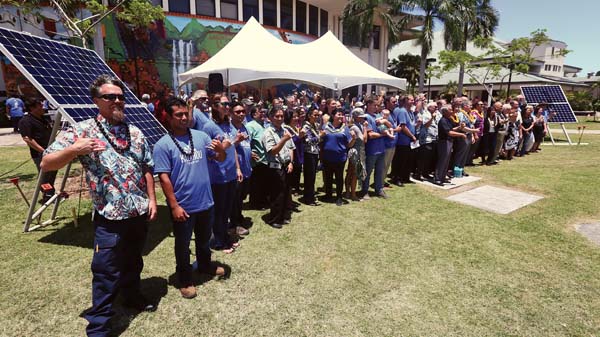
About 300 students and staff of the University of Hawaii Maui College as well as local energy companies pose for a photo Wednesday afternoon during a celebration and blessing for a deal to make the college use 100 percent renewable energy by April 2019. The Maui News / CHRIS SUGIDONO photos
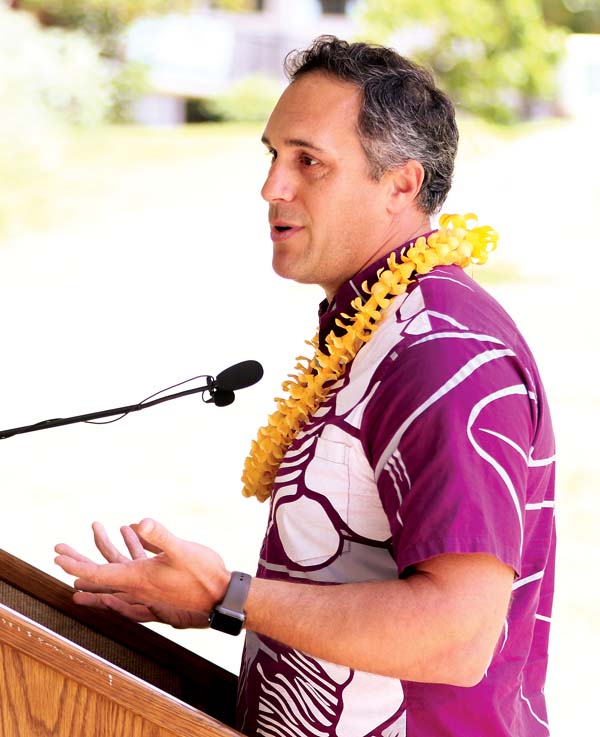
Brody McMurtry, business development manager for Johnson Controls, speaks to a crowd Wednesday afternoon during a celebration and blessing for a new solar panel energy contract on the campus’s Great Lawn.
About 300 students and staff of the University of Hawaii Maui College as well as local energy companies pose for a photo Wednesday afternoon during a celebration and blessing for a deal to make the college use 100 percent renewable energy by April 2019. The Maui News / CHRIS SUGIDONO photos
Brody McMurtry, business development manager for Johnson Controls, speaks to a crowd Wednesday afternoon during a celebration and blessing for a new solar panel energy contract on the campus’s Great Lawn.
Trending
KAHULUI -- Months of negotiations compressed into three days and a contract signed on the hood of a car at Haleakala Crater resulted in a deal that plans to make the University of Hawaii Maui College one of the first school campuses in the nation to use 100 percent renewable energy by this time next year.
For six months, UH officials had worked with contractor Johnson Controls and investor Pacific Current, a subsidiary of Hawaiian Electric Industries, on a deal for on-site solar photovoltaic systems coupled with battery storage. The arrangement nearly fell through when President Donald Trump announced stiff solar tariffs, but it was salvaged and signed March 2 by UH President David Lassner.
On Wednesday, the college celebrated the $6.3 million deal with a blessing and luau attended by about 300 students, staff and partners in the project.
"There was a Tuesday afternoon where we thought the project was dead. We really did," said Brody McMurtry, business development manager for Johnson Controls. "The president issued a 30 percent tariff on solar panels that literally killed the entire project, and we had until about Friday to get all of these final contracts together and get everything done."
McMurtry negotiated with Michael Unebasami, UH community colleges' associate vice president for administrative affairs, for three days and by 7 a.m. March 2 they had a contract. However, the contract needed to be finalized by 1 p.m. and Lassner and UH Chief Financial Officer Kalbert Young were on Maui for a Board of Regents meeting and to visit the telescope.
The two flew to Maui and hitched a ride from Maui College Vice Chancellor David Tamanaha up to Haleakala where the deal was finalized on Tamanaha's car.
Maui College Chancellor Lui Hokoana said the panels have been moved from Mexico to El Paso, Texas, and should be arriving on Maui soon. He noted that the two panels on display for Wednesday's crowd were similar.
"Isn't that the greatest place to go sign a contract that's going to use solar energy," Hokoana said of the crater. "We were nervous for the last three months. Brody says he didn't sleep for three days -- I think I lost sleep three months thinking, 'Is this going to happen?' because there's so many moving pieces.
"To me, this is quite an accomplishment for the UH system because this is ahead of its time and probably can serve as a model for other state agencies to develop these kind of energy savings and reduction in fossil fuel use."
The project is set to be completed by April 2019 with solar panels projected to last 25 years. Possible sites for the panels are the grassy area next to the administration building along West Kaahumanu Avenue; the grassy area across the college's dormitory along Wahinepio Avenue; next to the back parking lot across the Maui Arts & Cultural Center; and continuing on the college's existing solar panel-covered parking lot.
The 15-year contract will bring total solar panel capacity to 2.8 megawatts and battery storage to 13.2 megawatt hours at the college. The school already offsets about 30 percent of its total energy consumption for a savings of $37,000 annually, but the plan to add panels aims to increase savings to 98 percent, Hokoana said.
The school will only need to find an additional 2 percent in savings to reach "net-zero," meaning the campus would produce as much renewable energy as it consumes. The solar panels and storage batteries are paid for by a power purchase agreement in which the college buys power from Pacific Current at a lesser rate than that offered by Maui Electric Co.
Maui College began renewable energy work under former Chancellor Clyde Sakamoto by installing solar panels over the parking lot and science building several years ago. The school is one of the island's largest electricity consumers, paying about $1.5 million a year, but it saves about $2 million because of investment in alternative energy, Hokoana said.
"We were paying the same amount 10 years ago that we're paying today," he said. "It's because of the efficiencies we've done like changing the lightbulbs and moving from multiple chillers to a single one," which handle air conditioning for all the school's buildings.
Hokoana said he plans to continue retrofitting buildings and lighting to save more energy that could be sold back to Maui Electric. He said it could be a more efficient way of delivering power to Upcountry and other areas "rather than pump it from Maalaea."
"It makes sense because the peak usage for the county is around 6 p.m. when everybody gets home from work, and we're slowing down at 6 p.m. here," he said. "Our peak is during the day, and we have a few classes going at night so we might have all this extra power we could put on the grid.
"I think it's something up for discussion if it all pans out and we can create more electricity than we use, which we actually plan to do. If we can reduce by 2 percent, why not 10 percent or 20 percent?"
* Chris Sugidono can be reached at csugidono@mauinews.com.