
Doctor: Tremendous force used to inflict victim’s stab wounds
Injuries were not life-threatening, but they could have been
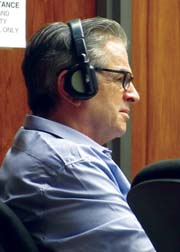
Wearing headphones to help him hear, Tisse Henriksen listens to testimony Friday in his attempted murder trial in 2nd Circuit Court. -- The Maui News / LILA FUJIMOTO
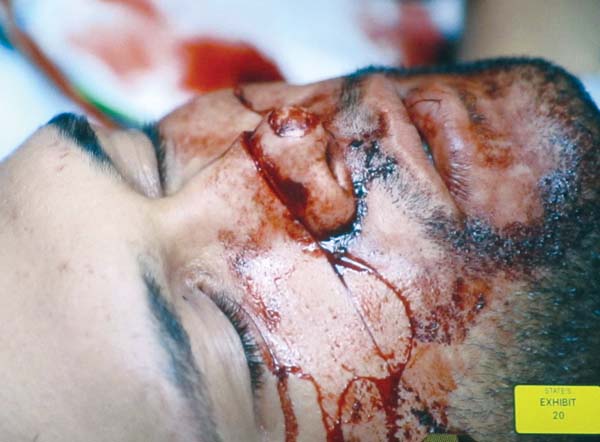
A photo shows a slash that went across victim Kalani Wright’s face, cutting through the cartilage of his nose. -- The Maui News / LILA FUJIMOTO
Wearing headphones to help him hear, Tisse Henriksen listens to testimony Friday in his attempted murder trial in 2nd Circuit Court. -- The Maui News / LILA FUJIMOTO
A photo shows a slash that went across victim Kalani Wright’s face, cutting through the cartilage of his nose. -- The Maui News / LILA FUJIMOTO
Trending
WAILUKU -- "A tremendous amount of force" was used to inflict stab wounds that were so deep that they hit a homeless man's rib and chipped his shoulder bone while missing vital organs, a doctor testified Friday.
Dr. Mitchell Tasaki said two of Kalani Wright's four stab wounds had the potential to be life-threatening, but his rib and shoulder blade stopped the knife from penetrating farther into his chest and reaching his diaphragm, lung, aorta or heart.
"The rib was exposed, and it stopped there," Tasaki said, describing a 3-inch-deep cut to Wright's lower chest that had an upward trajectory toward the middle of his body to hit his rib. "The rib sort of protected the knife from going into his chest."
Similarly, he said a CT scan of a 4-inch-deep cut in Wright's left chest near his armpit showed a broken fragment where bone had chipped off his shoulder blade. "That was probably protective, like the rib, in preventing penetration into the chest cavity," Tasaki said.
The general surgeon testified Friday in the 2nd Circuit Court trial of Tisse Henriksen, 58, who has pleaded not guilty to second-degree attempted murder of Wright.
Wright said he was stabbed after intervening in a confrontation between Henriksen and another man, who had been knocked to the ground on the lanai of the former Century 21 real estate office at Puunene and Kaahumanu avenues in Kahului shortly after midnight Jan. 1, 2017.
Wright and others had gathered there to watch fireworks at Kahului Harbor when Henriksen showed up and was told to leave, according to witnesses.
Tasaki examined and treated Wright, who was then 31 years old, when he was brought to the Maui Memorial Medical Center emergency room with four lacerations or cuts.
In addition to the two cuts to his chest, Wright had a 1.5-inch-deep cut across his face that cut through his nose and had to be sutured, Tasaki said.
Another cut, in Wright's left upper arm, was jagged and shredded his deltoid muscle, Tasaki said.
None of the wounds were life-threatening, although the two chest wounds had the potential to be, he said. Had the knife not hit the rib in the wound to Wright's lower chest, "it would likely have gone through the diaphragm to probably have hit the lung," Tasaki said.
As for the wound to Wright's left chest, "if it had penetrated into the chest cavity, there's some vital structures nearby, primarily the lung," Tasaki said.
"If it had gone deeper, the aorta, the heart," he said.
Deputy Prosecutor Emlyn Higa asked what would have happened if the knife had gone deeper.
"If it hit the aorta, the heart, he probably would have bled out immediately," Tasaki said.
He said that if the knife had hit the lung, there would have been significant bleeding that would have been life-threatening.
Under cross-examination by defense attorney Cary Virtue, Tasaki said CAT scans and X-rays of Wright's wounds didn't show obvious life-threatening injuries. "But in reality, it's often a different story," Tasaki said. "It doesn't always show everything."
Tasaki said reports showed Wright was high on ice, or methamphetamine, and he didn't lose consciousness after being stabbed.
Responding to a written question submitted by a juror, Tasaki said "a significant amount of force" was used to cause the wound to Wright's left chest.
"You're not going to get that injury that severe where the bone is breaking off from the shoulder blade bone with lackadaisical force," Tasaki said.
He said it would take a "tremendous amount of force."
Referring to the lower chest wound that hit Wright's rib, Tasaki said, "I'd rate that as similar . . . a tremendous amount of force."
He said the trajectory of the lower chest wound was upward toward the center of the body. The trajectory of the left upper chest wound was downward and toward the back, Tasaki said.
Under questioning by Virtue, Tasaki acknowledged he doesn't have training in forensic pathology and doesn't respond to crime scenes with police. Tasaki said he didn't receive information about who inflicted the stab wounds.
"Force is force, but the amount of effort would vary between individuals," Tasaki said. "I would argue that the force of those injuries was significant."
As a general surgeon, "I do cut every week and I know how much force it takes to get that deep," Tasaki said.
"Even with a very sharp knife, I would have to put a tremendous amount of force to get as deep as these wounds," he said.
After the doctor's testimony, the prosecution rested its case in chief.
Judge Peter Cahill is presiding over the jury trial, which was scheduled to resume Monday.
* Lila Fujimoto can be reached at lfujimoto@mauinews.com.