
Woman in deadly crash offers ‘low probability of danger’
First of 3 experts testifies at hearing to determine her fate
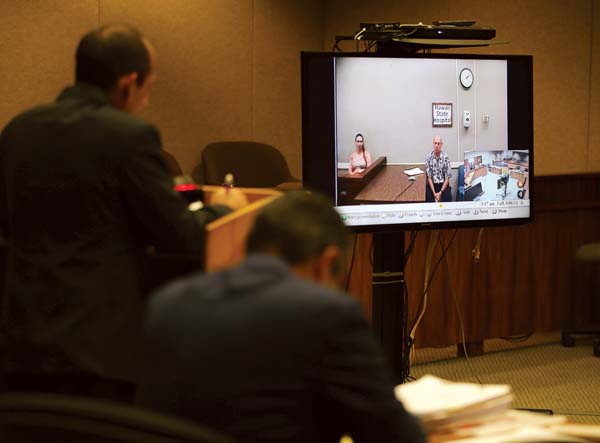
Ashley Wellman and state psychologist Alex Lichton appear before Judge Richard Bissen in 2nd Circuit Court via videoconference from the Hawaii State Hospital on Oahu on Friday. Wellman was acquitted of murder by reason of insanity in a 2016 crash in Pukalani and the hearing before Bissen was to determine her fate, which could range from conditional release to committal to the Hawaii State Hospital. -- The Maui News / CHRIS SUGIDONO photo
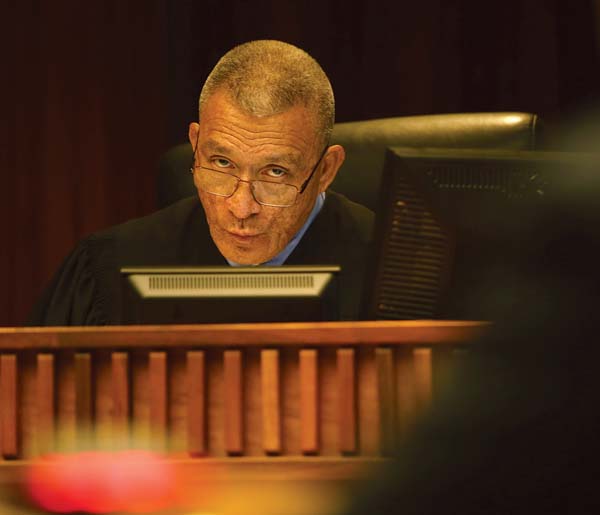
Second Circuit Mental Health Court Judge Richard Bissen presided over a hearing Friday that will determine the fate of Ashley Wellman, who has been acquitted of murder by reason of insanity. -- The Maui News / CHRIS SUGIDONO photo
Ashley Wellman and state psychologist Alex Lichton appear before Judge Richard Bissen in 2nd Circuit Court via videoconference from the Hawaii State Hospital on Oahu on Friday. Wellman was acquitted of murder by reason of insanity in a 2016 crash in Pukalani and the hearing before Bissen was to determine her fate, which could range from conditional release to committal to the Hawaii State Hospital. -- The Maui News / CHRIS SUGIDONO photo
Second Circuit Mental Health Court Judge Richard Bissen presided over a hearing Friday that will determine the fate of Ashley Wellman, who has been acquitted of murder by reason of insanity. -- The Maui News / CHRIS SUGIDONO photo
Trending
WAILUKU -- A woman acquitted of murder by reason of insanity in a vehicle crash in Upcountry in 2016 "presents a relatively low probability of danger" if she is released into the community under recommended conditions, a forensic psychologist testified Friday.
State psychologist Alex Lichton said Ashley Wellman was "very stable without significant signs of post-traumatic stress disorder" when he met with her Sept. 4 to evaluate her dangerousness.
He said she had been suffering acute symptoms of PTSD, re-experiencing a trauma and acting as if it were reoccurring on Oct. 8, 2016, when she ran a red light while traveling at least 127 mph uphill on Haleakala Highway to cause a crash that killed two people.
Police said the 2011 silver Nissan Altima driven by Wellman broadsided a white 1998 Toyota Tacoma pickup truck that had been turning left from Makani Road onto the highway. Pukalani residents Debi Wylie, 63, who was driving the truck, and her passenger and partner Traci Winegarner, 57, died at the scene of the crash.
On Aug. 7, Wellman, 34, of Waiehu was acquitted by reason of insanity of murder charges.
Second Circuit Judge Peter Cahill said three doctors who conducted psychiatric or psychological examinations of Wellman agreed that, at the time of the crash, she was affected by a physical or mental disease, disorder or defect that substantially impaired her capacity to conform her conduct to the requirements of the law.
For a hearing Friday before 2nd Circuit Mental Health Court Judge Richard Bissen, Lichton and Wellman appeared by videoconference from the Hawaii State Hospital, where she has been held temporarily since her acquittal.
After hearing from three psychologists or psychiatrists who evaluated Wellman, Bissen will decide what happens to her -- from conditional release to committal to the Hawaii State Hospital.
Lichton, who also met with Wellman in March to evaluate her penal responsibility and fitness to proceed in her criminal case, said Wellman's PTSD episode the day of the crash could have been triggered by a combination of stresses, which are no longer present.
He said she had discovered a co-worker dead in his apartment, was working at an agency that was in the same place where she had reported instances of being abused as a child and was living in a situation where she had fear that a relative who had previously abused her would try to do so again.
Lichton said Wellman reported she had lost her insurance and had trouble scheduling appointments to see a therapist because of a waiting period.
"It helps explain why these symptoms remained as severe as they were for a period of time," Lichton said.
After meeting with her this month, he said "she presents a relatively low probability of danger to others, herself or property as long as she's released under the recommended conditions."
He said the conditions would include that she not drive and live with her boyfriend in Waiehu, where she could walk to therapy.
She also would be required to have regular psychotherapy and see a psychiatrist and case manager, Lichton said.
"Any changes in her mental status could be picked up relatively quickly," he said.
He said the treatment team at the Hawaii State Hospital supports the plan to have Wellman released with conditions.
"The proposed treatment plan for discharge is pretty much the same treatment plan she had in place earlier when she was living in the community on Maui," he said.
She would be able to call after hours or send a text message to a therapist, Lichton said.
"Help is pretty much available rather quickly, unlike the time of the instant offenses," Lichton said.
Deputy Prosecutor Andrew Martin asked if it also would be important that Wellman not use illegal drugs, referring to her history of abusing substances including marijuana, crack cocaine, heroin, LSD, psychedelic mushrooms, crystal methamphetamine and alcohol.
Lichton said yes.
He said Wellman reported she was using marijuana, including on the night before the crash.
Lichton said that in general, marijuana should not be used by someone suffering from a mental disease. But he said PTSD is different from schizophrenia and other severe mental illnesses. "In small amounts, I would not expect it to exacerbate dangerousness," he said.
"There will be no one on a daily basis to insure she's complying with her medication?" Martin asked.
"Yes," Lichton said. "There's no professional, no probation officer, therapist, case manager. She's living with other people who may assess it. Is she going to be released to independent living where you don't have professionals supervising medications? That's true."
"Her relapse prevention plan -- it essentially consists of her being aware and being able to identify the warning signs, correct?" Martin asked.
"Yes," Lichton said.
Lichton said the success of the release plan ultimately would depend on Wellman.
"You cannot predict whether or not she will be dangerous?" Martin asked.
"Well, there's no 100 percent certainly about the factor," Lichton said. "You can only make an educated opinion based upon the available facts and the tools that are available to us."
Lichton said it would be important for Wellman to comply with taking her medication "as long as it's prescribed."
"At some point, the doctor may take her off," he said.
"She likes the medications now," he said. "She says, 'This is the first time I have felt 100 percent normal. I really feel good on these medications.' We don't expect her to stop."
Martin referred to similar comments Wellman made to a Kaiser Behavioral Health doctor in April 26, 2016, followed by a report to another doctor the day of the crash that she had discontinued her medication "because she did not find it helpful."
"Would you find it concerning or surprising if you knew that previously she had reported she loves being on her medication, that she feels back to her good self . . . only to go off her meds?" Martin asked.
"It's significant information," Lichton said.
After examining Wellman for penal responsibility in March, Lichton's report found that Wellman's cognitive capacities were substantially impaired as a result of post-traumatic stress disorder and depression. He acknowledged also reporting that she had feigned or exaggerated psychiatric symptoms in order to gain a favorable outcome but hadn't been faking symptoms of memory loss.
Judge Bissen asked whether the doctor believed the crash was an accident or occurred as a result of PTSD.
"I think both things are true," Lichton said. "Technically, isn't it considered a motor vehicle accident? I don't think there was any conscious intent to get into a collision or to injure herself or others, so in that sense I call it an accident."
"You don't think she did this on purpose?" Bissen asked. "You think this was just a car accident that happened coincidentally to someone who has PTSD?"
"It's not a coincidence," Lichton said. "It resulted from the PTSD."
Bissen asked whether personal support for Wellman, which Lichton said was important in reducing violence and recidivism, had been there at the time the crash occurred.
"I think the support was in place at the time," Lichton said. "She certainly had been living with the boyfriend."
She also likely had support from her boyfriend's family, her hanai family and two friends she's had for 23 years, Lichton said. "It does appear she had adequate support back then."
The hearing is scheduled to continue Friday.
* Lila Fujimoto can be reached at lfujimoto@mauinews.com.