
Expert: Defendant ‘moderate to high risk’ of danger
Testimony part of hearing to determine fate of woman who caused deadly crash
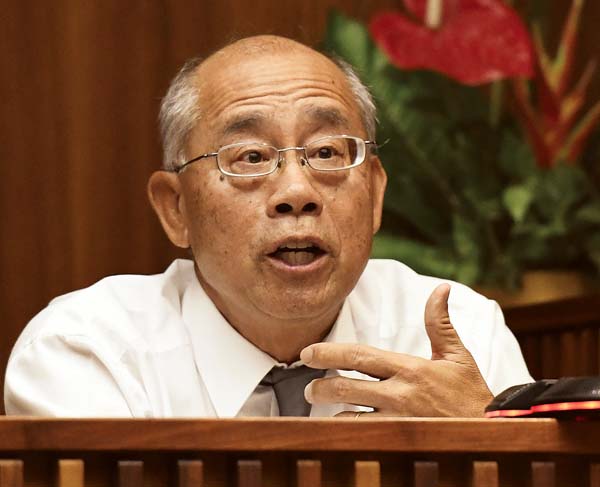
Psychologist George Choi testifies Wednesday on the dangerousness of Ashley Wellman in 2nd Circuit Mental Health Court. Wellman was acquitted of murder by reason of insanity for causing a fatal crash in Pukalani in 2016. The hearing was to determine what happens to Wellman next. The Maui News / MATTHEW THAYER photos
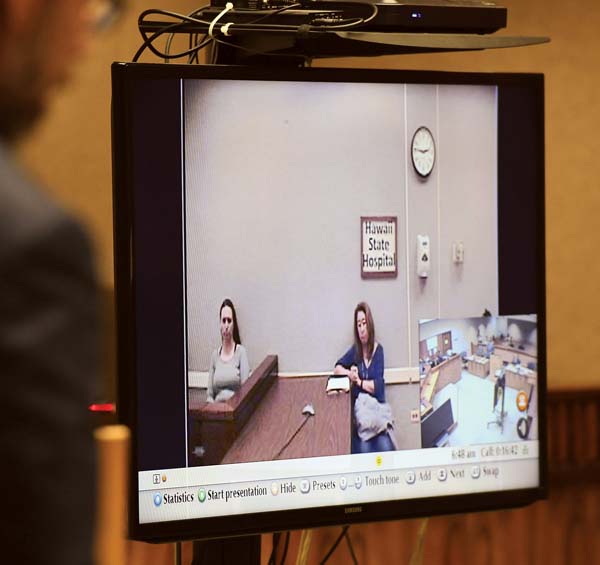
Defendant Ashley Wellman (left) follows the proceedings from the Hawaii State Hospital on a video conference call Wednesday.
Psychologist George Choi testifies Wednesday on the dangerousness of Ashley Wellman in 2nd Circuit Mental Health Court. Wellman was acquitted of murder by reason of insanity for causing a fatal crash in Pukalani in 2016. The hearing was to determine what happens to Wellman next. The Maui News / MATTHEW THAYER photos
Defendant Ashley Wellman (left) follows the proceedings from the Hawaii State Hospital on a video conference call Wednesday.
Trending
WAILUKU -- A woman acquitted of murder by reason of insanity poses a "moderate to high risk" of danger to herself or others and has a history of "poor decisions," including not checking herself into a hospital psychiatric ward the night before she caused a crash that killed two women, a psychologist testified Wednesday.
After meeting with Ashley Wellman and reviewing records in her case, psychologist George Choi said his opinion was that she should be committed to the state health director for treatment "for an indeterminate amount of time" before she can be discharged into the community.
He said Wellman has been diagnosed with depression and post-traumatic stress disorder that are "pretty severe."
"She's been struggling with that for a long time," Choi said." Historically, she's shown that she made some poor decisions. Some of those decisions led, in this case, to some really tragic consequences."
He said records showed Wellman had sought help from Kaiser Behavioral Health on the three days before the fatal collision. The night before the crash, she reported she had planned to check herself into the Molokini Ward at Maui Memorial Medical Center.
"Something happened. She decided not to do that," Choi said. "That concerned me. In this case, that decision of not following through with the plan resulted in some serious, serious consequences."
Choi testified before 2nd Circuit Mental Health Court Judge Richard Bissen, who will decide what happens to Wellman next. Options range from conditional release to committal to the Hawaii State Hospital, where she has been held temporarily since her acquittal Aug. 7.
Wellman, 34, of Waiehu was indicted on murder charges for the crash the morning of Oct. 8, 2016, when she ran a red light while traveling at least 127 mph uphill on Haleakala Highway, according to a police investigation.
Police said the 2011 silver Nissan Altima driven by Wellman broadsided a white 1998 Toyota Tacoma pickup truck that had been turning left from Makani Road onto the highway. Pukalani residents Debi Wylie, 63, who was driving the truck, and her passenger and partner Traci Winegarner, 57, died at the scene of the crash.
In acquitting Wellman of the charges, 2nd Circuit Judge Peter Cahill said three doctors who conducted court-ordered psychiatric or psychological examinations of Wellman agreed that, at the time of the crash, she was affected by a physical or mental disease, disorder or defect that substantially impaired her capacity to conform her conduct to the requirements of the law.
The same three doctors prepared reports on Wellman's risk of dangerousness for a hearing that began last month.
Wellman appeared by videoconference from the State Hospital for the hearing Wednesday.
Choi's opinion on Wellman's dangerousness contrasted with that of state psychologist Alex Lichton.
During testimony last month, Lichton said Wellman "presents a relatively low probability of danger" if she is released into the community under recommended conditions.
Lichton said Wellman was "very stable without significant signs of post-traumatic stress disorder" when he met with her Sept. 4 to evaluate her dangerousness.
Choi, who also met with Wellman after she was acquitted, said he administered a test to help assess her probability of engaging in violence.
"It's difficult to predict violence 100 percent," Choi said. "What's most useful is one's history."
He said there was "troubling" information in Wellman's history, including relationship instability and problems with employment and substance use.
As recently as before the crash, Wellman reported using marijuana to help her sleep, Choi said.
He said the drug "alters your perception, alters your psychological functioning."
"Cannabis alters one's mood," he said. "Cannabis can exacerbate paranoia and delusions."
"When I talked with her about the fatal accident and the death of two women she talked about sort of being sad about the consequences," Choi said. "I didn't get a sense of remorse. I hear it. I don't feel it. I don't get a sense of that."
In talking with Wellman for the two evaluations, Choi said he believed she was "overreporting some of the psychiatric symptoms."
"Before trial, there's more reporting of psychiatric symptoms," he said. "Is she giving me information based on convenience . . . or is this really accurate?"
He said there were inconsistencies in her reporting of psychotic symptoms. "A lot of times the history is not there, but she tells me so," he said. "It gave me pause to wonder, what is this about . . . manipulation or something else. It gives me pause."
Although Wellman had no arrests or convictions before the crash, "once it happened, it could happen again," Choi said.
"It was random, not planned," he said.
Asked by Deputy Prosecutor Andrew Martin how Wellman could gain insight into issues to decrease her potential risk of dangerousness, Choi said, "I think it's going to be over time."
"I'd like to see that in a more structured way first so that she could really be able to manage it much better before she could be back in the community," he said. "Because once she's in the community, a lot depends on her."
He said Wellman's history showed periods where she had been in treatment and taking mental health medication.
She reported she "loved being on" her medication during an April 26, 2016, doctor's appointment before telling another doctor two days before the fatal crash that she had stopped taking the medication because it wasn't working.
"Sometimes, she would be compliant and sometimes she would decide to stop on her own," Choi said.
Defense attorney Matthew Nardi asked about reports showing that Wellman was suffering from an episode that began in March 2016 when she found a friend dead by suicide and that continued to become more severe until the day of the crash.
"So it wasn't unpredictable," Nardi said. "We saw the trigger and we saw the worsening symptoms?"
Choi said yes.
He acknowledged that on the day of the crash, Wellman reported seeing a relative who had abused her years earlier.
Judge Bissen asked Choi whether he sees cases where "someone is so mentally ill they can't be held responsible for their conduct, but all of a sudden there's been a change" so their illness is not so severe.
"Do you see something that drastic?" Bissen asked.
Choi said he hadn't seen "this kind of drastic."
He said when people face criminal charges and dire consequences, "there's always a question of secondary gain of what you report or don't report or whether you report more or less to get a favorable outcome."
The hearing was scheduled to resume this month with testimony by the third doctor who examined Wellman.
* Lila Fujimoto can be reached at lfujimoto@mauinews.com.