
Courage at sea rescues disabled ship
Molokai-born man, 87, receives Coast Guard Commendation Medal . . . 66 years later
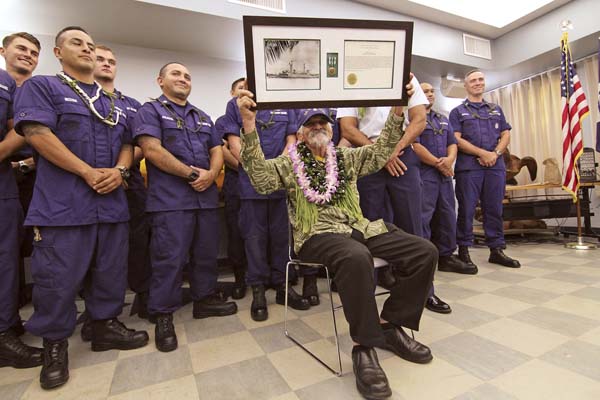
Surrounded by a U.S. Coast Guard crew from Maui, Mitchell Pauole Lani (center, seated) holds up the Coast Guard Commendation Medal he received Monday, 66 years after he singlehandedly helped a Coast Guard cutter avert disaster during a training exercise off the coast of Oahu. An experienced free diver, Lani dove below the ship to extract a cable caught in the ship’s propellers. The Maui News / COLLEEN UECHI photos
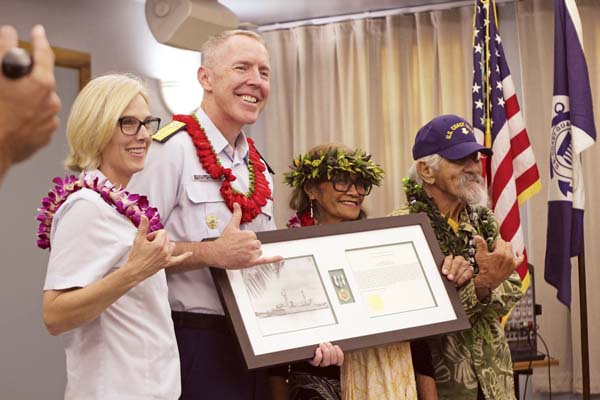
Master Chief Petty Officer Lori Fields (from left) and Rear Admiral Kevin Lunday from the Coast Guard office in Honolulu stand alongside Florence Lani and Mitchell Pauole Lani shortly after the awarding of the commendation medal.
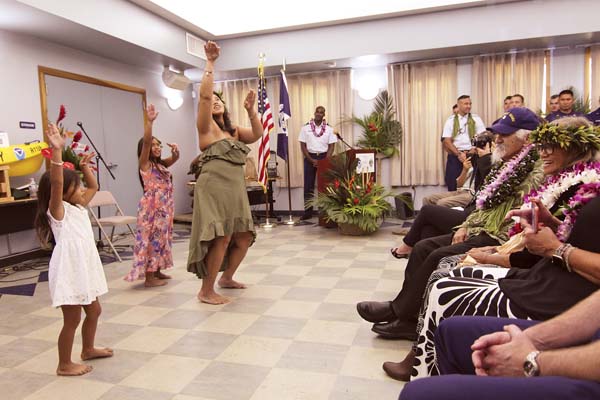
Four-year-old Laua‘e Lani-Montira (from left), one of Mitchell Lani’s granddaughters, dances hula with 7-year-old sister Lehiwa and mom Pasha. Also dancing but not pictured is 9-year-old Laule‘a.
Surrounded by a U.S. Coast Guard crew from Maui, Mitchell Pauole Lani (center, seated) holds up the Coast Guard Commendation Medal he received Monday, 66 years after he singlehandedly helped a Coast Guard cutter avert disaster during a training exercise off the coast of Oahu. An experienced free diver, Lani dove below the ship to extract a cable caught in the ship’s propellers. The Maui News / COLLEEN UECHI photos
Master Chief Petty Officer Lori Fields (from left) and Rear Admiral Kevin Lunday from the Coast Guard office in Honolulu stand alongside Florence Lani and Mitchell Pauole Lani shortly after the awarding of the commendation medal.
Four-year-old Laua‘e Lani-Montira (from left), one of Mitchell Lani’s granddaughters, dances hula with 7-year-old sister Lehiwa and mom Pasha. Also dancing but not pictured is 9-year-old Laule‘a.
Trending
KIHEI -- On an overcast afternoon in May 1952, a young petty officer from Molokai singlehandedly helped a U.S. Coast Guard cutter avert disaster off the coast of Oahu -- a heroic act that went unrecognized for 66 years.
On Monday, former Petty Officer 3rd Class Mitchell Pauole Lani, now 87 years old, was awarded the Coast Guard Commendation Medal in a ceremony that officials agreed was long overdue.
"Although today is far too long in arriving -- 66 years -- the events and actions we're going to recognize today are just as significant as when they happened 66 years ago," said Rear Admiral Kevin Lunday, commander of the Coast Guard 14th District in Honolulu.
Six decades ago, amidst the backdrop of the Korean War, 21-year-old Lani was serving as a cook on the U.S. Coast Guard Cutter Forster. Ships regularly conducted exercises off of Honolulu, and on this particular afternoon, the crew of the Forster was about 400 miles offshore, going through a gunnery exercise with a plane flying a drone target overhead.
While the cutter was firing, the pilot dropped the drone, target and cable into the ocean, and the cutter was sent to pick up the equipment. But as the ship approached the area, the cable slipped underneath and got tangled in the propellers.
"Now that's a very dangerous situation, because if the cable comes underneath and gets caught in the propellers, it can cripple the ship and put the ship and the crew in danger," Lunday said. "So the ship stopped."
The ship's commanding officer, knowing Lani was a free diver, asked him to go below the ship and investigate. Lani grew up the son of a Hoolehua farmer and loved the ocean, fishing and diving. But even for an experienced waterman, the task was not easy. The current was strong and the seas were rough, with swells of 8 to 12 feet, and the crew had spotted sharks nearby. But Lani agreed and dove in with nothing more than a pair of bamboo goggles.
"See the Coast Guard, they don't carry diving equipment on the ship. That's what makes it hard," Lani said. "So lucky I had my Hawaiian goggles with me. No matter where I go I take 'em. . . . Homemade but good."
Lani confirmed what the commanding officer had feared -- the cable was tangled around both propellers. Lani climbed back aboard and prepared for the ship to call a salvage tug. But then the captain asked Lani to perform an even more dangerous task -- freeing the propellers from the cable.
"When the captain asked me for dive the second time, I felt I no can make 'em," Lani said. "But am I still gonna do (it)? I said yeah. We all gotta die one day anyway. So I did. I continued diving because the ship and the shipmates is important to me. If I don't dive, who going dive? Nobody."
Lunday said the Coast Guard of today would never ask a crew member to do what Lani did that day. But 1952 was a different time.
"We used to have this saying that came from the days of the lifesaving service," Lunday said. "And the saying was, 'The rules say you have to go out, but no rule says you have to come back.' Now about 20 years ago, the commandant of the Coast Guard said that we will never utter that phrase again in our service because it no longer reflects how we value our people."
Lani said there may have been others among the 120-member crew who could dive, but nobody came with him, and he guessed they may have feared the sharks. It was around 4:30 p.m. when Lani descended alone and began to work on the cable, which was wrapped loosely around both propellers. With no fins, he would "kick like hell" to a depth of about 35 to 40 feet, spend about a minute unwrapping as much cable as he could, then resurface for air.
"I did that couple hours," Lani said. "Real bad. I was all buss up. The ship pound me, hit your body, your legs, your hip."
Lani made six separate dives over the course of a couple hours.
"To put it in perspective, this ship, the Forster, was a destroyer over 300 feet long, 1,600 tons under full load," Lunday said. "Mr. Lani was underneath that ship on those dives, and he was thrashed against the hull repeatedly by the current and the waves. . . . But Mr. Lani persisted, and he finally, on his own, freed the cable."
Exhausted, Lani swam back to the ship and climbed up the hanging ladder, getting smashed into the hull by a wave that caused internal injuries. But he still managed to scale the ship and pull the cable aboard.
After the cutter returned safely to Pearl Harbor, Lani was sent to the ship's doctor. But with no broken bones or visible lacerations, Lani did not receive higher-level medical care and was only given 20 days off -- another Coast Guard protocol that's changed since then, Lunday said.
"What happened that day and our failure in the Coast Guard to credit Mr. Lani caused him and his family a great deal of pain and difficulty in the decades since his service," Lunday said. "Mr. Lani, I deeply regret that you suffered from that, and you still do."
Lunday said that when Lani's heroic actions came to light, the Coast Guard launched an investigation and "gathered significant factual evidence" to prove that Lani was deserving of an award. Lunday explained that whenever the Coast Guard wants to recognize an event that happened more than three years ago, it must go to a panel of flag officers at Coast Guard headquarters. In September, the full panel of senior leaders unanimously approved Lani's recognition.
"While we should not have asked Mr. Lani to dive under those dangerous conditions, he got the mission done despite all those odds," Lunday said. "And he served with honor long before most of us were even born."
On Monday, in addition to his commendation medal, Lani also received certificates from U.S. Rep. Tulsi Gabbard and representatives for Gov. David Ige and state Rep. Lynn DeCoite.
"My heart humbly accepts the kind words," Lani said to a roomful of family members, elected officials and crew members from the Coast Guard's Maui station. The ceremony was held at the Hawaiian Islands Humpback Whale National Marine Sanctuary Visitor Center in Kihei.
The youngest of 10 children, Lani is the last of his siblings still living, daughter Irene Plunkett-Mina said. He lives in Kula and has 11 children and about 30 grandchildren.
Florence Lani said that her husband suffered from post-traumatic stress, had surgery for his eyes and hips, and dealt with knee and spine problems, all as a result of that incident. She said she was "so relieved" to see her husband get the medal Monday.
"It's going to take time to heal, because I hear his voice every day. He tells me (the story) over and over," she said. "He can forget about other things, but he cannot forget that incident."
* Colleen Uechi can be reached at cuechi@mauinews.com.