
Sign project aims to raise awareness of the state’s ancient land divisions
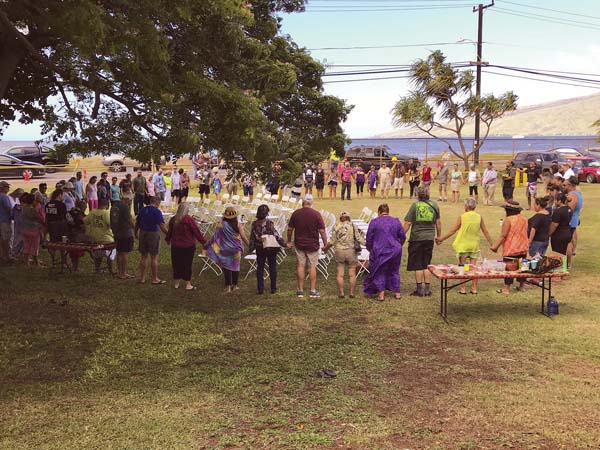
People hold hands during a blessing and groundbreaking ceremony Oct. 26. The event marked the installation of the first sign designed by Vernon Kalanikau to signify an ahupua‘a, or land division, within a moku on an island in Maui County. The sign project is supported by a $25,000 grant from the county Office of Economic Development. Signs are being installed along South Maui’s roadways indicating which ahupua‘a and moku people are in. Eventually, project organizers hope to have such signs installed in all 12 moku in the county. LYNN ARAKI-REGAN photo
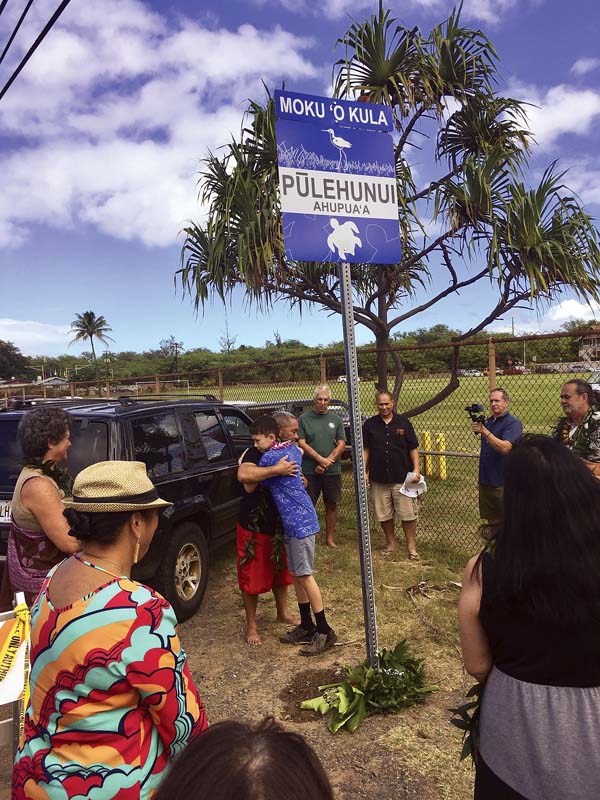
Vernon Kalanikau hugs Wailuku resident Riley Regan after the Oct. 26 installation of a sign to signify the Pulehunui ahupua‘a. Regan wrote a letter to The Maui News about how he saw ahupua‘a signs on Oahu but not on Maui. Kalanikau contacted Riley, giving birth to the cultural heritage project to raise awareness about Hawaii’s ancient land divisions. RAND REGER photo
People hold hands during a blessing and groundbreaking ceremony Oct. 26. The event marked the installation of the first sign designed by Vernon Kalanikau to signify an ahupua‘a, or land division, within a moku on an island in Maui County. The sign project is supported by a $25,000 grant from the county Office of Economic Development. Signs are being installed along South Maui’s roadways indicating which ahupua‘a and moku people are in. Eventually, project organizers hope to have such signs installed in all 12 moku in the county. LYNN ARAKI-REGAN photo
Vernon Kalanikau hugs Wailuku resident Riley Regan after the Oct. 26 installation of a sign to signify the Pulehunui ahupua‘a. Regan wrote a letter to The Maui News about how he saw ahupua‘a signs on Oahu but not on Maui. Kalanikau contacted Riley, giving birth to the cultural heritage project to raise awareness about Hawaii’s ancient land divisions. RAND REGER photo
Trending
The Maui News
Signs have been erected in South Maui to raise awareness about Hawaii's ancient land division system.
Workers installed the first sign Oct. 26 in Kihei after a blessing and groundbreaking ceremony at Kenolio Park. According to an announcement, the first signs are limited to the Kula Kai, also known as Kihei or South Maui, an ahupua'a within the moku, or district, of Kula.
The aim of the cultural heritage program funded by the county Office of Economic Development is to create and install signs eventually for all 12 moku in the county. For the time being, though, the signs will be installed along South Maui's roadways, indicating which ahupua'a and moku people are in.
More than 100 people participated in the blessing and groundbreaking ceremony at Kenolio Park.
Vernon Kalanikau, the overall project coordinator, said: "The sign project represents all of us, the people of Maui Nui, bringing us together as one people. The colors of the signs were created by me because, as a graphic artist, I color-coded the signs to give separation on the computer monitor because that's how I work. The colors had no bearing or connection to the specific ahupua'a."
However, he said, the chosen colors for the signs "seem to make sense in relationship to the mo'olelo (story or legend) and purpose of each ahupua'a," he said.
For example, light purple is associated with Keokea, where sweet potato thrived in the upland area. And, in Waiohuli, green stems from the fertile area where fresh water still flows into the ocean.
"The community in Kula Kai and other moku supported the colors, which is important," he said. "The designs or graphics on the signs are based on the food resources gathered from the kai within that ahupua'a. You'll find the limu lipoa and papio in the Waiohuli ahupua'a. Waiakoa ahupua'a you have limu 'ele'ele and akule."
Kalanikau said his inspiration for the sign project came from talking with people.
"Finding as we speak amongst ourselves things just falls in place, which really made this project happen," he said. "Life has no accidents or coincidences. I cannot forget our kupuna before us, the kohola and other forms of Kanaloa who truly inspired me throughout this project. And last but not least, 'serve all and not certain ones.' Be aloha, self-gratitude and trust."
Ahupua'a was the common subdivision of the land in ancient times. It consisted most frequently of a slice of an island that went from the top of a region's mountain to the shore, often following the boundary of a stream drainage. Each ahupua'a included a lowland mala (cultivated area) and upland forested region.
Ahupua'a varied in size depending on the economic means of the location and political divisions of the area, according to the announcement.
Ahupua'a is derived from the Hawaiian language "ahu," meaning "heap" or "cairn," and "pua'a" means pig. The boundary markers for ahupua'a were traditionally heaps of stones used to put offers, often a pig, to the island chief, the announcement says.
Maui County Council Member Kelly King said the cost of the sign project was $25,000.
"It's a small amount of money," she said. "It's having such a widespread effect on our aha moku community here."
She said Kihei is fairly well known as a tourist destination with strip malls, beaches and hotels.
"There's not a lot of recognition of the cultural identity of Kihei," she said. "This is kind of the first step in trying to bring some cultural identity to Kihei."