
Petition: Remove bathrooms at park to restore sanctity
Testifiers, officials spar over $3 million in proposed upgrades
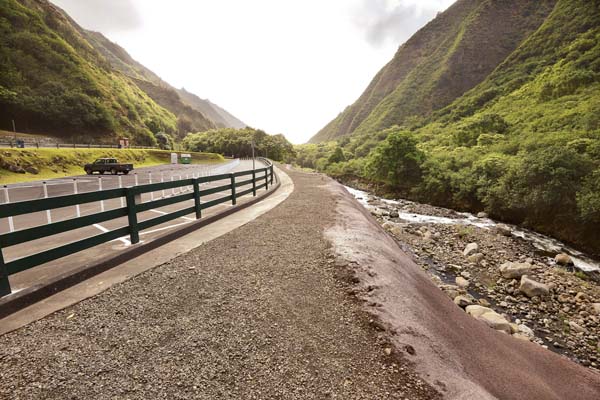
The Iao Valley State Monument parking lot housed one port-a-potty in 2017. A state proposal presented Thursday in Wailuku would use $3 million in state Legislature appropriated funds to upgrade the parking lot, entryway and nonoperational bathrooms, among other work. Residents submitted a petition at the meeting opposing the bathroom near the foot of Iao Needle, since the area is viewed by Native Hawaiians as sacred. The Maui News / MATTHEW THAYER photo
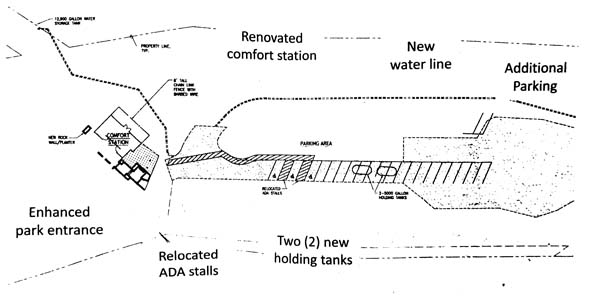
The site plan for the $3 million upgrade proposed for the Iao Valley State Monument parking lot, bathroom and surrounding area was presented at a meeting Thursday night. Department of Land and Natural Resources presentation graphic
The Iao Valley State Monument parking lot housed one port-a-potty in 2017. A state proposal presented Thursday in Wailuku would use $3 million in state Legislature appropriated funds to upgrade the parking lot, entryway and nonoperational bathrooms, among other work. Residents submitted a petition at the meeting opposing the bathroom near the foot of Iao Needle, since the area is viewed by Native Hawaiians as sacred. The Maui News / MATTHEW THAYER photo
The site plan for the $3 million upgrade proposed for the Iao Valley State Monument parking lot, bathroom and surrounding area was presented at a meeting Thursday night. Department of Land and Natural Resources presentation graphic
Trending
WAILUKU -- Decrying the lack of community engagement, residents submitted a petition to state officials Thursday evening to halt some aspects of a $3 million project to upgrade Iao Valley state park.
The petition, started by nonprofit director Kawewehi Pundyke, calls for ceasing work on a proposed park "comfort facility" and instead relocating its inoperative existing bathroom, which would restore the sanctity of what Native Hawaiians view as a holy place and what history affirms as the interment site for many kings, chiefs and leaders after a landmark Iao Valley battle in 1790, Pundyke said.
"All we're trying to say is, let Iao have its sanctity back," said Pundyke, who leads Lo'iloa, a Native Hawaiian cultural education organization.
Pundyke said the petition was signed by 1,600 residents.
Meanwhile, state Department of Land and Natural Resources officials working on the project and one testifier who owns a tour company backed bathroom construction at the park, saying it's an issue of public health and safety.
The project, now in its design phase, would include a new park new entry, about 35 additional parking stalls, a comfort station to replace the bathroom that was closed in 2009, water and sewer work, and slope stabilization of Kinihapai Stream, according to a DLNR presentation.
Holding tanks for the comfort station would need to be pumped every three weeks during peak visitor times. At $500 per load and three loads per pump, annual pumping costs would total about $189,000. Project leaders emphasized that no effluent would be discharged into the ground or stream.
DLNR Division of State Parks officials Russell Kumabe, development branch chief, and Larry Pacheco, district superintendent, presented the proposal at a Wailuku community center meeting Thursday evening with about two dozen in attendance, including state and county politicians, Native Hawaiian cultural practitioners and Wailuku residents, among others.
"To me, it's more of a desecration to have people going into the bushes," Pacheco said. "Who is going to caretake after them? We would have to go in and clean up."
Pundyke suggested increased community involvement in the planning process and collaboration with the state and county to find a solution.
"Why not just have people use Kepaniwai Park restrooms?" Pundyke asked.
Nearby Kepaniwai Park, which is overseen by the county, has a bathroom facility.
Several testifiers against bathrooms at the state park noted sacred sites around the world that don't have restrooms. One example was the Kukaniloko Birthstones State Monument on Oahu.
Hokuao Pellegrino, president of stream restoration and protection group Hui Na Wai Eha, echoed the need for community engagement in the Iao park amenities planning process.
Calling Iao "the holiest of holies," he voiced concern over slope repairs proposed for Kinihapai Stream, the need for archeological monitoring and the cost of adding bathrooms when the port-a-potties "aren't as pretty" but function fine.
"Kinihapai Stream has some of the most important endemic and indigenous aquatic species," said Pellegrino, who traces his lineage to Iao. "The potential of enclosing that or channeling it without looking at aquatic biota would be an injustice to all the work to right the injustice that has happened over the last 100 years," referencing the recent restoration of area in-stream flow standards after years of plantation ag diversion.
"This needs to be looked at holistically from a community engagement approach," he added.
Kumabe emphasized after the meeting that there are two concurrent Iao projects: The $3 million park improvement project presented Thursday, and the ongoing master plan project, which started in 2014.
As a popular destination for tourists and residents, Iao Valley State Monument attracts about 1,800 people per day, according to a 2017 estimate, DLNR said. Parking fees for nonresidents were implemented around 2013-14, and $18,750 per month in parking revenues goes to a special fund for state park staffing and operating costs.
Officials said construction on the park improvement project could start as early as next year, funded by $3 million that the state Legislature appropriated for improvements in 2017, a year after a massive flood roared through the valley and altered area topography.
Construction would take about six months and require park closure.
"In light of concerns and issues raised at the Wailuku meeting last night, the project team will discuss proposals shared at the meeting," Kumabe said via email Friday. "We still have the responsibility for public health and safety in the park and the team will determine which improvements we will need to implement and which we can defer.
"On a parallel track, the Iao master plan project will continue in establishing its community involvement process as several meeting attendees provided referrals and interest in participating in that process."
* Kehaulani Cerizo can be reached at kcerizo@mauinews.com.