
Group intervenes over Welakahao project concerns
Developers, lineal descendants headed for mediation over impacts
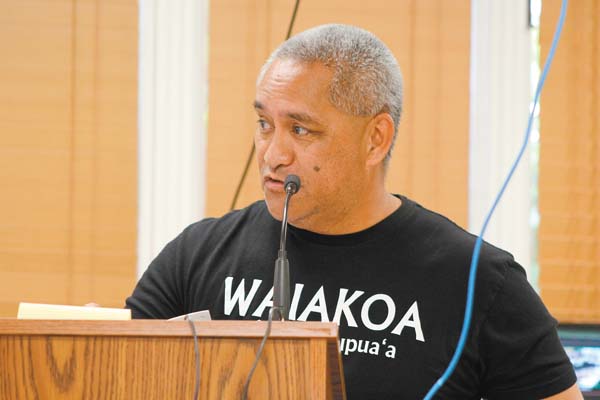
Vernon Kanani O La‘ie Kalanikau shares his concerns about the Welakahao Village subdivision, a market-priced housing project proposed by Paynella Hawaii, before the Maui Planning Commission on Tuesday. The commission granted Kalanikau and two other community members’ petition to intervene on the project. The Maui News / COLLEEN UECHI photos
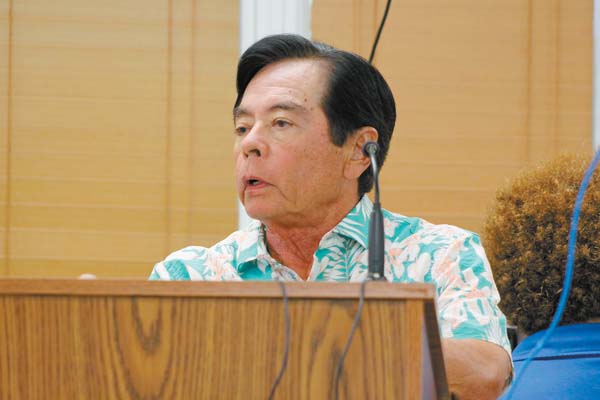
Allen Yap
Vernon Kanani O La‘ie Kalanikau shares his concerns about the Welakahao Village subdivision, a market-priced housing project proposed by Paynella Hawaii, before the Maui Planning Commission on Tuesday. The commission granted Kalanikau and two other community members’ petition to intervene on the project. The Maui News / COLLEEN UECHI photos
Allen Yap
Trending
WAILUKU -- A market-priced housing project in Kihei is on hold while developers meet with lineal descendants of the area who raised concerns about the impacts to the wetlands and water flows.
On Tuesday, the Maui Planning Commission granted a request from three community members to intervene on the project. The next step is mediation, and if needed, a contested case later on down the line.
"I'm not a fan of intervention," commissioner Keaka Robinson said. "I always feel this commission can do the job. . . . Having said that, I'm actually in favor of this intervention because there wasn't a meeting between the two parties."
The developer, Paynella Hawaii, is seeking a special management area use permit to build the Welakahao Village subdivision, a single-family residential project with 80 developable house lots at the corner of South Kihei Road and Welakahao Road.
Each lot would each range in size from 10,002 to 20,325 square feet, with an average size of 11,366 square feet. The homes would be a mix of one and two-story structures with three to five bedrooms and two-car garages or carports.
Ohana dwellings would be allowed, since the 41.3-acre project is in the residential-zoned district.
Keokea Gulch would cut through the development, giving way to a 3-acre park and a 6-acre open space area for stormwater drainage detention. The development has been designed to avoid a 1.83-acre freshwater wetland on the makai section of the property.
The estimated cost of the project is $91 million. Per county rules, workforce housing must make up 25 percent of the project. Developers said that could either mean building 16 units on-site or 20 units off-site.
Project manager Allen Yap said developers want to remove a planned roadway across the gulch connecting the north and south lots. The north lot "was programmed to be some of the better homes and the higher price" because it would be more private, secure and only accessed by the residents, with no through traffic, Yap said.
"However, if we do install that roadway, that's going to destroy that concept and will have a severe financial impact on the developer," Yap said.
Commissioners said it was an issue they would consider later down the line should the project get a permit.
The project has undergone numerous studies, including a wetland survey, a botanical and fauna report, two archaeological inventory studies (which consultants said revealed no historical sites or burials) and a cultural impact assessment (which consultants said showed no records of cultural sites, historical home sites or practices).
However, three community members who make up Na Kahawai O Kula Kai, meaning "the waters of Kula Kai," raised concerns about impacts to the wetland, stream flow and cultural practices.
Vernon Kalanikau said his connections to the area go back as far as the 1500s and that his family's lineage is descended from Kiha, son of Chief Piilani and Princess La'ielohelohe; Kekaulike, king of Maui; Kalola, daughter of Kekaulike; and Keopuolani, considered the most sacred wife of King Kamehameha I.
He said his tutu from the Big Island gave him his middle name, Kanani O La'ie, which means "the beauty of La'ie." There is a Laie on Oahu and one in Kihei next to St. Theresa Church. Kalanikau explained that he has a kuleana to preserve the waterways in the area.
"That water is the water of Kane, and the water of Kane gotta reach the ocean, the kai," said Kalanikau, president of Na Kahawai. "It's all part of the circle of life. Water from the top comes down to the bottom, goes to the ocean, clouds do its thing. If you cut that circle of life . . . then there's no chance of restoration of the shorelines."
Cody Nemet Tuivaiti, member of Na Kahawai, said he was hanai-ed by the Kahalekai and Akina families and has lived his whole life in the Welakahao area. He said that after heavy rains, the property where Paynella wants to build the housing project has been flooded for a week afterwards.
"Even though a scientist may portray one small area as a wetland, this whole area functions as a wetland because the water sits and then the water filters," Tuivaiti said. "It doesn't mean the water's always going to be there. It doesn't mean the water is always going to be moist for kiawe trees to keep growing. It's always in this continuous stage of moving. Water moves, and the water will always find its known source or path every single time."
Tuivaiti is an active cultural practitioner and worried that continued development would make it harder for the land to heal.
Rob Aldrich, a former hazardous waste investigator and the third member of Na Kahawai, said that runoff from the project could pollute the water quality and impact the marine life in the area.
"It is just a gem in Kihei," Aldrich said of the wetland. "So much so that I wouldn't want to see anything happen to it, anything that degrades it."
Commissioners said they believed the petitioners had demonstrated their ties to the land and hoped the intervention would allow the two parties to meet and hash out their concerns. They voted unanimously to choose Glenn Kosaka as mediator and Lee Ohigashi as hearings officer.
Planning Director Michele McLean said Thursday that the project will first go to mediation, and if that resolves the concerns, then the project could come back to the commission. If not, then the parties would move on to a contested case.
McLean said she wasn't sure when the mediation would be scheduled.
* Colleen Uechi can be reached at cuechi@mauinews.com.