
Body of humpback whale calf found on Maui
Trending
State officials were notified Friday morning of a newborn humpback whale calf that was found dead on a beach in Kihei.
Federal officials worked with a Native Hawaiian practitioner as well as with state and county officials to carefully bring the calf to its final resting place far offshore, said Celeste Hanley, spokesperson for the National Oceanic and Atmospheric Administration.
NOAA officials declined to be specific about the final location.
Whale bodies occasionally wash up on Maui shores, but observers say it's unusual because a calf in the ocean is usually eaten by sharks with no one witnessing its death. There was a humpback whale calf stranding reported south of Lahaina in 2008. The calf seemed underweight and not healthy.
In January 2019, 10 melon-headed, or pygmy, whales were stranded on Sugar Beach in South Maui. Six were coaxed back out to sea, and the remaining four were euthanized.
To prevent whale deaths and injuries, mariners are advised to reduce to speeds of 15 knots or less when transiting waters of the Hawaiian Islands Humpback Whale National Marine Sanctuary during whale migration season, which runs from November through May. Mainers are also advised to reduce their speed to 6 knots or less when approaching or leaving an area within 400 yards of a whale.
Humpback whales are listed as a federally endangered species and protected under the Marine Mammal Protection Act in 1972. They migrate from northwest waters of North America, including Alaska, to warmer waters such as Hawaii in winter months during breeding season.
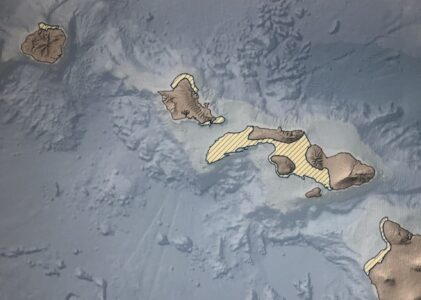
The sanctuary covers 1,370 square miles of state and federal waters off six of the Hawaiian Islands and includes waters and submerged lands.
The current population has rebounded to nearly 80,000 humpback whales, up from a low point of 10,000 to 15,000. Commercial whaling reduced North Pacific's humpback whale numbers to a few thousand before the practice ended in the 1970s.
The Marine Mammal Protection Act and Endangered Species Act prohibits hunting and harassment of whales in U.S. waters.
Humpback whale numbers in the North Pacific Ocean climbed from about 16,875 in 2002 to 33,488 whales in 2012, according to NOAA. Between 2012 and 2021, the number of humpback whales declined, falling by an estimated 7,000, reflecting a decline in food supplies because of climate change.