
Archaeologist revisits Waihee dig 30 years later
Plans in 1987 were to work the area for five years but the property was sold to developers
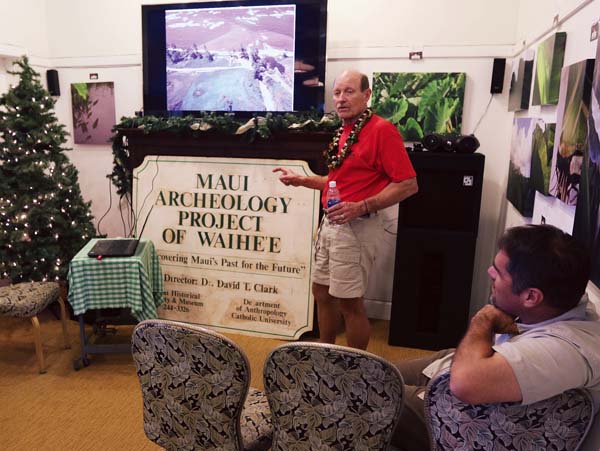
Archaeologist David Clark, a professor at Catholic University of America in Washington, D.C., discusses of his former excavation site in Waihee on Thursday during a private gathering at Hale Ho‘ike‘ike, formerly the Bailey House Museum. The Maui News / CHRIS SUGIDONO photo
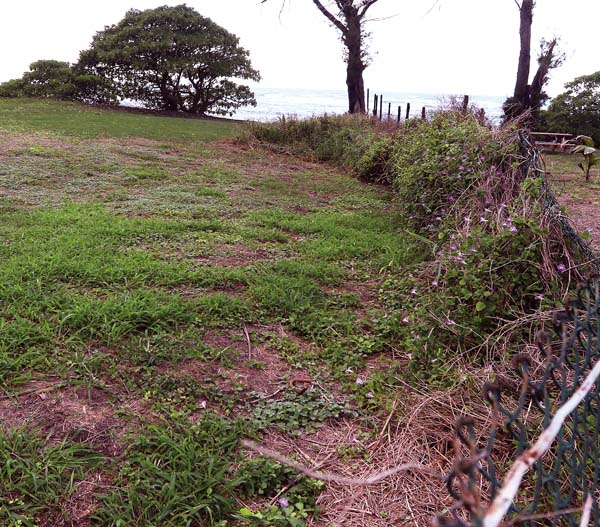
Shown here is the site of the former Maui Archeology Project of Waihe‘e, which was dug up in the late 1980s. The project uncovered more than 30,000 pieces of materials dating back nearly 1,000 years. The Maui News / CHRIS SUGIDONO photo
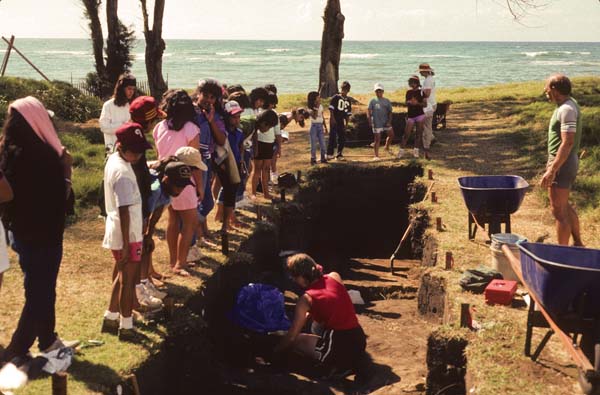
Elementary school children watch archaeologist David Clark (right) and his team uncover ancient artifacts at the old Waihee Dairy site in the 1980s. Photo courtesy David Clark
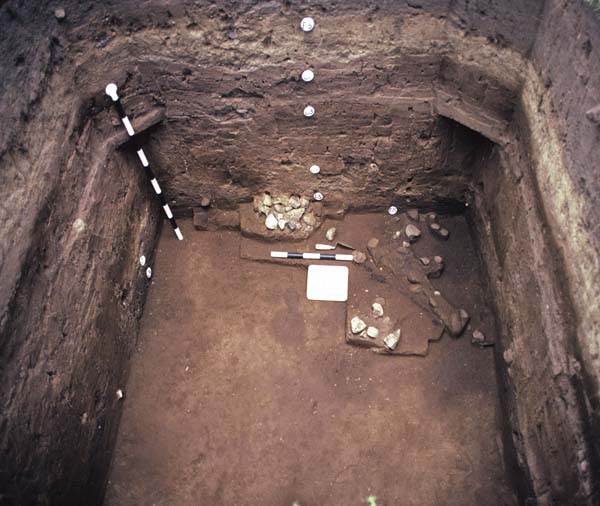
Trenches were dug up to 8 to 10 feet deep as part of the excavation of the old Waihee Dairy site. Photo courtesy David Clark
Archaeologist David Clark, a professor at Catholic University of America in Washington, D.C., discusses of his former excavation site in Waihee on Thursday during a private gathering at Hale Ho‘ike‘ike, formerly the Bailey House Museum. The Maui News / CHRIS SUGIDONO photo
Shown here is the site of the former Maui Archeology Project of Waihe‘e, which was dug up in the late 1980s. The project uncovered more than 30,000 pieces of materials dating back nearly 1,000 years. The Maui News / CHRIS SUGIDONO photo
Elementary school children watch archaeologist David Clark (right) and his team uncover ancient artifacts at the old Waihee Dairy site in the 1980s. Photo courtesy David Clark
Trenches were dug up to 8 to 10 feet deep as part of the excavation of the old Waihee Dairy site. Photo courtesy David Clark
Trending
WAIHEE -- Three decades ago, archaeologist David Clark made one of the most significant prehistoric discoveries on Maui.
The old Waihee Dairy site, which is at the end of an access road across from the county's Waiehu Golf Course, encompassed just 40 square meters, yet yielded more than 30,000 pieces of materials dating back nearly 1,000 years.
After two summers of digging, though, the property was sold and covered up to make way for a golf course. When those plans fell through, it was sold to the Hawaiian Islands Land Trust and has gone largely forgotten by the public.
That may soon change.
"We all thought this was just the tip of the iceberg," Clark said Thursday at the site.
Clark, a professor at Catholic University of America in Washington, D.C., returned to the site for the first time in nearly 30 years. He shared his story about the site and his burning desire to see it resurface.
"I was committed to do five years on the project," he said. "We know it would've been landmark in terms of communicating this history and having the community participate in this along the way."
In the summer of 1987, Clark was solicited to do an archaeological dig on the island as part of "The Year of The Hawaiian" celebration. His team went through all the records and previous archaeological digs on the island and found a couple surveys from the 1960s in Waihee that piqued his interest.
Artifacts found in the surveys included fishhooks foreign to Hawaii and appeared to be from southern Polynesians, suggesting that they were early settlers of the region. Clark also surveyed the geography of the area, which has a stream to grow crops, calm nearshore waters for fishing and a channel to go into deeper water.
"All of those things told us that this is where there's going to be villages. It was a no-brainer," he said.
Clark recalled walking the beach in 1987 and finding some old imu pits, which he selected to be the site. His small crew of university students and volunteers got to work digging trenches as deep as 8 to 10 feet with the goal of finding materials to be radiocarbon-dated.
"We all knew that this was going to be an old place," Clark said. "We just didn't realize how much stuff there would be."
Discoveries included three large circular areas that were probably used as storage pits, post molds from large buildings and substantial amounts of basalt chips used to make small tools. The crew also found five or six fireplaces, six or seven food preparation pits and many small finishing tools.
Clark said that a small piece of charcoal excavated at the site was dated to be about 870 years old, but another archaeologist later found material more than 900 years old.
"One place had thousands of these little seeds in it and this circular depressant. We left it there because that wasn't our goal to dig this stuff up," he said. "What would we do with it anyways?"
Dozens of stories published by The Maui News documented Clark's visits to the island and two excavation periods in the summers of 1987 and 1988. Many revolved around elementary school students who helped clean uncovered materials at the site and learned about Native Hawaiian history.
Clark said that educating students was one of the primary goals for the project and estimated around 1,200 students worked at the site. He planned to continue work for three more years, but landowner C. Brewer had other ideas.
"This is what we dreamed about -- that this would be held in perpetuity for the Hawaiian people," he said. "But when we started this in '87, we never realized that there was going to be this political firestorm that these guys lied to us and all the while had intentions to sell the property."
Japanese company Sokan Hawaii bought the 277-acre property for $10 million in 1988 with plans to build an 18-hole golf course. The company also discussed selling memberships for as much as $66,000 and building tennis courts, a swimming pool and homes, according to stories published by The Maui News on April 6, 1990.
Clark said that he begged the company to allow his crew to continue work.
"I got down on my knees and went to their reps and said, 'Look, just give me four weeks to bring my crew to dig out and just map all the stuff that we left there and we'll fill it in forever or whenever we're going to come back,' " he recalled saying. "But they made it quite clear that they did not want me there during the permit process.
"I was really offended by that and I was maybe a little immature on my part, but if they couldn't see the light," then what could he do, Clark said.
The company's proposal sharply divided the Waihee community and was eventually put on hold in the 1990s due to a collapse in Japan's economy. The property was eventually sold to the Maui Coastal Land Trust (now part of the Hawaiian Islands Land Trust) for $4.8 million in 2004.
On Thursday, Dale Bonar, the land trust's first executive director, recalled the historic purchase alongside Clark at the renamed Waihe'e Coastal Dunes & Wetlands Refuge. The preserve is now conserved in perpetuity through a partnership between the land trust and the state Department of Lands and Natural Resources.
"It's a real chicken-skin place," Bonar said.
The preserve is believed to be the place where the peace treaty after the Battle of Kepaniwai was agreed upon and the resting place of the goddess Mo'o, known as the lizard god, whose body was placed in a fishpond, Bonar said.
"It's a highly significant site," Bonar said. "More significant than most people even realize."
Scott Fischer, associate executive director of the land trust and Maui island director, said that the preserve is unquestionably one of the earliest sites on the island and has 93 state-listed archaeological sites ranging from the 10th century to the plantation era.
Fischer noted another story of the region about the demigod Maui, who was said to have gathered coconut husks from just behind the preserve at Pe’eloko, or Paeloko, that he used to make a net to snare the sun.
"It's such an incredible place and has such a story to tell for really everyone on Maui," Fischer said.
The stories about the preserve and artifacts found in the region draw parallels to the home island depicted in Disney's film "Moana." While creators of the film were reportedly inspired by trips to Fiji, Samoa and other islands, history of the Waihee area could drum up renewed interest in discovering more about the region.
Fischer said that he is doing postdoctoral research on paleoecology, which was launched by Clark's findings. He said many questions about the origins of Polynesian people in Hawaii have been answered over the last 30 years, but people still do not understand how Hawaii's lands were quickly transformed and how the early Polynesians lived in harmony with the land.
"We can learn so much from our kupuna and that's what we really need to emphasize," Fischer said. "Our kupuna went through the same challenges we're going through now and they were able to live in harmony with one another so there's so much more we can learn from them."
Fischer hopes archaeological work will resume at the site, but needs strong support from the community. He said permits, grants and educational opportunities would follow.
Clark is eager to see the site uncovered again and hopes it will find funding and support from the community. Archaeological digs for research and academia are rare nowadays, despite the field enjoying the largest job market in the country ever.
"It's all development," he said. "If you want to clear a highway so you can build an expressway or a building or townhouses -- you bring your archaeologist in, they clear the right-a-way, you write your report and you go on to the next one."
As for the Waihee site, Clark said that his team laid out plastic before the area was filled in so someone could easily continue work. He said he would like local archaeologists to take over the project.
However, he made one request.
"I just want a chance to go back there for a few years and set up what I started out to do," he said. "I need to go back and dig the site that I designed."
* Chris Sugidono can be reached at csugidono@mauinews.com.