Keeping an eye on Irma
It’s all hands on deck at the Pacific Disaster Center in Kihei where specialists are working to provide critical real-time information to emergency managers worldwide
As Hurricane Irma barrels through the Caribbean and threatens South Florida, storm watchers at the Pacific Disaster Center in Kihei are thousands of miles away, monitoring one of the strongest hurricanes ever recorded in the Atlantic.
“Irma presents an extraordinary threat to the people, communities and economies in the path of the storm,” said Tim Manning, a senior adviser at the center and a former deputy administrator with the Federal Emergency Management Agency.
The Pacific Disaster Center exists “to help mitigate these threats before they happen and to provide real-time information to emergency managers so they can help protect and support the most vulnerable populations,” he said.
On Thursday, the storm had killed at least 11 people — four on the French side of St. Martin (also injuring about 50), four in the U.S. Virgin Islands and one each on the British island of Anguilla, independent Barbuda and the Dutch side of St. Martin. The death toll in the Virgin Islands was expected to rise. The hurricane destroyed homes, schools and roads as it roared through the northeast Caribbean.
Hundreds of miles to the west, Florida braced for unprecedented wind and rain. Forecasters warned that Irma could slam headlong into the Miami metropolitan area of 6 million people, punish the entire length of the state’s Atlantic coast and move into Georgia and South Carolina.
More than 500,000 people in Miami-Dade County were ordered to leave as Irma closed in with winds of 175 mph.
According to an announcement from the University of Hawaii-managed center, its staff is working around the clock to produce analytical products and reports through state-of-the-art impact models and DisasterAWARE technology.
Erin Hughey, director of disaster services, said the center is providing emergency managers with critical information at the right time.
For example, they need to know how severe the storm’s impact will be, she said. These include economic impacts as well as the number of individuals and families exposed to the storm.
“We also look at vulnerable populations like the very young or very old,” she said. “By answering these basic questions, emergency managers can determine who, how much and what type of assistance will be needed (such as diapers and formula).”
The assessment of vulnerable populations includes the social and cultural aspects of communities “that help us to determine if they are receiving emergency messages and/or evacuation orders and how likely they might be to take appropriate action,” Hughey said. “Knowing this will help emergency managers take the right approach to communicating the risk to the population and delivering it in a form (door-to-door, radio, TV, text message, etc.) that will be most effective in encouraging an appropriate response that will reduce losses and save lives.”
By using the latest in science and technology, the center has become the international leader in providing decision-makers with multihazard early warnings, she said.
“Much of the data and information provided to officials is done in near real time and available on mobile devices,” she said. “The technology known as DisasterAWARE also allows the many agencies responding to an event to effectively share information and gain access to the most accurate and reliable data.”
According to the center’s website, DisasterAWARE integrates information, modeling and mapping technologies to provide “situational awareness and decision support in a highly visual and easy-to-use web application.”
Gayle Outten-Moncur, senior assistance secretary and operations manager for the Bahamas National Emergency Management Agency, said her agency has worked with the Pacific Disaster Center for 16 years.
“Dr. Hughey and the PDC have been by our side working hand-in-hand for countless events, including response and recovery efforts to Hurricanes Frances and Jeanne in 2004, Joaquin in 2015 and the 2016 Hurricane Matthew event,” Outten-Moncur said. “Irma will be no different. We will rely on our partners to effectively support the residents of the Bahamas.”
The center also provides emergency management support to the Dominican Republic, Haiti, Jamaica, the Federal Emergency Management Agency, the U.S. Department of Defense, the Florida State Emergency Management Agency and Miami-Dade Emergency Management.
For more information about the Pacific Disaster Center and to follow its situational analysis of Hurricane Irma, go to www.pdc.org/event-dashboard/2017_Hurricane_Irma.
* Brian Perry can be reached at bperry@mauinews.com.
-
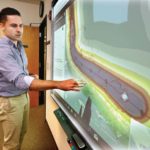
- Pacific Disaster Center’s Disaster and Response lead management specialist Michael Chatman shows staff members the latest update of Hurricane Irma’s track provided by the National Weather Service. The current track predicted the Category 5 storm would pass directly over the Miami metropolitan area. The Maui News MATTHEW THAYER photo
-
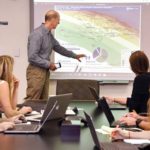
- Pacific Disaster Center science adviser Doug Bausch leads a discussion on Hurricane Irma’s economic impact on the Dominican Republic and Haiti during a staff meeting Thursday afternoon in Kihei. The center provides international emergency managers with critical real-time information to manage responses to protect people before and after natural disasters, such as Hurricane Irma. On Thursday, the Category 5 hurricane wreaked havoc on Caribbean islands and is now approaching South Florida. The Maui News MATTHEW THAYER photo
Local News
Photo of the Day: Prehistoric Wood
Continued water conservation urged for South Maui
The County of Maui Department of Water Supply continues to urge all South Maui customers to conserve water today, ...

Aloha FurEver Pets Foundation achieves 501(c)(3) nonprofit status

Rotary Club of Lahaina Sunset to award five academic scholarships

MEO gala raises more than $150,000 while honoring state Sen. Troy Hashimoto