
Ocean and its creatures the stars of the show
For 20 years, Maui’s aquarium has been making the

Families get a thrill from the stingrays and fish passing over the glass tunnel in the Maui Ocean Center on Sunday. The ocean center kicked off its #seaLOVEbration, a yearlong campaign to celebrate the aquarium’s 20th anniversary. The Maui News / COLLEEN UECHI photos
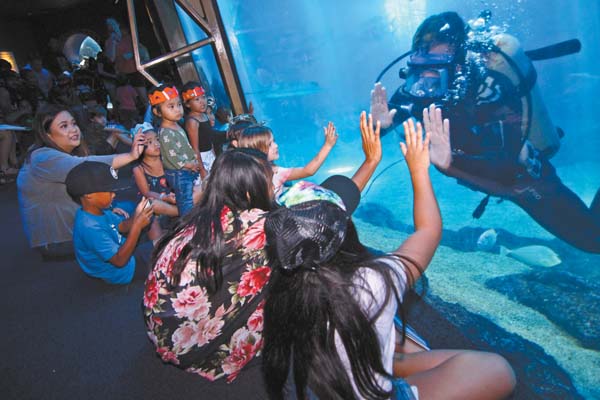
Assistant curator Jim Luecke high-fives a group of kids following an educational presentation in the center’s main tank.
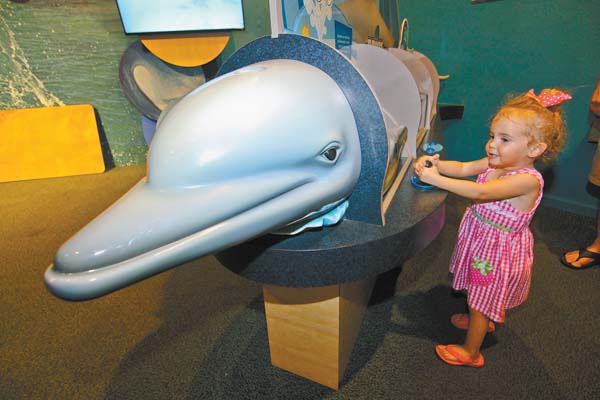
Two-year-old Ella Downs of Kihei plays with the dolphin sounds exhibit. Parents Justin and Beth Downs said they’ve been bringing Ella to the aquarium since she could walk.
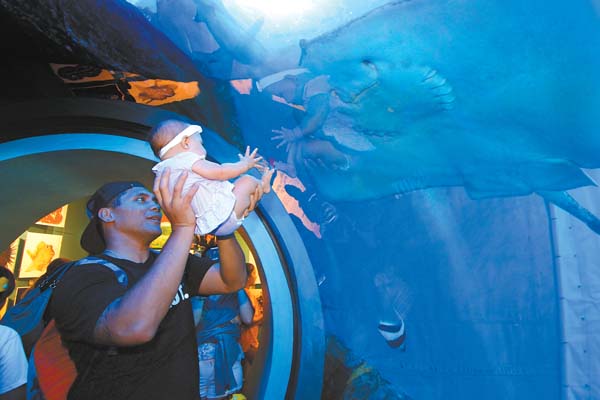
With a little help from dad Viane Visesio, 5-month-old Amara Visesio of Napili gets up close and personal with a stingray in the Maui Ocean Center’s glass tunnel. Sunday’s #seaLOVEbration event featured prize giveaways, educational presentations, live entertainment and discounted admission for kamaaina.
Families get a thrill from the stingrays and fish passing over the glass tunnel in the Maui Ocean Center on Sunday. The ocean center kicked off its #seaLOVEbration, a yearlong campaign to celebrate the aquarium’s 20th anniversary. The Maui News / COLLEEN UECHI photos
Assistant curator Jim Luecke high-fives a group of kids following an educational presentation in the center’s main tank.
Two-year-old Ella Downs of Kihei plays with the dolphin sounds exhibit. Parents Justin and Beth Downs said they’ve been bringing Ella to the aquarium since she could walk.
With a little help from dad Viane Visesio, 5-month-old Amara Visesio of Napili gets up close and personal with a stingray in the Maui Ocean Center’s glass tunnel. Sunday’s #seaLOVEbration event featured prize giveaways, educational presentations, live entertainment and discounted admission for kamaaina.
Trending
MAALAEA -- Evan Pascual had always known coral was a live animal, but it wasn't until he peered at it under a microscope and watched it actually "reaching out and grabbing its food" that it really sunk in.
"I don't know how else you'll get that understanding without seeing it," said Pascual, who grew up in Lahaina and is now the marketing and public relations coordinator for the Maui Ocean Center.
Over the past 20 years, countless people like Pascual have grown a greater understanding for the ocean by watching the marine life swimming through the tanks at the aquarium in Maalaea. On Sunday, hundreds of people came to kick off the center's #seaLOVEbration, a yearlong campaign celebrating the aquarium's 20-year history and Hawaii's rich marine life.
"It's a great milestone," said assistant curator Jim Luecke, who's been at the center for 17 years. "For us to just continue to be an excellent resource for the community and really teaching the public why we desperately need to care for our marine environment and teaching them all of the things that we do on land really do affect our open oceans."
The Maui Ocean Center opened in 1998, the vision of diver Morris Kahn and his marine biologist son, Benjamin, General Manager Tapani Vuori said.
Kahn loved diving in the Red Sea and wanted others to experience what he saw. In the 1970s, he founded Coral World International and opened the Underwater Observatory Marine Park in Eilat, Israel. Benjamin Kahn moved to Maui about 25 years ago and opened the Maui Ocean Center. The center also has sister aquariums in Australia and Spain, with another soon to be built in Germany.
The center hosts one of the world's largest displays of live coral. Exhibits include the popular glass tunnel through a tank of sharks and stingrays, as well as outdoor touch pools, educational displays on dolphins and whales, and tanks hosting a diversity of creatures.
The center also pumps in 1.2 million gallons of ocean water per day from Maalaea Bay, filters it and releases it back into the ocean, which Vuori said helps to dilute the sedimentation and runoff muddying the waters.
"There are a lot of people, believe it or not, here in Hawaii who don't know how to swim, who don't go into the ocean and who don't know how to snorkel or dive, or who have phobias about doing that," Vuori said. "So how do you bridge that gap of that disconnect where people can protect what they love once they understand what's in the ocean?"
After 17 years, Luecke said working at the center "still doesn't get old." Luecke has worked for public aquariums for more than 20 years. He does educational dives and is involved in collecting marine life for the center.
Luecke said the center has an annual renewable permit and must submit a collection plan to be approved by the state every month. The center is not allowed to use any chemicals to slow the fish; divers use scoop and barrier nets, and sometimes use a hook and line for larger creatures like sharks.
Animals are selected and monitored carefully, and if they don't seem to be adapting to life in the center's tanks, they're released.
"Many people that think things should be better left in the ocean, you know what? I agree with you 100 percent," Luecke said. "That's where they're from. . . . However, this is the median between perhaps those that make political decisions as to how we care for our environment. . . . Honestly, I don't want to go collect stuff off the reef. If I could aquaculture everything here, that would be great. But that's a developing story."
By 2020, the center's goal is to get 20 percent of its marine life from "sustainable supply chains," Vuori said. That could include Hawaii Pacific University's Oceanic Institute, which has been working to raise yellow tang -- the "No. 1 ornamental fish in the aquarium industry" -- through aquaculture. Bringing in marine life from sources like that would help ease aquariums' reliance on the ocean, Vuori said.
The general manager added that a "significant portion" of the animals are sent back to the wild. He didn't have an exact percentage but said it was more than half. Black-tip reef sharks, for example, are raised in the center for a year before being returned to the ocean. Since 1998, the center has also raised and released 72 turtles.
Going forward, the center plans to continue expanding its educational programs, as well as growing its nonprofit, the Maui Ocean Center Marine Institute, which will focus on rehabilitating endangered turtles, expanding the center's coral genetic databank and promoting education. In February, the center broke ground for its dome theater, which will seat 139 and feature 360-degree, 3-D laser projected images of marine life and the night sky.
"We really need to be a solution for the community as we go forward," Vuori said. "As you look at what's going on in the ocean, how can we advocate for positive change in the community. . . . Because if it's not us, then who?"
On Sunday, the center mesmerized multiple generations of families. Kawailehua Hall came to the center Sunday with her one-year-old daughter Waianu and mom Lani Kuluhiwa. Hall said it was her daughter's first time.
"I've definitely seen how the reef changed growing up -- less and less fish," said Hall, who lives in Kihei. "So that's why this place is so important to teach our next generation how to care for our ocean and our reefs, so they can have something in their generation."
Viane Visesio of Napili said he grew up visiting the center. Now he and Heather Iwankiw bring their daughters, 3-year-old Evelina and 5-month-old Amara, to see the marine life.
"I think it teaches them about keeping the environment clean, because when you litter it ends up in the ocean," Iwankiw said. "So they kind of see how (the marine life) live. I think it's good to see that."
* Colleen Uechi can be reached at cuechi@mauinews.com.