
Nene down-listed from endangered to threatened
State bird comes back from brink of extinction, a state ‘success story’
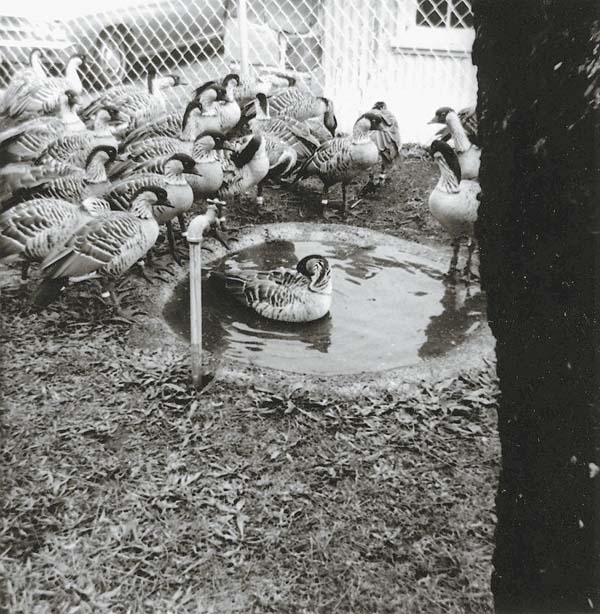
A group of nene surround a pond in a pen behind Haleakala National Park headquarters in 1972. NATIONAL PARK SERVICE photos
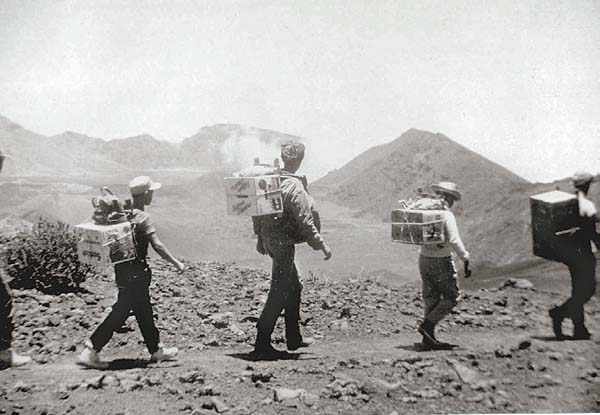
Boy Scouts carry nene geese in cardboard boxes as part of their reintroduction to Haleakala Crater in 1962. Nene disappeared from Maui prior to 1890; Haleakala National Park was chosen as the reintroduction site because of its large area of habitat suitable to nene.
A group of nene surround a pond in a pen behind Haleakala National Park headquarters in 1972. NATIONAL PARK SERVICE photos
Boy Scouts carry nene geese in cardboard boxes as part of their reintroduction to Haleakala Crater in 1962. Nene disappeared from Maui prior to 1890; Haleakala National Park was chosen as the reintroduction site because of its large area of habitat suitable to nene.
Trending
Nearly 60 years after a group of Boy Scouts carried 35 nene down into Haleakala Crater, Hawaii's state bird has made a comeback -- enough so that the federal government has down-listed the nene from endangered to threatened.
U.S. Secretary of the Interior David Bernhardt announced the down-listing Sunday at the Pearl Harbor National Wildlife Refuge. And while local conservationists are still keeping a cautious eye on the nene, for now they're celebrating.
"Everybody loves a success story," Maxx Phillips, Hawaii director and staff attorney for the Center for Biological Diversity, said Monday.
"The Endangered Species Act is the most effective legal mechanism that we have in this nation to ensure that our plants and animals aren't led down a path toward extinction. It's always great news to see a species bounce back in this way."
According to the U.S. Fish and Wildlife Service, endangered species are "in danger of extinction throughout all or a significant portion of its range," while threatened species are "likely to become endangered" within the near future.
State and federal agencies have estimated that as many as 25,000 nene lived in the Hawaiian Islands before the arrival of Capt. James Cook in 1778. But by the 1950s, fewer than 30 were still around, due to aggressive hunting of the birds, collecting of their eggs and the introduction of predators like mongoose, rats, pigs, dogs and cats.
The nene, which officially became Hawaii's state bird in 1957, was listed as an endangered species in 1967. In the decades that followed, nearly 3,000 captive-bred birds were released at more than 20 sites throughout the main Hawaiian Islands, including national wildlife refuges, national parks and state and private lands, according to the U.S. Department of the Interior.
Currently, there are more than 2,800 nene in Hawaii, with stable or increasing populations on Maui, Molokai, Kauai and Hawaii island.
If there was a population of nene on Maui prior to Western contact, it was gone by 1890, according to Haleakala National Park, which was chosen as the reintroduction site on Maui.
In the summer of 1962, nene raised in England and from Hawaii island were delivered to Maui, tucked carefully into cardboard boxes and carried into the crater by park rangers, naturalists and Maui Boy Scouts. The Boy Scouts strapped the boxes to their backs and hiked 9.8 miles to Paliku, where the geese were temporarily released in an open-top pen until they adapted to their surroundings.
"They were originally put into the park because that was the largest area that had habitat that would support them," explained Michelle Bogardus, team manager for the Maui Nui and Hawaii island branch of the U.S. Fish and Wildlife Services' Ecological Services.
Although about 500 nene were released into the park during the 1960s and '70s, the population dropped to about 100, park spokeswoman Jin Prugsawan said. But thanks to a combination of "aggressive" predator and feral ungulate control, population monitoring and public outreach, the park's nene population has risen to about 280.
Bogardus said the park has been "absolutely instrumental" to the nene's survival and growth, through restoration of habitat and food sources as well as predator control for both the nene and the `ua`u, or Hawaiian petrel. The park also has a rescue pen at its headquarters for orphaned or hurt goslings or adults.
While many other species of waterfowl prefer life on the water, nene actually can live away from the water, Bogardus explained. They prefer grasslands and shrubs to forest, and while they can survive on Haleakala -- the nene there are particularly hardy -- they prefer warmer areas downslope.
"Birds still are in the park, and they do pretty well there," Bogardus said. "But it's cold up there, so they have dropped down to lower elevations, and they do a little bit better in areas where they have warmer temperatures and more food."
Bogardus said there are about 500 to 550 nene on Maui. Beyond the national park, they're mostly found on state lands, including natural area reserves in both East and West Maui, as well as private properties. Maui has a large number of private landowners involved in proactive nene conservation, and Haleakala Ranch is one of the biggest, Bogardus said. The ranch has a safe harbor agreement with the U.S. Fish and Wildlife Service and offers a translocation site for birds that need a safe place to live and breed. Areas have been fenced off to protect from predators.
On Molokai, nene were reintroduced just within the last 15 years. There are only about 30 of them breeding on a single fenced site at Pu`u O Hoku Ranch on the island's east end, but there are plans to do more nene breeding on state lands, Bogardus said.
Both she and Phillips credited partnerships between the state Department of Land and Natural Resources and the scientific community with helping the nene recover. And, the public has played a role as well, from "the smallest act of driving slow in nene territory to the biggest act of private landowners having nene relocated there," Phillips said.
Phillips added that the biggest concerns now are the rollbacks of the Endangered Species Act by President Donald Trump's administration, including changes to the process for listing species and designating critical habitat and protections. She explained that endangered and threatened species were afforded the same protections under a "blanket rule," but under the new interpretation, threatened species have fewer protections.
"Some of these changes to America's bedrock environmental law could very well lead to the extinction of hundreds of animals and plants just like the nene," Phillips said.
Bogardus, however, said that the law still prohibits people from harming, killing or harassing a nene to the point where it can't reproduce. But, the changes will allow more flexibility for conservationists and land managers to move nene without the waiting time and permitting processes so long as they have an approved plan. She also said that the nene is still considered endangered under Hawaii state law, so those protections remain.
Regardless, places like Haleakala National Park will continue monitoring, controlling predators and educating the public. Prugsawan said that park visitors can help by observing speed limits and slowing down for nene. The birds sometimes wander or fly near roadways and parking lots.
"We ask that you help keep nene wild by not feeding them and giving them their space if you see them in the park and especially on the trails," Prugsawan said. "It is currently nesting season for the nene, and they are especially vulnerable during this time."
* Colleen Uechi can be reached at cuechi@mauinews.com.