Native American film’s story is fiction, but with authentic basis
‘Neither Wolf Nor Dog’ has Hawaii premiere at ProArts Playhouse in Kihei
“Neither Wolf Nor Dog” is a fictional movie laced with authentic and culturally significant Native American history and driven by the decades of experiences of Lakota elder Dave Bald Eagle.
It will show for the first time in Hawaii at 7:30 p.m. Friday at ProArts Playhouse, 1280 South Kihei Road in Kihei. Tickets are $12.
“It’s exciting to finally have it on the islands there. We’ve had 500-600 showings in North America but never to Hawaii, so it’s nice to be able to bring it to some people there,” said Scottish director and producer Steven Lewis Simpson on Wednesday in a phone interview.
“Most of the audience, if not all of the audience, will fall madly in love with Dave Bald Eagle’s performance in the film,” continued Simpson. “He was truly a remarkable human being in life, and he really puts his spirit on screen.”
Dave Bald Eagle died at age 97 on July 22, 2016, a year before the movie was released.
“They’re listening to him through their heart as well as their head, and you know, what happens in this film is a bit historic really,” Simpson said. “Dave is more than (the audience) dreamed because his essence is so luminous . . . We are experiencing this man sort of lifting this burden off his shoulders just before the end of his life.”
Adapted from the 1996 best-selling novel by Kent Nerburn, “Neither Wolf Nor Dog” takes place in a poor Native American reservation in lands of the Dakotas, where a white American writer Kent (played by Christopher Sweeney) receives a phone call from 95-year-old Lakota elder Dan (Dave Bald Eagle), who asks him to transform a box of notes into a book.
In the film, Dan relates American history from the Native American point of view while Kent slowly begins to understand and learn about the culture, while the two men build a bond.
“My favorite scenes with Nerburn is when he’s got no dialogue, he sits in the back of the car, and they’re parked, and Dave’s talking about these horrific things in their history, and he’s absorbing it all,” Simpson said. “You’re not just hearing it through the screenplay, you feel it from this elder, so every emotion is as you feel it.”
Simpson said he was emotionally moved from behind the camera.
Wounded Knee, S.D., where a massacre of several hundred Lakota Indians in 1890 by United States soldiers took place, is where the climax of the movie was shot.
During a scene on sacred land, Simpson said he threw away the script and let Bald Eagle improvise.
“Dave spoke from his heart because he, through his own family, were closer to the event and the massacre than the character he was playing,” he said.
“Through the outpour of that scene, he takes us to a depth that people couldn’t really get to otherwise,” Simpson added. “At the end of that scene, he said ‘I’ve been holding that in for 95 years.’ ”
Simpson said that this was “no ordinary movie to make,” considering some of the cast experienced first hand oppression and war.
Bald Eagle, who was born in a tepee in 1919 and spoke only Lakota until he was 12 years old, was a World War II and D-Day combat veteran. His grandfather, White Bull, may have killed Gen. George Armstrong Custer at the Battle of Little Big Horn, according to a press kit for the movie.
Co-star Richard Ray Whitman, Grover in the film, was an activist for the American Indian Movement during the 71-day occupation of Wounded Knee in 1973.
“They both went through atrocious combat experience,” Simpson said. “That was something that the rest of us couldn’t comprehend particularly, these are experiences that you would hope nobody has to go through.”
Hawaiian history shares a background of oppressed culture, language, and people, including the overthrow of Queen Lili`uokalani in 1893 that led to Hawaii’s annexation by the United States.
“It’s a curious thing when you do Native American films, people will look at it and go, ‘Well, how will this work for other audiences . . . who are not of this community?’ ” he said. “That is what we really look for in cinema, is being transported to places we’ve never experienced before but seeing bits of common threads of humanity that we can all relate to and share.
“I think that’s the magic of cinema.”
Simpson said he gave the cast more leeway to candidly express their roles than in a typical Hollywood movie.
The film was made in 18 days on a low budget with an average crew of two and seven actors. The cast’s bond helped to make work days flow and the film successful, he said.
“Neither Wolf Nor Dog” has played in more than 500 venues across the U.S. and has a Rotten Tomatoes audience score of 95 percent.
“To be truthful, I came away from the end of the film thinking, I have no idea what I’ve got,” Simpson said. “When you shoot so fast and you have a 95-year-old, you’re shooting shorter days than normal . . . But when you start editing it, you are sort of reminded how long you’ve worked on the screenplay, so things really fell into place the way they were meant to.”
* Dakota Grossman can be reached at dgrossman@mauinews.com.
_______________
THE EVENT
• What. Showing of movie “Neither Wolf Nor Dog.”
• When. Friday, 8 p.m.; opening remarks at 7:30 p.m.
• Where. ProArts Playhouse, Azeka Mall, Kihei.
• Cost. Tickets are $12. They are available online at proartsmaui.com or at the ProArts box office.
-
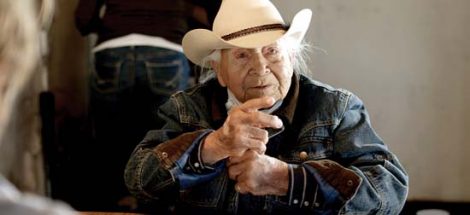
- Lakota elder Dave Bald Eagle appears in a scene from “Neither Wolf Nor Dog,” which will be shown at 8 p.m. Friday at the ProArts Playhouse in Kihei.
-
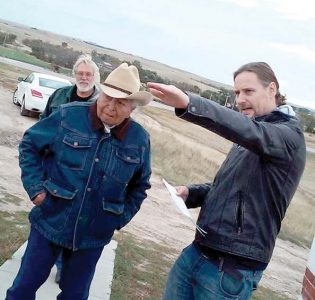
- Scottish director and producer Steven Lewis Simpson discusses a scene with Dave Bald Eagle in “Neither Wolf Nor Dog.” The actor died at age 97, about a year before the film was released in 2017.
Local News
Maui Food Bank CEO to step down in April
Haleakala National Park reopens after storms
Both districts of Haleakala National Park are open following the recent storms. The park reported it had reopened ...
Emergency fund to aid recovery efforts on Molokai, Maui
Meeting to feature talk on arts and Lahaina recovery
Housing department seeks proposals for experimental housing projects
The Maui County Department of Housing is seeking applications from qualified nonprofit organizations for projects ...