
Kalaupapa community leader dies
Clarence ‘Boogie’ Kahilihiwa was 79
Clarence “Boogie” Kahilihiwa, who had a “big warm smile” and evolved into a “real leader” for Hansen’s disease patients in Kalaupapa, has died.
Kahilihiwa, 79, died Friday at Leahi Hospital on Oahu, his friend Valerie Monson said.
A celebration of life will take place on Thursday at St. Francis Church in Kalaupapa, said Father Patrick Killilea, pastor of the church where Kahilihiwa was a member. Killilea said he believed that Kahilihiwa’s wife Ivy will be the only one allowed in the church due to COVID-19 restrictions.
“He was a lot of fun,” Killilea said. “He could give a good talk when he was called on. He was never ever short on words.”
Kahilihiwa moved to Oahu around two years ago to be with his wife of more than 43 years, friends said.
Prior to the move, “Uncle Boogie,” as he was known, would go to Mass every morning, Killilea said, adding that Kahilihiwa came back to Kalaupapa one last time around four or five weeks ago and stayed for a few days.
“He was anxious to meet with people,” Killilea said, adding that Kahilihiwa was in a wheelchair and “was fading by that time.”
Monson, the former executive director of Ka ‘Ohana O Kalaupapa, worked closely for years with Kahilihiwa, the president of the organization. Set up by residents in 2003, the group promotes the value and dignity of every individual who was forcibly isolated on the peninsula since 1866, according to its website.
She said Kahilihiwa was one of the younger patients and that she was sad to see him go.
“We thought he would be with us for more years,” Monson said.
Monson, Kahilihiwa and many others have been pushing for the Kalaupapa Memorial, which will display the names of the nearly 8,000 men, women and children who were taken from their families and forced to live on the peninsula.
The state Department of Health said there are 11 surviving Kalaupapa patients, with six still living there and five now residing elsewhere.
Monson said the memorial is in its compliance phase and that they have overcome the hurdle of finding the names of all those residents.
“He wanted everyone to be remembered, remembered by their name,” Monson said of Kahilihiwa. “He looked forward to seeing all the names on the memorial.”
According to Ka ‘Ohana O Kalaupapa’s website, Kahilihiwa had once said that “when you see the names on the memorial, it will be like everyone from Kalawao and Kalaupapa is standing right there in front of you. It will bring tears to my eyes.”
Soon, Kahilihiwa will be remembered on that memorial, too.
Kahilihiwa contracted Hansen’s disease while living in Kalapana on Hawaii island. He was taken from his family and sent to Hale Mohalu in Pearl City when he was 9 years old. In 1959, Kahilihiwa moved to Kalaupapa, where a brother and sister were already living, Monson said.
Kahilihiwa worked for the state of Hawaii as a house painter and plumber and also helped with upkeep of the settlement.
After retiring from the state, he worked at the Pacific Historic Parks bookstore in Kalaupapa National Historic Park. He was also active with the Kalaupapa Lions Club and had at one point been president.
After watching the kupun
-
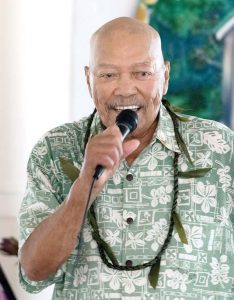
- Clarence “Boogie” Kahilihiwa delivers an opening greeting at the 2018 annual meeting of Ka ‘Ohana O Kalaupapa at Kalaupapa. Kahilihiwa died Friday at age 79. HENRY G. LAW photo
-
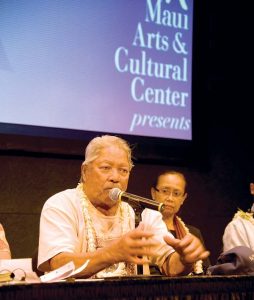
- Clarence “Boogie” Kahilihiwa participates in a panel discussion with descendants of Kalaupapa to talk about the importance of remembering the people of the Kalaupapa community during an event at the Maui Arts & Cultural Center in 2012. WAYNE LEVIN photo
“He was already very friendly, outgoing, always helpful. But then I saw him evolve into a real leader and speak up on issues and take stands,” Monson said.
He became president of Ka ‘Ohana O Kalaupapa in 2009 and testified many times at the state Legislature.
Monson, who started out as coordinator then became executive director of the organization, worked under Kahilihiwa. She would sit with him at the bookstore after hours drafting letters and position papers. She called it “some of my favorite times.”
When Kahilihiwa signed the letters they worked on together, Monson said, “you just felt really good you were trying to make a difference.”
As news of Kahilihiwa’s death spread, state Sen. J. Kalani English, who represents East Maui, Molokai and Lanai, said that his “big, warm smile will surely be missed.”
“He dedicated his entire life to preserving the settlement and he worked hard to honor the dignity of every individual that was forced to relocate there,” English said in a statement.
State Rep. Lynn DeCoite, who lives Molokai and also represents East Maui, Molokai and Lanai, described Kahilihiwa in a Facebook post as “one of a kind. A gentle soul with a huge heart and a smile you could see from a mile away.”
“Uncle Boogie was a kindhearted man and was full of life,” she added via text on Saturday. “He took nothing for granted.”
* Melissa Tanji can be reached at mtanji@mauinews.com.
Local News
Students shine at Hawaii History Day district fair

Healthy Kids Running Series draws over 175 participants at kickoff event

2025-26 MIL All-Stars: Milaniakai Padilla named Division II girls volleyball Player of the Year
Healthwise Maui: Experts answer your health-related questions
Physicians, providers, and administrative staff who practice at Maui Health hospitals and clinics answer questions ...

‘Ea’ highlights Lahaina family’s legal battle to protect ancestral kuleana lands
Weather affects Great Whale Count totals in March
A statewide snapshot of humpback whale activity showed a sharp decline this year, with weather and fewer volunteers ...