
‘Ea’ highlights Lahaina family’s legal battle to protect ancestral kuleana lands
Trending
Filmed mostly before the 2023 fire devastated Lahaina, the powerful new documentary "Ea (Sovereign)," focuses on Kanaka ʻŌiwi community leader Keʻeaumoku Kapu and his family's efforts to reclaim and steward land in Kauaʻula Valley.
Recently premiering at the DisOrient Asian American Film Festival in Eugene, Oregon, the documentary highlights a Lahaina family's decadeslong legal battle to protect ancestral kuleana lands.
Directed by Noah Keone Viernes with Sancia Miala Shiba Nash, Viernes was inspired to make the film after investigating his own family's ties to ancestral land and researching the ʻUluʻulu archive at the University of Hawaii's West Oahu campus.
"I grew up listening to Eddie Kamai records, and I was fascinated by his return to Lahaina with the film, 'Lahaina: Waves of Change,'" said Viernes, who is currently an associate professor at Akita International University in Japan. "I was looking through the outtakes, and that's where I chanced upon Keʻeaumoku Kapu."
The Kapu family battled in court for 20 years to reclaim ancestral land. Almost 170 years ago, Kapu's ancestors were awarded the land during the 19th-century Great Mahele, which allowed private property ownership in Hawaii for the first time.
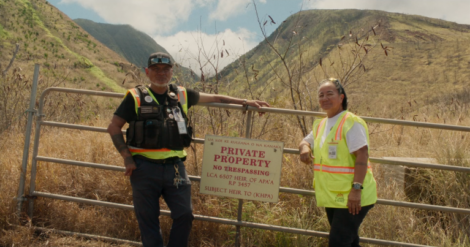
Keʻeaumoku Kapu and Uʻilani Kapu. Courtesy photo
In 2017, the family won a legal victory when a jury ruled they owned the entirety of a 3.4-acre parcel. Their attorneys, Lance Collins and Bianca Isaki, proved the Pioneer Mill had gained the deed to the property in the 1890s from a person the family didn't know -- and who didn't actually exist.
"It was a huge deal because after that, the police department changed their policy that if there's a dispute over title, they refer to the civil courts and they don't arrest people for trespass anymore," explained Collins, who produced "Ea." "That was one of the ways that Pioneer Mill and AmFac would be able to control land. They would call the police and say, 'These people are trespassing,' and they would show them a paper, and the police would arrest the Hawaiians."
Interviews in the doc with Keʻeaumoku Kapu, Uʻilani Kapu, Akoni Akana, Sam
Kaʻai, Ekela Kaniaupio-Crozier and others frame sovereignty as a daily responsibility rather than an abstract concept.
The film also highlights the legacy of the Nā ʻAikāne o Maui Cultural Center, which was destroyed by the Lahaina fire. It housed priceless archival records, maps, documents and rare books signed by Hawaii's kings.
"Part of the story is it's not just the couple who's winning their jury trial," said Collins. "It really is about Native people reclaiming their family lands and basically the whole arc. And part of it is the educational stuff they did at the Nā ʻAikāne o Maui Cultural Center before it burned down. So there's a lot of footage of Lahaina before the fire in the documentary."
A former teacher at the University of Hawaii Manoa and the University of Hawaii Hilo, Viernes said, "There were a lot of things we didn't film before the fire, and then we couldn't film afterwards. There was so much regret when that happened."
Viernes previously made "Ka Leo," which gathered Native Hawaiian voices and layered them over images of the 2019 stand against the construction of the Thirty Meter Telescope International Observatory on Mauna Kea.
Blending resonant landscapes, archival memory and contemporary Indigenous expression, "Ea" incorporates original animation and digital cartography.
Viernes felt it was important to emphasize the land in the new film. "The first goal was to figure out a way to amplify things that really don't resonate in documentaries about Hawaii," he said. "Make the land itself stand out a little more. So we were really thinking carefully, how to just show it, not quickly moving past it and just talking about stories that shock people or something like that. Maybe that would help encourage people to pursue their own ties to it."
Hoping the film inspires others, Viernes explained, "We tried to show that it is possible, though it's not easy, and it takes somebody like Keʻeaumoku Kapu. He's a charismatic voice. I felt he's a person that needed to be on screen."
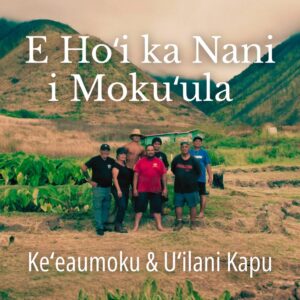
In conjunction with the documentary, a new recording of the 19th-century Hawaiian mele "E Hoʻi ka Nani i Mokuʻula" was released, performed by Keʻeaumoku Kapu and Uʻilani Kapu. Originally composed in 1862, it's a place-name song that calls forth the beauty, winds, hills and sacred presence of Mokuʻula, the former royal and spiritual center of Lahaina.
"If you did anything educational (at the Lahaina center) that was the song that they taught everybody," said Collins. "There aren't any recordings of it anywhere commercially. So when the documentary happened, I said, 'Why don't we get them into Joel Katz's studio and have them record it?'"
Plans are underway to screen the documentary in Hawaii. "We are still trying to work that out and negotiate," said Collins. "There's going to be an official Hawaii premiere, and then after that, we already have a number of community groups that have asked to host screenings. I think once people start seeing it, it's probably going to be requested."
The Kapus have been leading Kuleana Land Workshops to help other Native Hawaiians with land disputes. They will be in Waiʻanae on Oahu on Saturday sharing their knowledge at a free workshop.
"E Hoʻi ka Nani i Mokuʻula" is available on digital streaming platforms.