
Mosquito birth control seeks to zap avian malaria
Disease threatens native birds; project could start next year
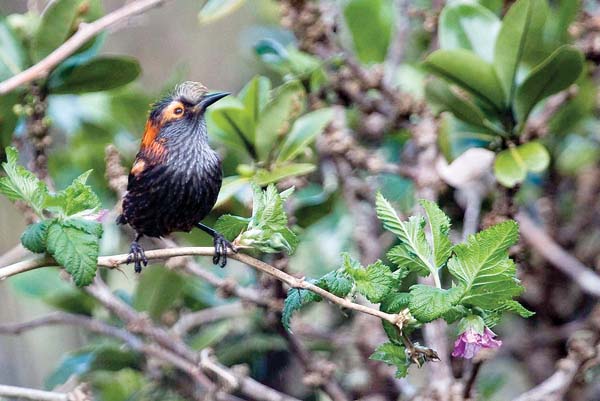
The rare and critically endangered ‘akohekohe, or crested honeycreeper, perches on a branch. Local scientists hope to start a mosquito control project that could prevent the spread of avian malaria and save birds like the ‘akohekohe, kiwikiu, ‘akeke’e and ‘akikiki, which have the highest risk of extinction among Hawaii’s native birds. — C. ROBBY KOHLEY photo
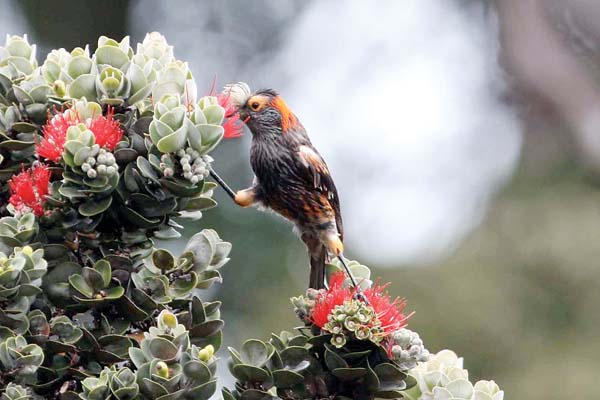
An ‘akohekohe, or crested honeycreeper, pulls off a balancing act. It’s one of the endangered native birds that local scientists hope to save with a mosquito control project that could launch as soon as next year. — C. ROBBY KOHLEY photo
The rare and critically endangered ‘akohekohe, or crested honeycreeper, perches on a branch. Local scientists hope to start a mosquito control project that could prevent the spread of avian malaria and save birds like the ‘akohekohe, kiwikiu, ‘akeke’e and ‘akikiki, which have the highest risk of extinction among Hawaii’s native birds. — C. ROBBY KOHLEY photo
An ‘akohekohe, or crested honeycreeper, pulls off a balancing act. It’s one of the endangered native birds that local scientists hope to save with a mosquito control project that could launch as soon as next year. — C. ROBBY KOHLEY photo
Trending
Local scientists are steps closer to playing mosquito matchmaker in an effort to quell avian malaria, one of the top threats to native birds facing extinction, such as Maui's kiwikiu.
The multiagency mosquito control project, the first of its kind in the state, is currently in the process of acquiring state and federal permits. Trials could happen as early as next year if approvals move forward, Lainie Berry, a forest bird biologist with the state, said during a recent Board of Land and Natural Resources meeting.
Scientists would release male mosquitoes carrying a specific strain of bacteria. Upon mating with wild female mosquitoes, the match made in a science lab would create nonviable eggs.
Hanna Mounce, biologist and Maui Forest Bird Recovery Project coordinator who has been working for years to save kiwikiu, said the mosquito project is central to saving many threatened native birds.
"These efforts are crucial to the recovery of our native birds and need to be expedited as soon as possible," she said last week.
Just one of the six types of mosquitoes found in Hawaii harms native birds -- the Culex quinquefasciatus.
In a lab setting, male Culex quinquefasciatus mosquitoes would get a different strain of Wolbachia than the kind that's normal for them. Wolbachia is a bacteria that is naturally occurring in 60 to 70 percent of all insect species, including Hawaii fruit flies, according to the state.
Many with the strain would be bred, and the males would be released to mate with wild females. Called incompatible insect technique, the method acts like a birth control for mosquitoes.
The approach has already been implemented on the U.S. Mainland and around the world to protect humans from mosquito-borne illnesses. Targeting avian malaria via this technique would be the first of its kind, however.
"It's not yet being used to target wildlife diseases, so this would be a first," said Berry, who works with the Department of Land and Natural Resources' Division of Forestry and Wildlife. "But it has been used around the world and it is being used in the U.S. Mainland for targeting mosquito populations to reduce transmission of human diseases."
The state's incompatible insect technique project has been in the works for years, and Berry presented an update at the BLNR meeting March 25.
Berry said the state completed the trans-infection of Hawaii mosquitoes in conjunction with a university on the Mainland. Officials are currently in the process of acquiring a permit from the state Department of Agriculture to bring the mosquitoes back to Hawaii since they are "not currently on the import list."
Also, officials are working on a federal Environmental Protection Agency permit for the project. If an expedited EPA permit is acquired, pilot releases in forest bird habitats could happen as soon as 2022 or 2023, Berry said.
She added that officials wouldn't be ready for landscape-level release -- which would cover a geographic area large enough to make a difference -- until at least 2024.
Mounce, a leader in kiwikiu conservation efforts, said the project requires infrastructure and funding, along with approvals from multiple agencies. She said she hopes the plan can be implemented soon because Hawaii species do not have "many years left to hold on."
Kiwikiu, 'akeke'e, 'akohekohe and 'akikiki have the highest risk of extinction among Hawaii's native birds and would benefit most from avian malaria measures, according to Berry.
Considered the most threatened among Hawaii's honeycreeper family, kiwikiu can be found nowhere else in the world but Maui. A DOFAW report said fewer than 150 individuals remain in the wild within a narrow swath on the windward slopes of Haleakala. They potentially have three to five years remaining before extinction from decades of habitat loss, predation and avian diseases.
More than a decade in the works by a host of federal, state, county and nonprofit groups, a highly anticipated kiwikiu translocation project in October 2019 transported 14 kiwikiu from windward Haleakala to a reforested area high atop leeward Haleakala.
The translocated birds did well feeding and moving around but quickly succumbed to avian malaria.
"Having landscape-level disease control would absolutely have made a difference in the kiwikiu translocation in 2019," Mounce said. "I believe that without disease moving in and changing the habitat we would have had a completely different outcome, and we would have kiwikiu on leeward Haleakala."
The Maui biologist said if disease isn't managed, saving Hawaii's native birds is a losing battle.
"We are trying to recover these birds while the habitat is shifting under our feet," she said. "Without an effective method to stop disease from moving into these high-elevation forests, our other recovery efforts may all be ineffective."
* Kehaulani Cerizo can be reached at kcerizo@mauinews.com.