
State to address chemicals in fire training pit, groundwater
Elevated levels of chemicals used in firefighting foam detected in soil
Trending
Several chemical compounds were detected at or above state Department of Health "environmental action levels" in the soil and in non-drinking groundwater around Kahului Airport's Aircraft Rescue and Firefighting training pit this week.
The state Department of Transportation is now taking steps to address per- and polyfluoroalkyl substances (PFAS) that have impacted the soil within the vicinity of the training pit by fencing off the area and submitting an interim remedial action plan to the Health Department.
PFAS are manmade chemicals used in many industries to make things waterproof, non-stick and stain resistant, such as firefighting foam (aqueous film-forming foams or AFFF), furniture, some personal and household products, waterproof clothing and certain types of food packaging, according to the Health Department's Hazard Evaluation and Emergency Response office.
The PFAS compound perfluorooctanesulfonate (PFOS) was detected in soil at the fire training pit. The Health Department's environmental action level for PFOS is 0.025 parts per million and the highest concentration of PFOS identified in soil was 0.8 parts per million, the Health Department said Wednesday night.
These chemicals are often described as "forever chemicals" because they do not break down over time and can build up in the environment and in the human body, according to the Hazard Evaluation and Emergency Response office. There are thousands of PFAS, but only a small number have been studied on their impacts to human health and the environment. PFAS compounds, like PFOS, were phased out of use by U.S. manufacturers in the 1990s, but some still persist in the environment.
The Health Department has many projects in the works to better understand PFAS contamination in Hawaii and the associated risks.
Recently, a spill of 1,100 gallons of fire-suppressing foam containing PFAS at the U.S. Navy's Red Hill fuel facility sparked criticism and an investigation by the Health Department.
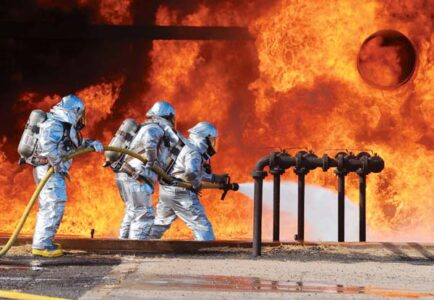
Still, use of aqueous film-forming foams is necessary for firefighting at airports due to the nature of aircraft fuel fires, the Transportation Department said in a news release Tuesday. Firefighting foam is no longer released in training, but was used in sessions prior to 2021.
Airport rescue and fire vehicles statewide have also been retrofitted to limit the use of AFFF only to fires with or nearby aircraft fuel, the Transportation Department said.
Based on historical uses, though, the Transportation Department began soil sampling for PFAS at six locations, including the Kahului Airport training pit, the former aircraft rescue and firefighting training pit at the Daniel K. Inouye International Airport, the training pit at the Ellison Onizuka International Airport at Keahole, the two former training pits at Hilo International Airport and the former training pit at Lihue Airport.
When AFFF is used for fire training or to fight fires, it soaks into the ground and can reach groundwater and drinking water as well as leak into the ocean. PFOS, along with four other chemical compounds, were identified in groundwater beneath the Kahului Airport fire training pit.
The Health Department environmental action level for PFOS in groundwater is 1.1 parts per billion. The highest concentration of PFOS found in the groundwater was 1,600 parts per billion, the department said.
The Transportation Department emphasized that the groundwater "is not a source of drinking water and does not threaten other drinking water resources on the island."
Additional investigation of the groundwater contamination is ongoing, the department said.
"Several monitoring wells have been installed to monitor potential impact in the area," the Health Department added.
Adverse health effects from PFAS are still being gathered through scientific studies and "a lot is unknown," the department said. Still, there is evidence that high exposure to PFOS and perfluorooctanoic acid through drinking water contaminated with these chemicals can cause reproductive, developmental, liver, kidney and immunological problems in laboratory animals.
Human studies have shown problems with cholesterol levels, the immune system, thyroid gland function and decreased weight at birth, the Health Department said. Some human studies have also shown carcinogenic effects, meaning high, long-term exposures to some of these chemicals may lead to cancer.
Fencing the area impacted by PFAS at Kahului Airport is a temporary measure to prevent direct contact with the soil. The Department of Transportation said Wednesday afternoon that it will continue to work with the Health Department on remedial actions at this site, which could include covering the soil.
The Transportation Department said that fire training does not need to pause while solutions are formed since the pit has been lined already and the ARFF unit has been training with water only since 2021.
"We have multiple monitoring areas surrounding the pit and conduct quarterly monitoring," the department said.
The results of the four other compounds detected in the groundwater include:
• Perfluorohexanoic acid (PFHxA): The highest concentration found in the groundwater was 43 parts per billion, above the Health Department environmental action level of 0.04 parts per billion.
• Perfluorohexane sulfonate (PFHxS): The highest concentration found in the groundwater was 370 parts per billion, above the environmental action level of 10 parts per billion.
• Perfluoroheptanesulfonic acid (PFHpS): The highest concentration found was 29 parts per billion, above the environmental action level of 0.02 parts per billion.
• Perfluorooctanesulfonamide (PFOSA): The highest concentration found in the groundwater was 260 parts per billion, above the environmental action level of 0.8 parts per billion.
* Dakota Grossman can be reached at dgrossman@mauinews.com.