
New species of bee discovered on Molokai
Trending
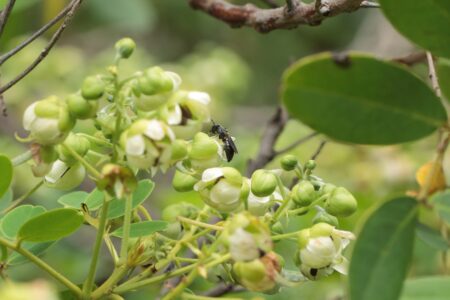
Entomologist Dr. Karl Magnacca said he and his team had just spent four days in the rainforest in Molokai last year when they came across a site with a rare native shrub called "kolomona."
"I'd never seen that. It's a pretty rare plant," he explained.
Upon a closer look, there were bees surrounding the native shrub, and at that moment, much to his surprise, Magnacca realized he had come across a new bee species.
"I wasn't expecting to find a new bee there," he said. "This is the first new bee recorded on Molokai in a long time."
Having named more than 200 species before, he called the newly identified bee "Hylaeus paumākō," as "paumākō" means "mourning" or "grief" in Hawaiian. Distinguished by its all-black face, a unique characteristic not seen in any other known male bee species on Molokai, he said he felt the name was appropriate. Following the theme in Latin naming, where species with dark features are often named with the Latin word for funeral, he carried on that tradition in Hawai'i.
"Something to reflect the Hawaiian land and culture and show appreciation to the place," he said.
While it’s possible the bee may be on other islands, or used to be, it’s the only one that they know is endemic to Molokai, he said. He discovered Hylaeus paumākō in Mākolelau, an ahupuaʻa of east Molokai in an area that the Department of Land and Natural Resources acquired in 2022 for conservation purposes.
Magnacca is the Department of Land and Natural Resources' Division of Forestry and Wildlife survey entomologist. He said he was conducting a survey at the time of the discovery with the Molokai Plant Extinction Prevention Program team. The effort is made possible through a grant from the U.S. Fish and Wildlife Service.
Despite significant degradation in some parts of the area from invasive species and erosion, there are pockets of native vegetation which have been fenced in, allowing for such a discovery to occur. Magnacca said it speaks to the importance of preserving these types of native forests.
"These mesic forests are the most diverse in terms of native plants and insects in general, and also the most threatened," he said. "Everyone's attention is grabbed by the wet rainforest, but we have large portions of those forests protected and in relatively good shape, while dry and mesic forests are much more endangered. So it's really important to protect these remnant patches even when they're small because our native species can survive in them."
New species of native insects are identified surprisingly frequently, Magnacca said, and he has collected some 500 new species in the past three years of field surveys.
"I do expect there will be more discoveries among the native bees," he said. "There are quite a few that haven't been seen in decades, and recently discovered ones that have only been seen once or twice, so they seem to be quite good at hiding from us. I have seen them persisting in surprisingly small or degraded areas, so that gives some hope that they may actually be doing better than it seems."
He said it's also possible the bee is an important pollinator for the native plants, such as the kolomona.