
Some farmers want rules eased for food trucks, trailers and farm tours
Trending
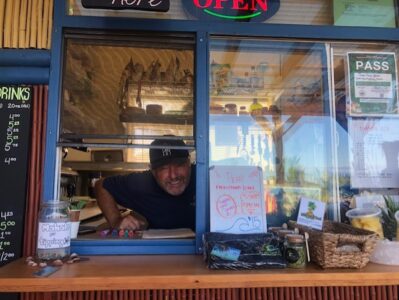
Peahi farmer Gale Ashby had been running his six-acre farm operation while selling coconuts, dragon fruit, lemons, smoothies and poke bowls out of a trailer along the Hana Highway for a few years when he was told in 2023 by Maui County planning officials that he couldn't operate a food trailer on his agricultural property.
"The code said we weren't allowed to, according to their interpretation," Ashby said. "We registered in 2019 and we're told by the department that we were OK."
Ashby said he had registered the food trailer with the county, but because it was on wheels, the county no longer recognized it as a food stand, as permitted under county ordinances.
As an outgrowth of discussions among some farmers including Ashby, a public hearing is scheduled for Tuesday to look at two bills to allow mobile food trucks or trailers in agricultural districts, as well as allowing agricultural tourism on farms in Maui County.
The meeting before the Maui Planning Commission is set for 9 a.m. Tuesday, Feb. 25, at the Planning Department Conference Room at 250 South High St. Maui County Council member Gabe Johnson, chair of the Agriculture, Diversification, Environment and Public Transportation Committee, introduced the bills.
The bills are making their way before the Maui County Planning Commission and other planning commissions on Lanai and Molokai before going to the Maui County Council.
Johnson said the intent behind the bill related to agricultural tourism is to support opportunities for local merchants, farmers and small businesses to sell their goods and services directly to the public. He said no county permits would be required, except for the farmer registering the activity.
A county ordinance now allows agricultural product stands under 1,000 square feet, where sales may occur of agriculturally grown products in Hawaii. The bill would amend the law to allow mobile food trucks or trailers to operate on a farm by a farm producer.
Under the proposed ordinance, the mobile food truck would not operate within 500 feet of any other mobile food truck or trailer, and registration would be granted on a first-come, first-served basis.
The bill also requires a producer to have at least three off-street parking spaces for customers.
Another bill proposed by Johnson would allow specific types of agricultural tourism on a farm but restrict the activities operation from 8 a.m. to 6 p.m.
The activities include demonstrations using agricultural products produced in the state, such as lei making, cordage and rope making, saddlery and leatherwork, basketry, weaving, carving, feather work, coffee roasting and tasting, and processing brewing, tapa production, honey and beeswax production, cacao process and tasting, dairying, cheese making, cooking, and instruction in medicinal plants and native Hawaiian agricultural practices.
The bill also includes support for activities such as retaining and improving archeological, historic and cultural sites.
No restaurants would be permitted on the site, but the designated agricultural tourism sites could have a gift shop and activities for demonstrating and presenting agricultural products made in Hawai'i.
Johnson feels the bills would provide additional income to small farmers. "We're trying to help the little guys," he said.
Haiku farmer Sydney Smith said she anticipates there will be some opposition to the bill in the same way there was pushback against the foodstand bill that was approved and put into the ordinance in 2015.
"They were saying there would be a pizza place everywhere in the country but there wasn't," said Smith, who added that she doesn't agree with physically spacing apart food trucks and trailers by 500 feet.
"Every farm should be able to have a food truck or trailer if they want one," Smith said.
Ashby said he still has a display produce cart along the highway, but the county's decision to ban the trailer took away about 75% of his farm income and he's hoping an amendment to the ordinance will fix it.
"It helps us to be successful and sustain the farm," he said.