
Monk seal counts up as scientists do annual survey
Trending
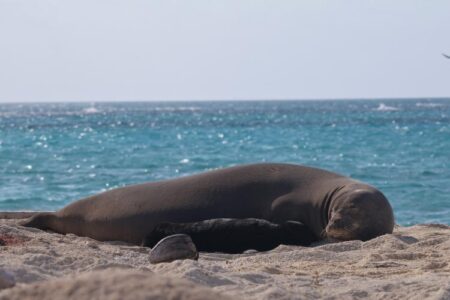
Scientists have arrived on Lalo Island in the Northwestern Hawaiian Islands to conduct their annual wildlife count, including what has been a rise in the number of endangered monk seals.
After decades of declining numbers, the total population of monk seals started to increase gradually in 2013 in the Northwestern and main Hawaiian Islands.
“Monitoring Hawaiian monk seal and green sea turtle populations is critical to supporting their recovery," said Michelle Barbieri, lead scientist for NOAA Fisheries' Hawaiian Monk Seal Research Program.
More than a decade ago, federal officials relocated some juvenile monk seals from the Northwestern Hawaiian Islands to the main Hawaiian Islands to improve their chances of survival, partially because of aggressive male seals.
The population of monk seals was more than 1,500 in 2021 for the first time in 20 years, but that was still about a third of the animals' historic population levels, according to the National Oceanic and Atmospheric Administration.
The federal agency reported the seal population was about 1,600 in 2024 as compared to 1,435 in 2019. Their numbers were estimated at 1,208 in 2006 in the Northwestern and main Hawaiian Islands and were decreasing at a rate of 4% a year.
NOAA said that from 2013 to 2021, the monk seal population grew at an average of 2% per year, providing hope for the species' long-term recovery. Even so, the level required for the species to be down-listed from endangered to threatened under the Endangered Species Act is more than double the current number of monk seals.
The number of endangered Hawaiian monk seals born in the main Hawaiian Islands is growing, according to the state Department of Land and Natural Resources, which reported that 34 pups were born in the main Hawaiian Islands in 2024, and at least three pups have already been born this year.
Some 169 pups were born at six major pupping sites in the Northwestern Hawaiian Islands in 2024, according to the federal agency.
Federal marine officials also reported disentangling four seals from debris, relocating 14 weaned pups away from high-risk shark predation areas at Lalo Island, and reunited four nursing seal pups with their mothers.
During the 2024 season, field teams freed more than 450 turtles and 33 seabirds from aging infrastructure on Tern Island. They disentangled two turtles from a net mass anchored on a reef at Manawai and conducted 26 Hawaiian monk seal survival interventions.
They identified 1,260 turtles at Lalo, 512 females were on Tern Island, and 223 females on East Island.
Additionally, Native Hawaiian cultural practitioners and scientists with specific knowledge about manō, the sharks, were integrated into the Lalo camp recovery mission.