
Maui taro farmer has renewed hope
Trending
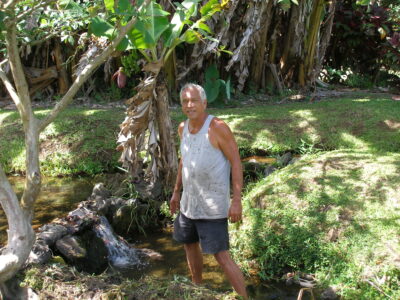
East Maui taro farmer Ed Wendt remembers when there were no state instream flow standards to make sure there was enough water flowing from the mountains to the sea, including the Waiokamilo Stream near his family's farm in the 1990s.
"The taro died, and the o'opu and opae, fish and shrimp died. The area became black with mosquitos," said Wendt, a native Hawaiian who can trace his family farming the land back six generations before the mid-1800s when Hawaii was still a monarchy.
"These are traditional and customary rights," Wendt continued. "When the stream was dewatered, it denied us from teaching and passing on the traditional practice of farming. It's slowly coming back."
The East Maui Water Authority, established through a Charter amendment, is scheduled to have a series of tours, workshops and discussion this week with residents in different communities to hear about their vision, hopes and needs.
A meeting was held Monday in Keanae and another Tuesday at the Kula Community Center. A third meeting was held Wednesday at the Haiku Community Center.
Besides the impact on farmers, environmental observers say limiting the 74-mile network of canal diversions taking the water from East Maui to Upcountry residential and farm areas can also have an effect the fragile East Maui ecosystem, where a number of endangered species live, including the Maui Parrotbill Kiwikiu, the honeycreeper I'iwi, species of yellow-faced honeybees, and the hoary bat ope'ape'a, and the orangeblack Hawaiian Damselfly, and 25 rare plant species.
An East Maui irrigation ditch system, built between 1876 and 1923 to provide water for sugarcane cultivation, continues to move water along the slopes of Haleakala.
With the closure of Hawaiian Commercial & Sugar Co.. the last sugar plantation in Hawaii in 2016, one of the main issues has been how much water, reportedly 200 million gallons a day during the sugar era, should continue to be diverted.
Hawaiian Commercial, the parent company, said in 2017, it needed 115 million gallons a day for new agricultural operations.
The Native Hawaiian Legal Corp., representing many East Maui farmers, said Hawaiian Commercial was presenting its vision, not evidence it needs to keep 30,000 acres of former sugarcane land in agriculture.
In 2019, 50 percent of East Maui Irrigation was purchased by Mahi Pono, a joint venture between Pomona Farming LLC and the Canadian pension-based Public Sector Pension Investment Board.
The joint venture partnership, which owns 41,000 acres of agricultural land in Central Maui, said it will be growing a variety of citrus fruits and has planted 2 million trees on 11,000 acres of land.
Wendt said he feels the intent of the Charter amendment passed by voters was well-intentioned but fears the needs of farmers and wildlife in the East Maui area might get lost in the politics.
He said of those appointed to the East Maui Water Authority, he knows of only one board member who was an advocate supporting the Charter amendment.
He said with the state enforcing instream flows, he's been able to farm 30 taro patches, about three acres, and now, a son and grandchildren are helping him to take care of the family land.
Wendt said he's also worried about global warming and has noticed rainfall hasn't been as much as before in his area of East Maui and hopes people will look at smart growth alternatives, including the storage of water to maintain the stream flows throughout the year.
"It makes me feel good that I have passed on the knowledge," he said. "But I'm very concerned about the future."