
Woody Harrelson lends voice to ‘Kuleana,’ a documentary about protecting the ocean
Trending
With narration by Woody Harrelson, the new documentary, "Kuleana," will be screened Sunday at the Maui Arts & Cultural Center as part of the Hawaiʻi International Film Festival, presented by Halekulani Hotel.
A timely, sobering film directed by acclaimed London-based filmmaker Georgia Scott, it takes audiences on a visually stunning journey into the heart of ocean plastic pollution using Hawaii as its focus.
The Hawaiian islands act as a filter for global plastic pollution, making the beaches some of the dirtiest in the world for accumulating marine debris.
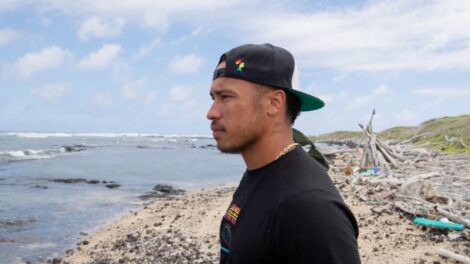
"This is the Hawaii nobody sees," said former professional baseball player Kolten Wong standing at Kamilo Beach on Hawaii Island, where the Great Pacific Garbage Patch dumps plastic trash.
In just 15 years, the amount of plastic in the sea is projected to double. By 2050, it could outweigh all marine life combined.
"Plastic pollution is affecting everything from the smallest of tiniest little fish in the nursery grounds surrounding the coastlines," Scott explained. "There's a coral researcher who works on Coconut Island and she recently discovered that the coral are consuming microplastics in the water. When they consume the plastic, in essence they're starving to death."
To help more effectively disseminate this message, Scott worked with sports figures and leading scientists. Former MLB player Chris Dickerson, founder of Players for the Planet, joined world-class athletes including Kolten Wong, Maui surfer Kai Lenny, Maui spearfishing champion Kimi Werner and shark conservationist Mike Coots in dialogue with the scientists.
"It's been a two-and-a-half-year long project, and it really started with myself and Chris Dickerson wanting to reduce plastic in sport arenas," Scott said. "We both felt very disillusioned by how we can connect with people around plastic pollution. So we came up with the idea of telling the story through the lens of sport and athletes. Instead of us hearing it personally from scientists, we take the athletes with us on this journey of discovery and the audience gets to understand the information through the eyes of people that they look up to.
"Hopefully by doing it this way we are able to deliver quite difficult information and facts around plastic pollution affecting whether it's fish, turtles, or even our own body. We actually tested the blood of Kai Lenny, the world champion surfer from Maui. I don't want to reveal too much because I want people to watch it, but it was shocking to see the discoveries."
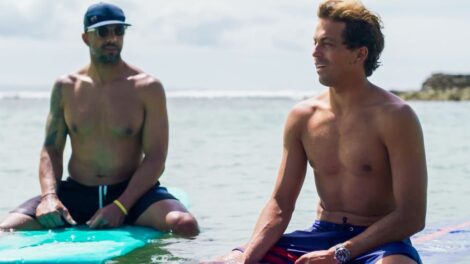
Champion Maui surfer Kai Lenny is featured in the new documentary, "Kuleana," which focuses on plastic pollution in Hawaii's waters. Courtesy photo
Scott chose to focus on Hawaii after connecting with Hilo-born baseball player Kolten Wong.
"He was talking about the Great Pacific Garbage Patch and plastic pollution arriving on the shores of Hawaii," Scott said. "So I then went on a journey of discovery connecting with different scientists who are working from the deep sea to the shorelines of Hawaii.
"In my life I've documented some pretty difficult stories in the world of conflict, but I was shocked by the new science that they were uncovering. Hawaii is a very interesting place because of its geographical location and unfortunately the currents bring the world's trash to its shores. It's a very important place and I think culturally it was also really interesting to dive into the history of Native Hawaiian culture and what that means today and how we can actually learn some very important lessons from how they used to live and try to apply them to how we live today."
Getting part-time Maui resident Woody Harrelson involved was a major bonus.
"I got to know Woody and his wife Laura (Louie Harrelson) through some work I was doing at the BAFTAs many years ago," she noted. "Laura came on board as an executive producer and helped raise some money for the film, and Woody volunteered his time and his voice for the film, which was really special because he brings such a powerful dimension."
Also on board as an executive producer, Olivier Harrison, the wife of George Harrison.
"Laura connected me to her," she said. "They were neighbors on Maui in the past. We pitched the film to her and she really felt connected to the story as well and came on board as an executive producer quite early on. I hope that they will share this film on all their channels and their community."
Filming around the islands, Scott twice shot scenes on Maui. "We took Chris out surfing with Kai," she said. "It was really phenomenal to see Maui through the eyes of Kai Lenny, who grew up in those waters, and get to know the island through his eyes. The love and dedication and energy he has for the ocean and Hawaii just radiates through the lens into the audience. That was pretty cool."
The co-founder of GroundTruth Productions, Scott's previous work includes "Shadow of War" (2014) set in Bosnia, "Lost in Lebanon" (2017) and "Tomorrow's Freedom" (2022) on imprisoned Palestinian politician Marwan Barghouti, known as the Palestinian Mandela.
She is working on a new project, "Conversations With Ice," which highlights polar explorer Felicity Aston's groundbreaking work on microplastics and anthropogenic climate change, the impact of melting glaciers and what we can learn from ice cores. In 2012, Aston became the first woman to cross Antarctica alone and the first human to traverse across the 1,084-mile continent without dogs or snowmobiles.
"She's an expert on microplastics and what they were discovering up in the ice sheets in the Arctic was quite incredible as well," said Scott. "There's no one living up there, yet plastic is found in the ice. All these years of the big pieces floating around, and it's now breaking down into these nanoparticles which can go everywhere. There's no part of the planet that remains untouched from plastic pollution. I think a lot of people think, 'Oh well, you know, it affects the planet or affects the environment,' but now it's in our own bodies. It's affecting our own health, so I hope that can be a real wake-up call to people."
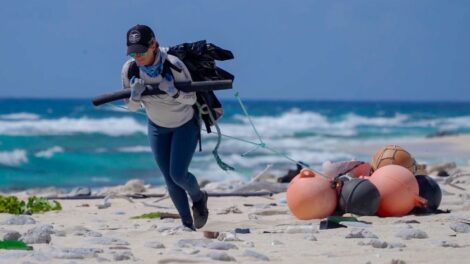
By 2050 plastic in the sea is projected to outweigh all marine life combined. Courtesy photo
Scott said GroundTruth only makes films that can be used as tools to create real change.
"With 'Kuleana,' it's going to spearhead a multi-leveled impact campaign that is going to hopefully drive behavior change in our own lives," Scott explained. "We're also going to be doing a real educational push, doing cutdowns of the film and educational toolkits for high schools and universities."
At the policy level, Scott said they hope to get the film in front of decision-makers to advocate for stronger laws around plastic pollution.
"That's the hard part, but that's the part I enjoy most because it's challenging, but it's doable," Smith said. "I hope that because of the way we've made this film, it's not a kind of traditional long-format cinema documentary, that we can get to the people who are making decisions around stadiums. I was at the UBS Arena at Long Island to watch Billie Eilish and we had a tour of the stadium, and they've managed to replace all the plastic cups that that stadium used to use -- thousands of cups every night -- with a reusable system where they wash the cups and they reuse them, so it is possible.
"It's a hard mission, but I love it, and I was so inspired being in Hawaii, because it's so beautiful, and the people are wonderful. There's this real sense of connection between how people live and the environment. I hope that we can bring some of that to living rooms around America and further afield."
"Kuleana" will be screened at 3 p.m. Sunday at the MACC. Co-producer Sasha Fairhead will attend along with Ed Freedman from the Stable Road Foundation. For tickets, go to www.mauiarts.org.