
Kula looms large in Chinese history as Maui celebrates Year of the Horse
Trending
A few trees and a dry rock reservoir are all that remains of Chinese immigrant Sun Mei's mountainside ranch and farm in Kula.
However, as festivities celebrate the Chinese New Year, the Kwock Hing Society in Kula will be keeping alive the memory of him and his brother Sun Yat-sen, who led the overthrow of China's last imperial dynasty in the early 1900s and the founding of a Chinese republic.
The temple contains photographs and written accounts from the Sun family.
"I'll be telling the history of the temple built in 1907 to support Sun Yat-sen and his activities," said Sara Shim, president of the Kwock Hing Society. "We always acknowledge that."
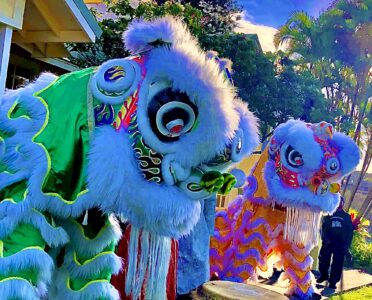
On March 1, the Kwock Hing Society is scheduled to have a New Year's observance at 11 a.m., featuring lion and sword dancing, an incense-burning ritual and a variety of food.
The society plans to present some traditional foods that are symbolic -- noodles for longevity, gao made of mochi for family unity and cohesiveness, and baked watermelon seeds for fertility.
The Kwock Hing Society supported Dr. Sun Yat-sen's effort to overthrow the Qing dynasty and establish a republic and has several photographs on exhibit featuring the Sun family, who lived on Maui, and their ranch and farm operations.
Sun Mei's ranch served as a refuge for his family and the family of Sun Yat-sen after their unsuccessful first attempt to start a revolution in 1895, according to Luke Chan, author of the memoir, "Sun Yat-sen: As I Knew Him."
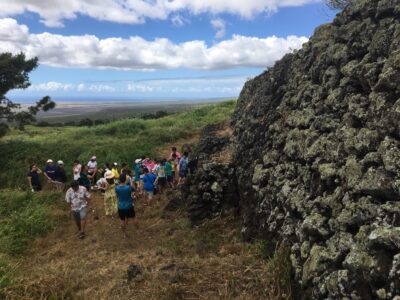
Chinese students visit a large reservoir built on the ranch where the Sun family lived. Ranch owner Sun Mei supported his younger brother Sun Yat-sen's schooling at a boarding school in Honolulu. Gary Kubota/The Maui News
Sun Yat-sen was in exile until 1911, when the 11th attempt to overthrow the dynasty was successful, according to historians.
Sun Yat-sen's place in Chinese history is unique. While disagreeing on many political issues, the Taiwan government and mainland China both regard Sun Yat-sen as the father of modern China and have named more than 60 schools and parks after him.
Students from China have visited the site of Sun Mei's ranch as part of their study of Chinese history.
While the United Nations has designated the Sun Yat-sen Museum in Penang as the place where Sun Yat-sen planned the 1911 revolution, Sun Mei's ranch in Kula was part of the financial foundation that funded Sun Yat-sen's education and his early years as a revolutionary, according to Victor Sun, author of "Sun Mei: My Great Grandfather."
Sun Yat-sen attended a boarding school at Iolani School on Oahu from 1879 to 1882, where he learned not only English but also the principles of United States democracy and Christianity, prompting him to become a Christian and study Western medicine.
He was among the first two graduates of the Hong Kong College of Medicine for Chinese in 1892.
The brothers also organized and received support from dozens of overseas Chinese in cities, including Honolulu, San Francisco, New York, London, Japan and Singapore.
Sun Yat-sen also had friends from the Iolani School who assisted him, including Chung Kun Ai, who donated money to help Sun Yat-sen in his early years as a student, and Chan, who helped Sun Yat-sen's family flee China and travel to Hawaii.
Both Chung Kun Ai and Chan recounted their memories of Sun Yat-sen in their books.
Former Honolulu City Council member Leigh-wai Doo, founder of the Sun Yat-sen Foundation of Hawaii, said a number of Chinese in Hawaii volunteered to fight for the republic, including Oahu resident Sen Yet Young.
Young, a pilot and engineer commissioned by Sun Yat-sen to build the first airplane manufacturing plant in China, is considered the father of the Chinese revolutionary air force and has a school named after him in China.
Doo said Young brought the latest in airplane technology to help Sun Yat-sen defeat the warlords.
"He gave the country hope," Doo said.
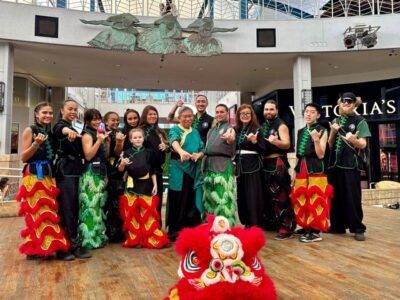
The Queen Ka'ahumanu Center will be celebrating the Lunar New Year from 12-4 p.m. Sunday, Feb. 22. Courtesy photo
Local celebrations planned
Various festivities are planned to help celebrate the Chinese New Year.
A lion dance will take place at 9 a.m. Friday at the Kalana O Maui Building, 100 High St., in Wailuku. There will be an exhibition of Au's Shaolin Martial Arts led by Master Ben Seng Au of Honolulu in recognition of the Chinese Lunar New Year. The performance also includes firecrackers, drums and cymbals. Lai see envelopes will be handed out for audience participation to feed the lions for good luck.
2026 is the Year of the Fire Horse. The Chinese zodiac rotates through a 12-year cycle of animals with the horse representing hard work and resilience.
On Saturday, the 24th annual Maui Community Chinese New Year's Festival will be from 9 a.m. to 3 p.m. at the Maui Mall Village in Kahului. The event includes Chinese music, food and crafts, a calligraphy table, a New Year's ritual and family table, a children's horse art display, keiki craft tent, and a photo booth where people can take a photo with a "Good Luck Lion."
Festival official John Tam said the festivities will feature some history about Chinese heroes in Hawaii as well.
The event also includes:
• 9 a.m. -- Martial arts Taiji on Maui
• 9:30 a.m. -- Chinese Heroes
• 10 a.m. -- Lion Dance & Blessing
• 10:45 a.m. -- Cooking demonstration
• 11:15 a.m. -- Hawaii Tai Chi Chuan Association
• 12 p.m. -- Keiki Fashion Show
• 12:10 p.m. -- Ohana Martial Arts Show
• 1 p.m. -- Lion Dance & Blessings
• 1:30 p.m. -- Art contest awards and the appearance of Miss Maui Teen USA Olivia Tom
• 2 p.m. -- Exergy 35 Edutainment – Dragon parade and ribbon dance.
On Sunday, Au Shaolin Martial Arts will perform at Kaahumanu Center, ushering in the Lunar New Year with a Chinese lion dance performance and fireworks from 1 to 2:45 p.m., starting at Center Court and winding through the shopping center.
Guests are welcome to feed the lion with customary red envelope offerings, symbolizing the sharing of good fortune throughout the community.