
New study sheds light on Maui’s tiger shark activity
Research team says they have identified ‘mating hub’ at Olowalu
Trending
Maui resident Tiare Lawrence doesn't hesitate when asked if shark warning signs should remain up on the beach at Olowalu.
"Absolutely," said Lawrence, who grew up in the area. "Shark sightings are common in Olowalu. It's very well-documented in Hawaiian stories."
Maui outpaced all other Hawaiian Islands in the frequency of shark bites from 1995 to 2021, with about 40 nonfatal bites and five fatal bites, according to data compiled by the Hawaii Institute of Marine Biology. The highest frequency of tiger shark sightings on Maui was found to occur at Makena Point, with Kalama, Palauea and Olowalu also showing high rates of shark activity.
A recent study from the University of Hawaii at Manoa suggests one reason Olowalu might have so many tiger shark sightings: It's a mating hub.
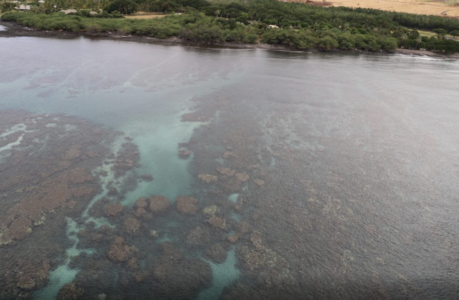
The Olowalu reef in West Maui is known for its diversity. Besides sharks, the reef is home to the largest population of manta rays in the United States. Photo courtesy Hawaii Department of Land and Natural Resources
Warnings at the beach
Olowalu was the first place in the state where officials authorized permanent shark warning signs, according to the state Department of Land and Natural Resources. However, the signs have been the victim of souvenir stealers, vandals and beach erosion.
On a recent Tuesday morning in late January, more than 20 cars and trucks were parked in a quarter-mile stretch, as a combination of visitors and residents enjoyed a sunny day at the beach.
Some of the beach-goers were unaware of the presence of sharks in the area or past shark bites. There is no lifeguard stand at the beach.
Cat Gallagher was visiting from Austin, Texas. She said she knew there were sharks at Olowalu, but she wasn't aware of the shark bites.
"I feel knowledge is power. It would help to be aware," she said.
Kula resident Robert Ward, who is a kayaker and has seen tiger sharks at Olowalu firsthand, said it's only fair for the visitors to know about the animals' presence in the area.
"There's a blacktip shark breeding area I've been to," he said.
Makawao kayak fisherman Nate Sarol also supports posting more shark warning signs.
"My cousin and I saw a tiger shark splashing 50 yards out," Sarol said as he pointed to the location where he saw it.
The signs say, "Warning. Sharks may be present. Shark bites have occurred in this area." According to the state Division of Aquatic Resources, due to theft, vandalism and erosion, the signs do not last long.
The division said four shark warning signs were posted a couple of months ago, including one at Olowalu landing and three on a stretch of beach under a growth of kiawe trees. On Jan. 29, there were no signs visible on any metal poles near the parking areas, but signs were found nailed to kiawe trees along the beach.
One of the signs had advertising stickers blocking part of the wording. Another was blocked from view by tree limbs. A third was 20 feet from where vehicles could park.
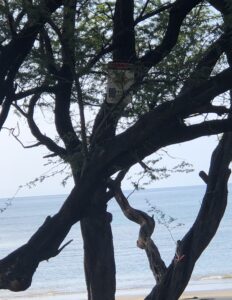
Tree branches partially block one of the shark warning signs at Olowalu. Gary Kubota/The Maui News
Shark bites at Olowalu
The Hawaii Board of Land and Natural Resources decided in 2002 to permanently post the shark warning signs at Olowalu following three shark attacks in less than 11 years, including the death of Marti Morrell in November 1991 as she swam near her beach home.
There is documentation of at least three other shark bites at Olowalu.
On Oct. 18, 2000, a woman from California was bitten while snorkeling on the upper right torso and buttock about 450 yards from shore by an unknown species of shark that was 6 to 8 feet long. The attack took place at about 11:20 a.m.
At about 1 p.m. Jan. 1, 2002, a man from Los Angeles was bitten by a tiger shark while he was snorkeling about 100 yards off shore.
On March 31, 2016, another snorkeler was bitten on the left foot by a tiger shark about 400 to 450 yards from shore. The water was turbid, and the laceration was minor. The attack took place at about 11 a.m.
'A mating hub'
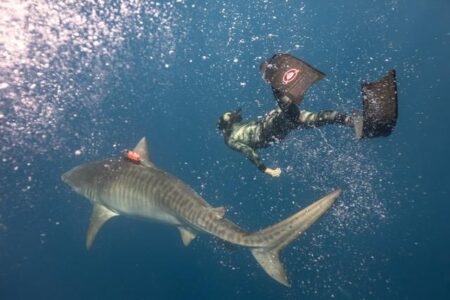
A team of shark researchers from the University of Hawaii at Manoa recently reported identifying the first-ever documented mating hub for tiger sharks.
Led by the Hawaii Institute of Marine Biology Shark Lab, the study used six years of acoustic tracking data to pinpoint Olowalu and the nature of tiger shark mating.
The researchers said their findings challenge the idea that tiger sharks are solitary animals, and reveal a seasonal convergence of adult tiger sharks that coincides with the humpback whale calving season in Hawaii.
"Tiger sharks typically roam widely in what can seem like random patterns, so finding such a strong and consistent seasonal trend in their movements around Maui was unexpected," said Paige Wernli, lead author of the study and a graduate student in the HIMB Shark Lab.
The long-term tracking data revealed a strong, predictable seasonal presence and high overlap of both mature male and female sharks at Olowalu, with both sexes exhibiting physical signs of mating activity.
"To our knowledge, no group mating site for tiger sharks has ever been identified. This paper adds an important piece to the puzzle of tiger shark reproduction," said Carl Meyer, co-author of the paper and principal investigator of the HIMB Shark Lab.
The timing of the sharks' convergence indicates that the sharks may be positioning themselves to take advantage of foraging opportunities, such as vulnerable whale calves or placental falls.
The researchers noted that these gatherings are not dense but rather diffuse, spanning multiple months and several kilometers.
"This study expands our knowledge of tiger shark mating and challenges our conventional understanding of the term 'gathering,'" said Meyer. "Together, the results suggest that both reproduction and food availability play key roles in shaping tiger shark movements in Hawaii."
The six-year study required the team to safely catch and implant acoustic transmitters in large sharks, then maintain a vast network of underwater listening stations across the main Hawaiian Islands.
Moving forward, the team plans to equip tiger sharks with camera accelerometer tag packages to directly document mating behavior and shark-whale interactions, providing a real “shark’s eye view” into their daily lives.
Olowalu has also gained prominence for its 939-acre reef extending 4 miles along the coast and a half-mile from shore, and for its role as a mother reef helping to seed other reefs. Another study found the reef has the largest known manta ray population in the United States.
State land and aquatic officials have received a $10 million federal grant and are collaborating with a half-dozen conservation organizations to look at protecting and restoring West Maui reefs, including Olowalu.