
Native plants help rebuild dunes at Baldwin Beach
Trending
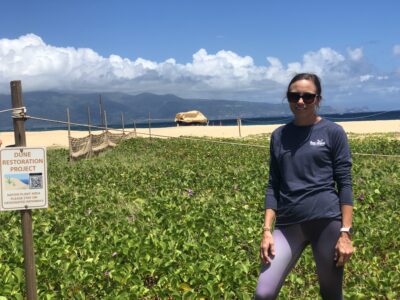
Where once there was a depression in the sand from the removal of a pavilion over a year ago due to coastal erosion, a test plot of native groundcover plants has collected windblown sand, turning the depression into a mound on Maui's North Shore.
"The plants keep growing up and accumulate more sand. They're adapted for this environment," said Tara Owens, an extension agent with the University of Hawaii Sea Grant College Program. "They can accept the wind, the sun, the waves, and they won't die."
Owens and her team of technical experts and volunteers have received more than $1 million grant from the National Fish & Wildlife Foundation. They hope to restore portions of the sand dune system at Kapukaulua, also known as Baldwin Beach Park.
The project stretches from the Paia Youth Center to Wawau Point, and it is no small task in an area that was mined for sand for decades starting in the early 1900s. The sand was used to manufacture hydrated lime for sugarcane soil enhancement and making concrete.
At Baldwin Beach, the team seeks to restore the remaining dunes to give the natural system a buffer against seasonal erosion and high waves, allowing the dunes to rebuild themselves as sand accretes from the ocean to the shore.
Earlier this year, the beach near “the cove” widened by at least 100 feet.
Owens said that in the spring and summer, the trade winds blow from the northeast and push the waves and sand from east to west.
She said peak erosion usually happens around the end of August or beginning of September, and then it recovers when Maui receives winter swells.
"That's when the sand gets pushed back from west to east," she explained.
Owens said that during dune restoration projects, they may have as many as 30 to 40 volunteers during a community workday, in addition to Sea Grant staff as well as three Maui County parks workers who maintain the dune restoration sites.
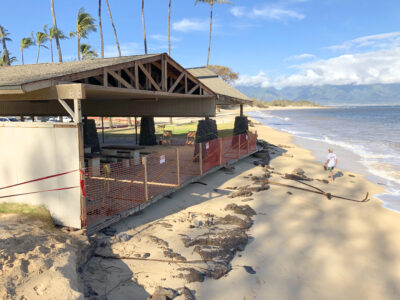
The pavilion at Baldwin Beach was removed in September 2024 after suffering irreparable wave damage. A dune restoration team has chosen not to rebuild it and is growing native plants there to help rebuild the dunes. Photo courtesy
Past barriers remain
Jutting about 100 feet into the ocean is a collection of black boulders that served as a rock revetment around the old Paia kiln and the nearby coastal waters where the dunes once stood.
"The beach used to be out there," Owens said. "That's the former position of the shoreline back in the early 1900s."
Owens added that because so much sand was removed from the system over the decades, it caused the beach to erode faster than anywhere else on the island.
She said the location of the lime kiln and nearby wall reflected wave energy, stopping the natural flow of the dunes, contributing to coastal erosion, which led the county to remove the former pavilion two summers ago.
Owens said that if the rock revetment boulders weren't there, sand would be coming from the east to the west, "but it blocks the transport of sand from the other side, and so you get this sort of deficit right here," she said.
Pilot project areas have success
In some areas where there has been localized work such as the planting of native ground cover, the dunes are rebuilding.
The growing dunes help create enough elevation to act as natural buffers, reducing the chances of high waves overwashing infrastructure, such as at Lower Paia Park. Owens said the new native plant growth at the Paia Youth Center added enough height to halt the flooding.
"It's a good model for what we hope the endpoint would be for all of Kapukaulua," she said. "We've gained a lot of elevation there, and now the waves don't wash into the park."
The team relies mainly on native vines and grasses that are adapted to the shoreline environment and help to stabilize dunes, including pohuehue known as beach morning glory, akulikuli, and aki aki grass.
The team is in the developmental stages of restoring the dunes at Baldwin Beach Park.
Its goal is to some degree to remove manmade structures and invasive vegetation that disrupt the natural movement of sand and prohibit the establishment of native vegetation.
Owens said work is moving forward to selectively cut down certain iron wood trees and replace them with patches of native plants along the coast from the Paia Youth Center to the old lime kiln site.
She said some of the iron woods are close to falling and their fallen needles can inhibit the growth of plants beneath them, preventing the natural growth of sand dunes.
"Basically, they're destructive," Owens said.
She said the dune restoration work is being done in partnership with Eco Management and Design Services and the Maui County Department of Parks and Recreation, with monitoring by the Maui County Department of ʻŌiwi Resources.
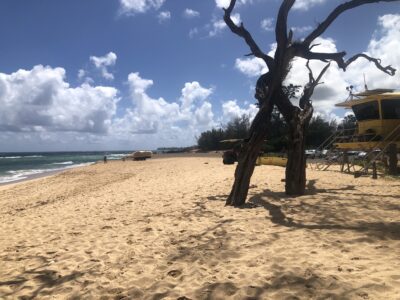
Baldwin Beach Park is close to its peak sand width during the spring-summer season but begins to narrow around September. A team is trying to restore the dune system by removing manmade structures that impede the flow and to grow native ground cover to capture and retain wind-blown sand. Gary Kubota/The Maui News
Monthly meetings gather information
Community members and project partners meet once a month to share and record their observations, documenting seasonal changes across the landscape, using their accumulated knowledge of the natural cycles as a guide for shoreline management practices.
These sessions are helping to inform the group as it moves through various phases in Kapukaulua Dune Restoration Project at Baldwin Beach.
Part of the plan is to designate pathways to the beach around cordoned areas of dune-growing native plants.
Sometimes sand fencing can be used for a quicker buildup of sand accumulation.
Owens said growing native groundcover is preferred because in the long run, it requires less maintenance.
Restoration plan revised
Owens said the team has been meeting since 2018 with the community and cultural advisors to discuss implementing the dune restoration plans.
As a result of these meetings, changes have been made to the plans along the way.
Based on feedback from the Maui Burial Council, a proposed bank sculpting of exposed clay in a certain area was removed from the plan.
Near the Maui Country Club, a plan to take sand at the top of a dune blowout will not be included in restoration activities. Initially, a proposal was made to transfer some sand to the main park area -- sand that had been funneled out of the system away from the beach.
"We did a lot of community engagement and there was some discomfort with that in our community so ultimately we decided to pause that for now and just work with the typical dune restoration tools starting with plants, pathways and perimeters," Owens said.
https://experience.arcgis.com/experience/7417e375f63a4eae9391cb257dbfe245/page/page_0