
Study finds low calf numbers among Hawaii Island spinner dolphins

Trending
A new study led by the University of Hawaii found unexpectedly low numbers of calves among spinner dolphins off Hawaii Island, raising concerns about the long-term survival of the isolated population.
The study, led by scientists with the Marine Mammal Research Program at the University of Hawaii at Manoa and published in Endangered Species Research, found that calves make up about 9% of the population. Researchers said that is well below the 17% expected in a healthy, stable population.
"The evidence suggests chronic human disturbance -- especially tourism and recreational-related interactions during critical dolphin resting periods -- as a likely contributing factor affecting reproductive success and calf survival," said lead author Fabien Vivier, who was a doctoral student at the Hawaii Institute of Marine Biology in the UH Manoa School of Ocean and Earth Science and Technology at the time of the work. "The findings support stronger conservation actions, such as time-area closures for human activities, alongside continued long-term monitoring -- actions that have long been called for."
Viewing spinner dolphins is part of Hawaii's tourism industry, but UH said those activities put pressure on the marine mammals. Previous research has shown that the Hawaii Island population experiences some of the highest levels of disturbance exposure recorded for dolphins worldwide.
To study the population, researchers used drone photography to measure the body length of free-swimming dolphins. They combined those measurements with age-length data from stranded spinner dolphins collected by Kristi West, a study co-author and researcher with the UH Health and Stranding Lab at the UH Manoa College of Tropical Agriculture and Human Resilience.

A drone image shows a large group of spinner dolphins off Hawaii Island. Researchers used drone photography to measure body length and estimate age classes in the population. Photo courtesy Fabien Vivier
The team created the first age-length growth curve for the Hawaii Island spinner dolphin population, allowing researchers to categorize dolphins as calves under 2 years old, juveniles from 2 to 9 years old and adults older than 9 years.
Researchers said age structure is an early indicator of population health. The low proportion of calves suggests the population may not be replacing itself fast enough, which could lead to future declines.
Spinner dolphins forage offshore at night and return to shallow coastal bays during the day to rest and socialize, making them vulnerable to tourism and recreational activity in nearshore habitats, according to the researchers.
"This study provides one of the first population-level demographic signals suggesting those long-term disturbances may now be affecting reproduction and calf survival," said Lars Bejder, co-author of the study and director of the Marine Mammal Research Program.
A 2021 federal rule requires people and vessels to remain at least 50 yards from spinner dolphins, but UH said experts with the U.S. Marine Mammal Commission and Pacific Scientific Review Group have argued that the measure is not enough. Study authors are calling for stronger conservation actions, including time-area closures that would restrict human access to critical resting bays during the day.
"Understanding these impacts is critical for protecting an isolated local population before declines become irreversible," said Randall Wells, study co-author and director of Brookfield Zoo Chicago's Sarasota Dolphin Research Program. "We hope this work provides the science-based evidence needed to develop effective protections for spinner dolphins while helping balance marine tourism, cultural stewardship, and long-term ecosystem health in Hawaii."
UH said future research and monitoring will depend on funding, with scientists hoping to track long-term changes in age structure, reproduction and population, while refining noninvasive drone-based research methods.
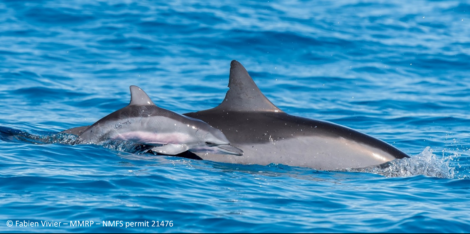
A mother and calf spinner dolphin swim off Hawaii Island. A University of Hawaii-led study found calves make up about 9% of the local population, below the 17% expected in a healthy, stable population. Photo courtesy Fabien Vivier