
Suzuki, Yoshida push students to take charge of their learning
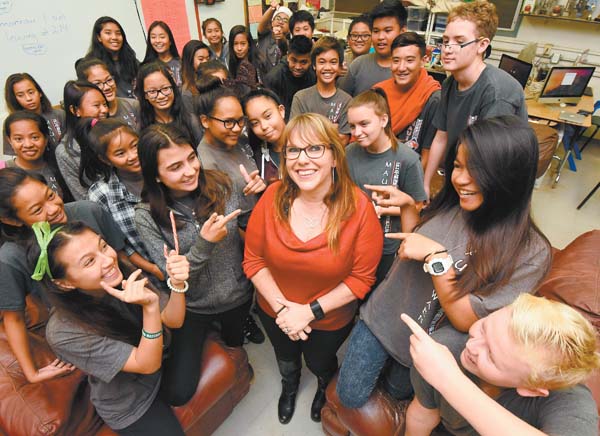
Maui District Teacher of the Year Jennifer Suzuki poses with some of her Maui Waena Intermediate School students in her classroom Wednesday morning. The Maui News / MATTHEW THAYER photo
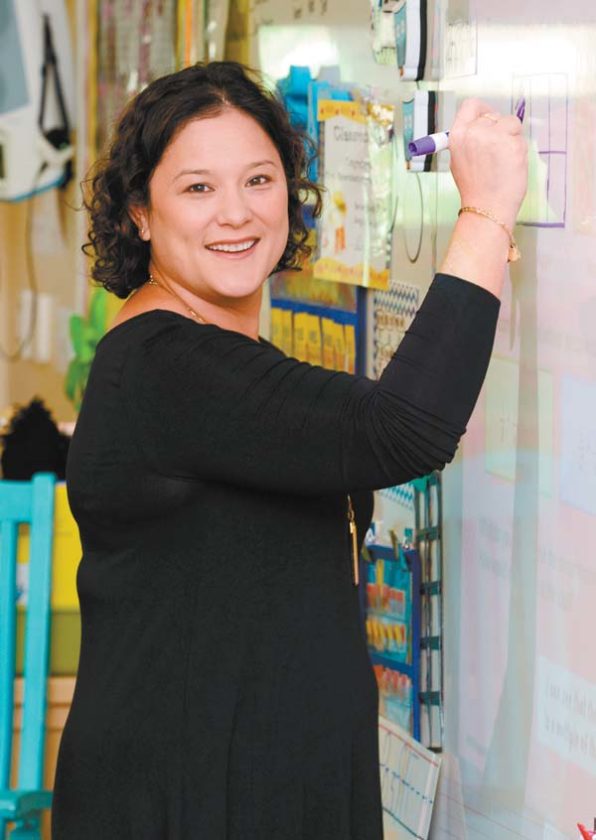
Puu Kukui Elementary School curriculum coordinator Eliza Akana Yoshida won the Presidential Award for Excellence in Mathematics and Science Teaching earlier this year. The Maui News / MATTHEW THAYER photo
Maui District Teacher of the Year Jennifer Suzuki poses with some of her Maui Waena Intermediate School students in her classroom Wednesday morning. The Maui News / MATTHEW THAYER photo
Puu Kukui Elementary School curriculum coordinator Eliza Akana Yoshida won the Presidential Award for Excellence in Mathematics and Science Teaching earlier this year. The Maui News / MATTHEW THAYER photo
Trending
When they're inside the classroom, Maui Waena Intermediate School teacher Jennifer Suzuki and Puu Kukui Elementary School educator Eliza Akana Yoshida are always trying to think outside the box.
They push students to set their own learning targets. They focus less on memorizing formulas for specific problems and more on building the confidence to take on any problem. It's "facilitating" learning versus "top down teaching," Maui Waena Principal Jamie Yap said.
"An outsider looking in might think these kids are just doing their own thing and acting crazy, but the activity of the class lends itself to the direction that (Suzuki) wants it to go," Yap said.
This year, both teachers were honored for their impact in the classroom. Yoshida, now a curriculum coordinator at Puu Kukui, was selected for the Presidential Award for Excellence in Mathematics and Science Teaching in August. Suzuki, who teaches media and technology at Maui Waena, was selected as Maui District Teacher of the Year by the state Department of Education in October.
Yoshida and Suzuki have different styles but a similar goal: creating self-motivated students who aren't afraid of real-world challenges.
Math for the real world
When Yoshida first started teaching math, she would open the textbook and lead students through a few examples, then let them do the rest on their own. She realized it wasn't working.
"The kids were not learning. They weren't engaged," she said.
Then Yoshida spent two years as a resource teacher instructing STEM -- science, technology, engineering and math -- for the state Department of Education. She got to visit different classrooms and sought out resources to help her become a better math teacher. When Puu Kukui opened in 2013, Yoshida knew "it was time to return to the classroom and implement all the things I learned."
In class, Yoshida said she never speaks for 10 to 15 minutes straight. She often asks students to turn to their partners to discuss their goals and talk about math problems. Yoshida said that she wants to give her students "ownership of their learning."
"Students need to know where they are, they need to know where the end goal is and how to get there," Yoshida said. "And that's my job -- to make sure they know all of those steps."
In math, "fast and right has been honored," Yoshida said. "And that's actually the opposite of what we want in math."
Of course, there's nothing wrong with "fast and right," she said. Students shouldn't be laboring over simple calculations like 2×2. But she wants students to take the time to explore different strategies to problems and build off of one another's ideas.
"The real math we see in the real world is in context," Yoshida said. "Their ability to persevere through any complex problem is what we care most about."
Yoshida applied for the presidential award during the 2013-14 school year and was notified of the honor earlier this year. Presidential awards "are the highest honors bestowed by the U.S. government for math and science," according to the awards website.
Yoshida said that she was nominated for the presidential awards while teaching at Kihei Elementary School several years ago. However, she didn't make it past the state level that time. Winning this year was "very validating," an indication of how far both she and her students have come.
"She established a culture of high expectations for students," Puu Kukui Principal Chad Okamoto said. "She really taught students to think and be able to express their thoughts in a meaningful way, continually challenging them to higher levels."
As a curriculum coordinator, Yoshida, a 14-year education veteran, no longer has her own regular class. Among her duties are coaching and mentoring other teachers.
"She has done much in the area of mathematics to promote understanding and effective instruction," Okamoto said. "I am proud of Ms. Yoshida's accomplishment. . . . Her experience helped our school learn more about what is possible if we continue to try to do our best."
'Never a typical day'
In any given class period, Suzuki's students at Maui Waena might be working on robotics, recording a music video or editing a news segment for the school's weekly broadcast show.
"There is never a typical day," her students all agree, laughing and chatting on the sofas in Suzuki's classroom on a recent afternoon.
"You hear them laughing and doing things and having fun," Yap said of Suzuki's students. "They don't see it as classwork. They just enjoy what they're doing. You could only hope all learning was like that."
At the start of each period, Suzuki sits her students down for a class meeting to talk about their goals. Like Yoshida, Suzuki doesn't expect her students to memorize specific terms. Information is at the children's fingertips, and programs are constantly changing, she said.
"I think it is more important for them to understand how all programs are similar and feel confident that they can learn any new program they run across," Suzuki said. "They also become good at independent learning and troubleshooting, because I literally don't have all the answers."
Seventh-grader Shyla Orquia said that Suzuki runs the class as if preparing students for real-life jobs in media.
The kids must constantly meet deadlines for things such as contests and the weekly show. They said it's pushed them to manage their time better and to be more confident.
"When you come to media, you think that you'll just be like filming," 8th-grader Mary Joy Dinong said. "But you learn stuff like creating stories and having a unique mind. It shows you a new door to everything."
Suzuki also doesn't grade her students. It's their responsibility to know their goals and evaluate their work, she said. At the middle and end of each quarter, she meets with students to go over their work. They explain the grade they think they deserve.
"I give commentary, but generally the grade they give themselves is the grade they get," Suzuki said. "They are way more critical and honest than some would expect."
Yap said that some of Suzuki's biggest contributions happen after school and outside of the classroom. Her door is always open to kids who need help, and she often stays long after the final bell has rung. Throughout the school year she takes students to film and robotics competitions on the Mainland. During the summer she's often organizing workshops and bringing in guest instructors for the kids.
"We learn both real-life skills along with how to work with others," 8th-grader Jadynne Zane said. "She makes us feel like family. She treats us like we're her kids."
Suzuki's seen a lot of changes in education over 17 years, but said "it all boils down to getting to know your students, having them trust you to lead them to important learning."
"Find authentic audiences for their work," Suzuki said. "Create an atmosphere that shows that that what they do is important and real."
• Colleen Uechi can be reached at cuechi@mauinews.com.