
Something to love: Hawaii without pesky mosquitoes
The news is abuzz with mosquitoes these days. Outbreaks of dengue fever on Hawaii island have us all a little more nervous when the high-pitched whine of a tiny pest reaches our ear.
Mosquito-vectored viruses like Zika and chikungunya are on the horizon. Health officials in both South America and the Big Island are scrambling to find ways to reduce mosquito populations and protect human health. Scientists are busy making nearly daily advances in the lab as well. All of the energy focused on removing these pests raises the question: How would the total removal of mosquitoes alter ecosystems?
There are over 3,500 species of mosquitoes in the world, of which only a few hundred bite. Mosquitoes and their larvae are food for fish, bats, birds and dragonflies. Male mosquitoes don’t suck blood, they daintily sip nectar. In return, they help to pollinate some aquatic plants. But despite their service as prey and pollinator, many scientists think ecosystems would recover just fine if mosquitoes were gone – other insects could fill that niche, and we’d have one less vector for disease. Good news globally, but it only gets better for Hawaii.
In Hawaii, mosquitoes are food for native bats (opeapea) and dragonflies (pinao). Would these species go hungry without this imported food source? Not in the least, explains Dennis Lapointe, an ecologist with the U.S. Geological Survey who researches the ecological role of mosquitoes and birds in Hawaii. “(Mosquitoes) are all non-native and everything that is native and endemic got along fine without them,” he said. Some species of native damselfly larvae eat mosquito larvae, but they have other food sources.
The greatest ecological benefit would be to our native birds. Disease-spreading mosquitoes are a significant factor keeping iiwi, apapane and other Hawaiian honeycreepers from flitting through the trees in your yard.
Mosquitoes first arrived in Hawaii when sailors dumped a barrel of water containing larvae of the Culex mosquito into the wetlands that once surrounded Lahaina. The Culex mosquito became the vector that spread avian pox and malaria from non-native birds to Hawaiian forest birds, precipitating their decline. The native passerines lacked any resistance against these foreign diseases.
Today, our few remaining native forest birds are relegated to high-elevation refuges, protected by temperatures cool enough to keep mosquitos at bay. But protection could be short-lived; current estimates of climate change indicate these refugia could disappear within 80-100 years.
If mosquitoes disappeared, so would the threat of avian malaria.
Currently, the fate of native birds is not foremost in our minds as human health threats loom. The Aedes mosquitoes, which are also found in Hawaii, are in the news now. A. albopictus, widespread throughout the islands, is the primary carrier of the Zika virus. A. aegypti, a mosquito found only in a few areas on Hawaii island, is the optimum carrier of dengue. Both Aedes species carry chikungunya. Both of these mosquitoes cause harm, with negligible environmental benefit.
Meanwhile, scientists are working on a tool to reduce mosquito populations without pesticides. Using genetic technology, a self-limiting gene is inserted into the DNA of male mosquitos. Reared in labs, the mosquitos are released to seek out and mate with females, but the self-limiting gene is passed along and their offspring die as larvae. The existing adults die off and are not replaced. Though years from being ready for release into the wild, scientists predict that these altered mosquitoes could be up to 99 percent effective in reducing mosquito populations, with no risk of developing resistance to pesticides. Each species of mosquito has to be targeted specifically, but Hawaii has only a handful of invasive mosquitos, all of which are non-native.
It’s something to think about: Hawaii without mosquitoes, without the threat of dengue, Zika or chikungunya. And, as an added benefit, Hawaiian forests with a few more native birds.
Until then, continue with mosquito-control efforts: Dump standing water, treat bromeliads and other plants that hold water and mosquito larvae, and regularly apply repellent. These actions can help keep these blood-suckers at bay in your backyard.
On the net:
* Eliminate mosquito breeding sites:
www.health.hawaii.gov/docd/files/2015/11/Mosquito-Breeding-Sites-11×17-FINAL-11-2015dj.pdf
* Ecological role of mosquitoes:
www.nature.com/news/2010/100721/full/466432a.html
* Avian diseases:
www.mauiforestbirds.org/articles/17
* Lissa Fox Strohecker is the public relations and education specialist for the Maui Invasive Species Committee. She holds a biological sciences degree from Montana State University. Kia’i Moku, “Guarding the Island,” is prepared by the Maui Invasive Species Committee to provide information on protecting the island from invasive plants and animals that can threaten the island’s environment, economy and quality of life.
Local News
Registration open for Ahupua‘a Stewards program on Maui
Hawaii Land Trust is accepting applications for the sixth year of its Ahupua‘a Stewards Leadership Program for ...
Maui housing market shows increased sales in March
Maui’s housing market saw increased sales activity in March, while the median prices of single-family homes and ...
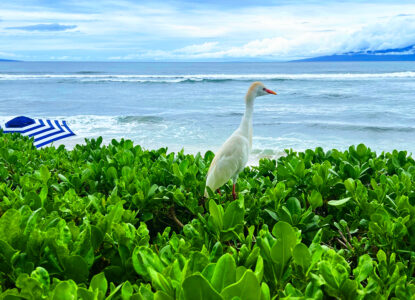
Photo of the Day: Where are the bugs?

School to Pool program helps children on Maui learn to swim

Hale Kau Kau distributed more than 5,600 meals in March
Hawaiian Electric using drones as a wildfire safety tool
Hawaiian Electric is using drones for aerial inspections of its electrical infrastructure on Molokai. According ...