
Keeping students engaged is a hurdle in distance learning
But there are some bright spots found during nine weeks for public schools
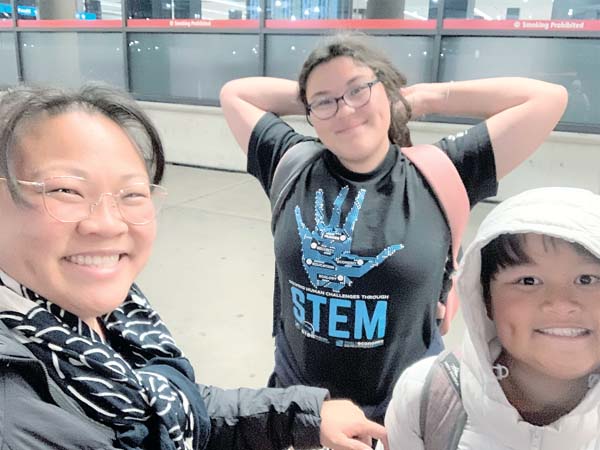
Lanai High and Elementary School math teacher Michelle Fujie is shown with her children, Meyah,12 and Nathan, 10. Fujie said she felt as if she was working more during the public school’s nine weeks of distance learning. She also had to homeschool her own children.
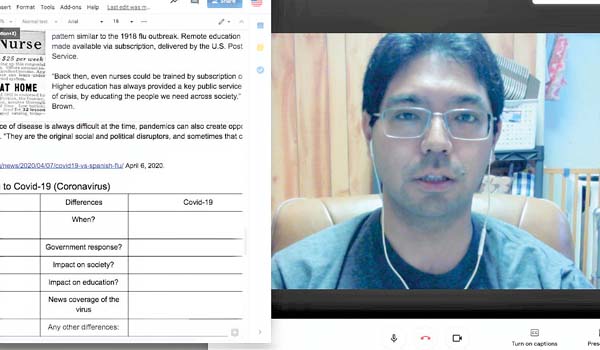
Robert Fusato, an 8th-grade social studies teacher at Maui Waena Intermediate School, is shown online alongside some assignments during the public schools’ distance learning.
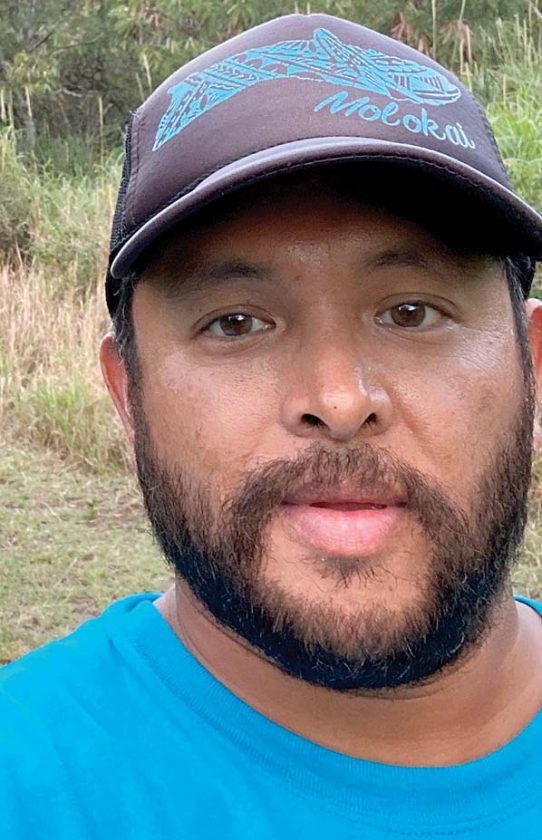
Emilio Macalalad is a Molokai High School science teacher.
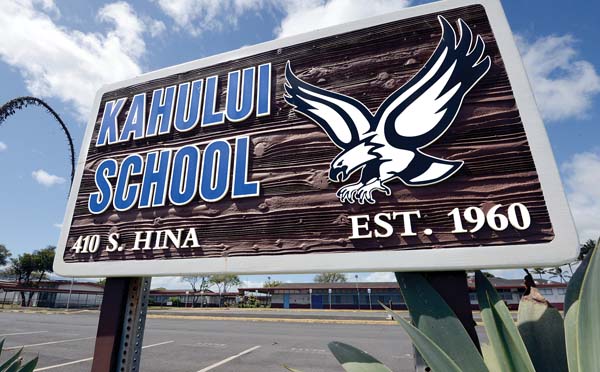
Kahului Elementary School is earmarked for $6 million for a new classroom building and additional money for air-conditioning improvements. Public schools across the state turned to distance learning for the fourth quarter. This photo was taken last month. — The Maui News / MATTHEW THAYER photo
Lanai High and Elementary School math teacher Michelle Fujie is shown with her children, Meyah,12 and Nathan, 10. Fujie said she felt as if she was working more during the public school’s nine weeks of distance learning. She also had to homeschool her own children.
Robert Fusato, an 8th-grade social studies teacher at Maui Waena Intermediate School, is shown online alongside some assignments during the public schools’ distance learning.
Emilio Macalalad is a Molokai High School science teacher.
Kahului Elementary School is earmarked for $6 million for a new classroom building and additional money for air-conditioning improvements. Public schools across the state turned to distance learning for the fourth quarter. This photo was taken last month. — The Maui News / MATTHEW THAYER photo
Trending
TikTok and YouTube videos, prizes and a chance to critique their teachers were not enough to motivate students to continuously engage in distance learning over the nine weeks of instruction at public schools that were shut down due to the COVID-19 pandemic, said several Maui County teachers recently.
But there were some bright spots. Students, who needed to boost their grades responded well to remote learning. Those preferring to make their own choices of assignments, which some virtual learning offered, thrived in the new environment.
Robert Fusato, a Maui Waena Intermediate 8th-grade social studies teacher, said that by the end of the school year May 28, participation in his distance learning courses through an online platform fell to less than 50 percent, compared to the 70 percent participation at the beginning of distance learning at the end of March.
"We are really not made for screens at all," he said. "But video game and TV, that's a different story."
Fusato said he and other social studies teachers voiced over stories on the Civil War and turned them into YouTube videos. Students could even share which teacher's acting skills they liked the best.
But that didn't keep all students' attention. Prizes didn't work either, he added.
Over at Lanai High and Elementary School, high school math teacher Michelle Fujie was hopeful students would be willing and able to engage and want to learn . . . anything.
"I was so concerned my students were going to give up on learning altogether," she said.
She allowed students to watch and make their own TikTok videos, which typically involve creating short music and lip-sync videos. What resonated with some of her students was a learning time sheet, where students would log at least one new thing that they learned.
Even if it didn't deal with math, Fujie was happy students were learning. Things students did included modifying food recipes using math, just cooking with their families and exercising.
"It was kind of really sweet to see the students were kind of motivated in their own sense," Fujie said.
At Lahainaluna High School, senior English and Advanced Placement English literature and composition teacher Ryan Granillo also had issues with engagement.
Only about 20 to 25 percent of students regularly were engaging at the end of March. By the end of the year, that percentage had fallen to about 10 percent.
Granillo had approximately 135 students enrolled in the last quarter.
But overall, Granillo said there was a bright spot, especially for those struggling to make passing grades.
"As hectic and uncertain as it was in the beginning, I do think there was a level of success. I was able to get students the necessary work via distance learning to improve to a passing grade. And those students responded," Granillo said in an email interview.
It wasn't easy.
"Relying on email for communication was stressful and did not always work," he said. "The benefits of interpersonal communication were greatly missed."
Department's view
The state Department of Education lauded the efforts of students, parents and teachers.
"The department is proud of the way our teachers, students and parents have been able to adjust to distance learning during these unprecedented times," said Lindsay Chambers, communications director for the state Department of Education. "There surely have been challenges associated with distance learning, but these are growing pains that will allow Hawaii's public schools to develop a long overdue and more modernized approach to education."
Maui County teachers said enrichment activities and assignments were handed out in various ways to students. Some were given worksheet packets, while many activities were dispersed through programs, such as Google Classroom, and posted to school websites. Online educational programs also were tapped.
Communication was done by phone, email and other online programs that allowed students to hand in work and discuss content.
Student and parent engagement levels "have been encouraging," said Chambers, noting that "some areas have struggled, often due to lack of internet access."
The DOE is working with internet service providers to provide mobile hot spots and devices to as many families as possible. The department is excited to roll out a mobile learning labs pilot project, which will assist students, families and communities in need.
According to Emilio Macalalad, a science teacher at Molokai High School, one of these learning hubs will be on Molokai. He said a bus equipped with internet and technology is being sent over.
Teachers are preparing for the launch of the learning lab, which will fulfill the needs of students requiring credit recovery.
On Molokai, Macalalad said students may not have been motivated because they did not have internet access.
"We had to provide an offline option for students to complete. But when students were finished, I wasn't sure if they turned in their assignments to the main office of if they were completing work at all," said Macalalad, who teaches science courses including biology, computer science, environmental science and Advanced Placement.
"I really think that most of the students that are highly motivated were the ones engaged," he added "Also, the incentive to boost their grade by 10 percent helped for students who wanted that extra bump in grade. Even with all our efforts, there were families and students that still felt confused about what assignment to do and where to turn it in."
Out of Macalalad's about 100 students, less than 20 percent were engaged throughout the nine-week distance learning process.
Both Macalalad and Fujie agree that having multiple children in families also hindered learning at times. One family's internet crashed because their bandwidth wasn't set up for so many devices going on at the same time.
"I think motivation was hard," Fujie said. "I think in terms of their emotional health and uncertainly that was happening, finding a space where they can actually focus on learning became difficult. I know of some of my students that have larger families, that was also difficult."
She said electronic equipment had to be shared among siblings in some families.
Grading
Another reason why some students did not engage in distance learning over time involved the knowledge that their grades from first through third quarter would be used to determine their final grade.
"So any senior with a passing quarter three grade already passed the class. Understandably, there wasn't much motivation for these students to continue enrichment assignments," said Granillo, whose classes are made up of seniors.
Chambers said the final grade for the course and related credit will be awarded to students who achieved the requisite proficiency through the third quarter. No grade will be entered for the fourth quarter, except for students participating in E-School, credit recovery programs and dual credit.
If students were not proficient at the end of the third quarter, additional support was provided with opportunities up until the last day of school to demonstrate proficiency and to earn credit, Chambers said.
The DOE also is offering summer learning opportunities for credit recovery, credit acceleration and extended learning opportunities.
In April, Chambers said the DOE sought and received approval from the Board of Education to modify high school graduation requirements for the Class of 2020. The DOE received consensus from schools to utilize grades from the third quarter to determine the final grade. At that time, about 90 percent of this year's 11,200 seniors were eligible to graduate on time based on third quarter grades.
Schools developed plans to provide intervention and remediation opportunities throughout the remainder of the 2019-20 school year to help all students graduate on time, if possible, she said.
Work loads
Teachers agreed that distance learning was time consuming and difficult for them.
"Grading was crazy," Macalalad said. "I would have multiple devices going, checking multiple websites with multiple tabs going, communicating with multiple people. I would be working on multiple tasks on the computer, then I would get a notification for a meeting or a question from a student or parent about an assignment. Then I would forget what I was doing in the first place.
"I would say I'm pretty savvy with tech, but it was difficult to keep my head on straight."
The early stages of distance learning added extra work for Fusato as teachers worked together to help each other out with technical issues, on top of preparing their assignments.
There were personal issues to navigate as well, Fusato has two children and helped out relatives with their children. Fujie had her two children to homeschool -- 12-year-old daughter, Meyah, and 10-year-old son, Nathan.
It "felt like we were working way more than our regular class," she said, For example, enrichment assignments had to be designed so that both students and their families could understand them.
Working from home, Fujie had to set boundaries for while teaching and attending to her children's needs.
"I think just being at home, and not having that physical distance between my kids, I'm still in the room, they can still access me," she said
She had to set a new mindset and boundaries. There were times when mom needed to be left alone to do her work and her children would have their own quiet time.
Looking forward
As teachers look back at the past school year, the DOE this week released a fact sheet effective July 1 on guidance for reopening schools, which includes recommendations from the state Department of Health.
The DOE is targeting opening schools for students Aug. 4, as originally planned for the 2020-21 school year.
Some of the guidance offered included, maintaining a distance of at least 3 feet between seats, including group tables, and at least 6 feet if students are seated facing each other.
Also face coverings must be worn when outside the classroom, especially when physical distancing is difficult.
The DOE notes that wearing masks is appropriate only if the child can safely and reliable wear, remove and handle the masks, following Centers for Disease Control and Prevention guidelines.
Enhanced cleaning measures and screening of students and school teachers and staff for illness are among the other guidelines.
The Hawaii State Teachers Association, the teachers' union, said this past week that the DOE did not share the one-page guidance document with the union in advance of release. On its website, the union said that it has "a number of questions and concerns."
Any changes in working conditions will require impact bargaining, the union said.
HSTA has said it has confirmed that no decision has been made on how exactly instruction will be delivered next school year.
"I hope we can learn from other countries about how to keep our keiki safe at school until we have an effective vaccine," said Macalalad, who was speaking on his own behalf. "There are countries that are making it happen. There are things that need to be put in place, such as effective safety protocols for students, screening students before they enter campus, testing and sanitizing supplies and masks.
"I think with the right leadership, we could be going back to school in August, just not the way we are used to."
Fujie concurs with a social media post she saw, saying that the focus should be on the child's emotional well-being.
"I truly believe that," she said. "When we get back in school, everyone will be on the same playing field. We've all experienced the same thing. We'll assess our students and pick up where we are at.
"I don't think anybody is going to start the next school year (and think) we are going to be in the exact same place as we left off."
* Melissa Tanji can be reached at mtanji@mauinews.com.